Opportunity knocked

Having talked about the decline of the middle classes it is only fair that I should discuss the working class. The recent State of the Nation report from the Social Mobility Commission provides a substantive basis to do so.

SMC class pay gap

The Social Mobility Commission conclusions are profoundly depressing for those who want to live in a fair country. The Commission says:

“People from working class backgrounds are 80 per cent less likely to get into professional jobs. Even when they do, class plays an important role in pay; within professional occupations, those from working class backgrounds earn 17 per cent less than people from professional backgrounds. Ultimately, class plays an outsized role in a person’s ability to move up the income and jobs ladder, and there has been no measurable improvement in recent years.”

Layered on top of this class unfairness, the Commission confirms a further and depressing gender unfairness as well:

SMC prof underpay

Contrary to the country that most of us aspire to live in (and perhaps a few still imagine us to be), we are not a country of equality of opportunity. Rather, the Commission confirms, poverty is currently in our nation an inherited trait, and that, transparently, is not fair. Poverty should not be a heritable condition. The fact that this is a truth seen in most other nations of the world does not absolve us of the challenge of trying to address it.

Equality of opportunity has a long pedigree in theories of just and fair societies. Perhaps inevitably given that I have chosen to write about fairness, I pay a good deal of attention to the work of John Rawls, and I favour his restatement of his core philosophy in Justice as Fairness. In effect this reworks his original A Theory of Justice (1971) to respond to the various comments and criticisms he received. My paragraph references are thus all to Justice as Fairness.

Rawls’ second principle of justice has at its heart the need for fair equality of opportunity. This for him is one of the baseline foundations for a fair and just society. And this goes further than apparent equality of opportunity — what Rawls calls formal equality of opportunity. In order actually to deliver this genuine equality of prospects across society, Rawls argues (13.2), “A free market system must be set within a framework of political and legal institutions that adjust the long-term trend of economic forces so as to prevent excessive concentrations of property and wealth, especially those likely to lead to political domination.”

The risk otherwise is clear, Rawls states (15.1): “Very considerable wealth and property may accumulate in a few hands, and these concentrations are likely to undermine fair equality of opportunity, the fair value of the political liberties, and so on.” The truth of this statement has been only too vividly illustrated by the Ivy League college admissions scandal in recent months, where the wealthy in effect paid for their children to access what are supposedly the most intellectually exclusive institutions. But even without this particular scandal, we know that Rawls’ prediction has come to pass.

Equality of opportunity, even Rawls’ fair equality of opportunity, does not lead to equality of outcomes. But it should lead at least to fairness, and it is a fair society that most of us would like to live in. As TM Scanlon says in his thoughtful but highly accessible monograph Why does Inequality Matter?, “equality of opportunity, even if it is achieved, is not a justification for unequal outcomes, but only a necessary condition for inequalities that are justified in other ways to in fact be just”. 

Scanlon also notes how easily psychology tricks us. It is commonplace for those who have achieved something to believe that their achievement is deserved and reflects something intrinsic in themselves. It is rare that people recognise that their initial advantages and pure luck have played a significant role in their achievements — and rarer still that they acknowledge it even if they do recognise it. The mere popularity of the nonsense peddled by Ayn Rand indicates just how readily people believe that success arises from inherent greatness rather than pre-existing conditions and chance. We would be better served if more wannabe Atlases shrugged less often and honestly looked at the world around them, and the shoulders of genuine giants on which they have the good fortune to stand. Perhaps then they might note their sheer good fortune that means they have succeeded while others of equal talent and equal determination have not.

Branko Milanovic is perhaps the greatest cynic about equality of opportunity in the current globalised world. As Milanovic says in his Global Inequality: A New Approach for the Age of Globalization: “there is currently no such thing as global equality of opportunity: a lot of our income depends on the accident of birth”. In an earlier work, The Haves and the Have-Nots, Milanovic estimates that fully 80% of a person’s income is determined at birth: roughly 60% by the country of birth, and 20% by the income class of its parents.

The global fairness challenge is a broader one. That much still depends on accidents of birth within a country is more shocking but also perhaps more tractable. The Social Mobility Commission shows us sadly that we still have far to go.


State of the Nation 2018-19: Social Mobility in Great Britain, Social Mobility Commission

Justice as Fairness: A Restatement, John Rawls, Belknap Press of Harvard University Press, 2001

Why does Inequality Matter?, T M Scanlon, Oxford University Press, 2018

Global Inequality: A New Approach for the Age of Globalization, Branko Milanovic, Belknap Press of Harvard University Press, 2016

The Haves and the Have-Nots, Branko Milanovic, Basic Books, 2011
The centre cannot hold

The middle class is disappearing, the OECD says. Having flourished for decades, those of middle income are facing a squeeze that is causing many to struggle. More recent generations are increasingly unlikely to have the opportunities that middle incomes allow, says the club for rich countries in the report Under Pressure: The Squeezed Middle Class, released earlier this month.

There is perhaps no clearer sign of fairness becoming unbalanced, the middle class being the centre of the fairness balance. Archimedes said give me a fulcrum and I will move the world; as the economic fulcrum of those enjoying middle incomes become squeezed, it is becoming harder to predict how our economies will move. Certainly, the OECD reports, “The middle class feels that the current socio-economic system is unfair”.

Some will not weep for the middle class. Perhaps this will be especially true in the UK, where only 40% admit to being middle class — in spite of the middle income portion of society being as large here as it is in other developed economies. Using as its metric those earning 75%-200% of the median national income, the OECD calculates that an average of 61% of the population in developed economies are middle class (it is around 50% in Chile, Mexico and the US, and 70% in the Nordics; it is as low as a third in South Africa).

That 61% figure is the mid-2010s number; in the 1980s it was 64% — and it has seemed to decline by a percentage point a decade, with those leaving the centre moving both up and down the income scale. These averages mask some striking results in individual countries, with a much bigger fall among the middle class in Sweden and Finland, and and increase in Ireland, France and Denmark.

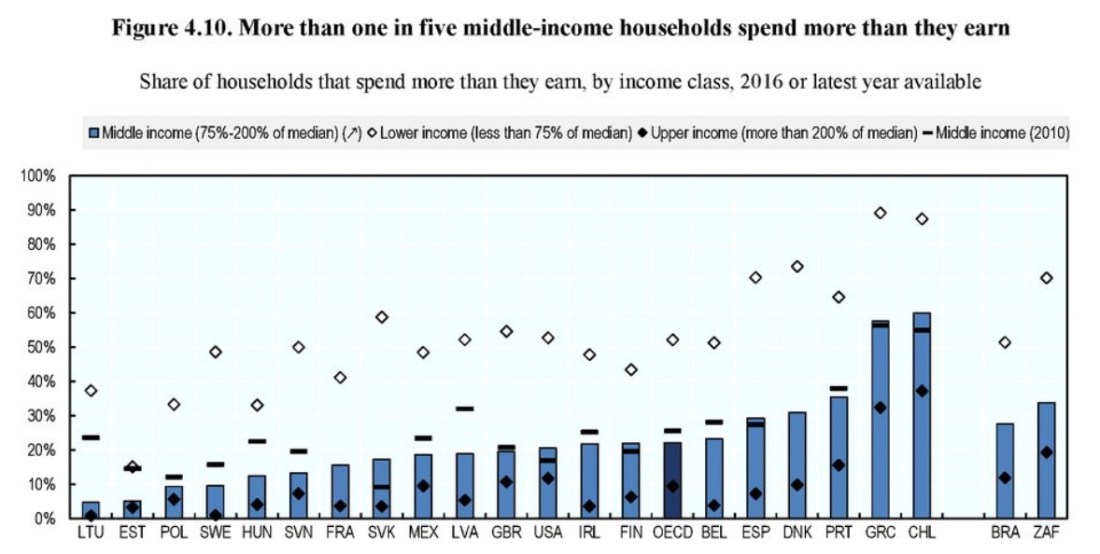
The statistics imply that life is getting harder. Half of middle-income households report struggling to make ends meet — as well as the three-quarters of lower income households. Fully 40% are financially vulnerable, either being already in arrears or being unable to cope with unexpected expenses or falls in income. Perhaps this is not surprising when fully 20% of middle income households spend more than they earn: 

Middle class overspend

The OECD, not a natural scare-mongerer, suggests that we should be worried. It is not sanguine about the shift we are experiencing:

“The investment of the middle class in education, health and housing, their support for good quality public services, their intolerance of corruption, and their trust in others and in democratic institutions, are the very foundations of inclusive growth.”

The middle class have too much to lose to riot and rebel, the OECD implies. Yet now the anchor of property ownership cannot be taken for granted: “in many countries, being middle class is traditionally associated with owning a home, so soaring house prices have touched on the very meaning of being part of the middle class”. Things fall apart, the centre cannot hold.

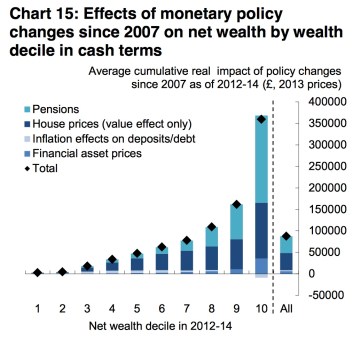
BoE wealth QE inequalityHouse price increases far in excess of income rises are a remarkably global phenomenon. The biggest increases were before the financial crisis (after all, they were one driver of it) but rather than unwinding since, the policies of central banks in terms of low to non-existent interest rates and the generosity of quantitative easing have served to freeze and even bolster the disparity in outcomes that the rise in property prices has driven, as shown in this chart from the Bank of England. It is only fair to note that this is the absolute wealth effect; the percentage effect for each income decile appears much more evenly balanced. But perhaps percentage terms are not the fairest way to consider these issues. The absolute absolutely does matter.

I suggest there are elements of middle class decline more important than property ownership. Psychologically, I would argue that the middle class is defined most by an aspiration for one’s children, that they should have a better life than their parents. Yet, it appears, it is this aspiration that is most under threat. Now, according to the Risks that Matter report, 60% of parents in the OECD list the risk that their children will not achieve the level of status and comfort that they have as one of the top-three greatest social and economic long-term risks. In several countries, this rises to 70% or more — including in Austria, France, Greece, Italy and Slovenia. The coincidence with the rise of populist politics is obvious.

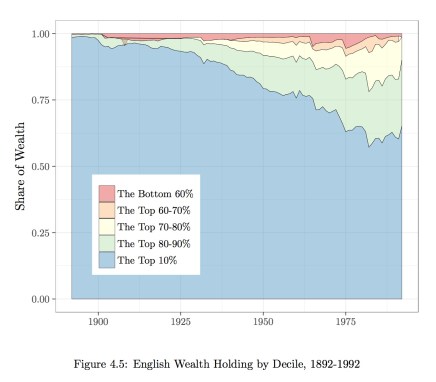
We should be careful about overstating these latest dynamics. Recently released research from the LSE, based on a remarkable detailed database of more than a century of probate (inheritance) records, suggests that in effect the middle class never existed at all. Neil Cummins concludes: “the median English person died with almost nothing throughout. All changes in inequality after 1950 involve a reshuffling of wealth within the top 30%.” Cummins probate wealth

This is obviously a wealth measure rather than an income measure, but it does show that in practice there may be little recent loss of an anchor of wealth. However, the loss of an expectation that one’s children will be better off does seem to be a recent phenomenon. And that investment in the future is perhaps the greatest wealth that the middle classes have ever possessed. 

On tackling this perceived unfairness, the OECD’s policy prescription is clear: “The main tool to foster fairness is the tax and benefit system”. Noting that middle income earners have less scope to minimise their tax burden than those at the top of the income bracket, the OECD suggests: “policies should consider effectively lowering the net tax burden on middle-income households while maintaining the sustainability of public finances. In many countries, the income tax system could be made more progressive, in particular for top income earners, and fairer for the middle class … the tax burden should be shifted from labour to broader bases, including income from capital and capital gains, property and inheritance.” The OECD also proposes policies to tackle the challenge of the rising cost of living, and the increasing labour market vulnerability felt by the middle classes.

It’s a long and ambitious list. We will have to see whether any of it is achievable, but without some steps this unsettling of the balance of fairness will persist, and its consequences will be significant.


From WB Yeats’ magnificent The Second Coming (1919, still fresh and vital a century on):

Things fall apart; the centre cannot hold;
Mere anarchy is loosed upon the world,

The best lack all conviction, while the worst
Are full of passionate intensity.


Under Pressure: The Squeezed Middle Class, OECD 2019

The distributional impact of monetary policy easing in the UK between 2008 and 2014, Philip Bunn, Alice Pugh and Chris Yeates, Bank of England Staff Working Paper No. 720, March 2018

Risks That Matter survey report, OECD 2018

Where is the middle class? Inequality, gender and the shape of the upper tail from 60 million English Death and Probate Records 1892-2016, Neil Cummins, Economic History Working Papers No 294, the LSE (2019)

Money is not the answer

Cecil Graham: What is a cynic?
Lord Darlington: A man who knows the price of everything, and the value of nothing.
Cecil Graham: And a sentimentalist, my dear Darlington, is a man who sees an absurd value in everything and doesn’t know the market price of any single thing.
Oscar Wilde, Lady Windermere’s Fan (1892)

Perhaps this blog is simply a call for more sentimentalism in our excessively cynical world, though perhaps we should aim for fair values rather than absurd ones — remembering that fair value is not always the current market market price.

Just as we trip ourselves up when we insist on trying to simplify complexity into a handful of handy financial metrics, so we make a mistake that money is the sole motivator — or even an appropriate motivator — for senior executives.

In a wonderfully blunt article a few years ago, the Harvard Business Review highlighted the fact that the work of CEOs is peculiarly ill-suited to performance-related pay. Stop paying executives for performance, the article stated, “from a review of the research on incentives and motivation, it is wholly unclear why such a large proportion of these executives’ compensation packages would need to be variable”. The article highlights flaws in measurement systems (and sadly notes the tendency to fraud or manipulation that is further encouraged by this), but also discusses the behavioural aspects of motivation and what it is effective for individuals to focus on. The delivery of creative and complex tasks is hampered by contingent pay, and performance in areas of complexity can be limited by a narrow focus on specifically defined areas of performance (these areas are often defined only because they are the aspects that are readily definable). Furthermore, intrinsic motivation (our own internal drivers to do a good job and deliver) is crowded out by extrinsic motivation (money).

The benefit of variable incentive pay is sometimes said to be a lower cost of removing an under-performer. But this doesn’t seem to happen in practice as departing executives appear to take not just a notice period’s worth of salary but also of incentive pay. The HBR authors argue that executive pay should not include any incentive element at all, but just be on a fixed salary basis.

The point about intrinsic and extrinsic motivations is seen all around us. By defining things in financial terms we undermine other motivations, and a broader understanding of the world. Rather than enhancing behaviour, we can worsen it.

A famous example is the experiment at a group of day-care centres in Haifa which sought to encourage parents to be more prompt in collecting their children by applying fines for lateness. The result was an increase in the level of late pick-ups, not a decrease. The fee turned guilt and embarrassment at inconveniencing others into just another financial transaction, and clearly many parents simply concluded that it was a price worth paying. And once this norm was developed, withdrawing the fines did not change the established behaviour. As the authors put it, A Fine is a Price. We should be wary of putting prices on things on the assumption it will deliver the behaviours we might be seeking.

There are multiple further examples of this negative motivation arising from establishing a price for something that should not be priced. For one, Boston’s Fire Department shifted from allowing staff unlimited sick days and in fact docked pay for those taking more than 15 such days in a year. Rather than reducing sick days, this had the effect of seeing them double. And in Switzerland, the willingness to have nuclear waste repository sited locally was seen to reduce when citizens were offered compensation.

Even just a switch of language is enough. Those playing versions of ultimatum games have very different behaviours as to whether they are introduced as ‘Wall Street’ or ‘Community’ games. Perhaps unsurprisingly generosity — or rather, fairness — is reduced simply by referring to the game as a ‘Wall Street’ game. I have noted in a publication for the RSA the way in which investment training tends to override even some of our most basic tendencies; even investment-associated words seem enough to do so.

Money carries a message, and it undermines voluntary cooperation. So we need to be wary of the modern tendency to use language that renders all of us consumers of services rather than citizens and parts of communities; this framing will change our behaviours, and it is unlikely to be for the better. We are less likely to hear the motivations of fairness and more likely to focus on our own interests. Our resulting behaviour may not be what we want, and we may find ourselves operating in ways that seem contrary to many of our natural instincts, including the instinct of fairness.

I am going to finish this blog with one further example of the negative implications of the financialisation of relationships that are better if approached from a community perspective. It is an example that I feel particularly personally.

Blood donations are an area where monetary rewards have had remarkable negative consequences. For example, Richard Titmuss in The Gift Relationship: From Human Blood to Social Policy (New York, The New Press, 1997), discusses how blood donations in fact fell after payments for blood donors were introduced. But another consequence of payment is that quality may be reduced also. Only now is the Infected Blood Inquiry, under the able charge of Sir Brian Langstaff, looking into the background and impact of the use of tainted blood products in the UK in the 1970s and 1980s. One conclusion from the Inquiry seems likely to be that, as a consequence of the payment system in the US, participation in donations was higher among those at the margins of society, including drug users and prisoners, and that this led to a prevalence of HIV and hepatitis among the blood products that were imported and given to UK patients.

DSC_1000
My photo of the memorial sculpture created as part of the commemoration which marked the first day of the Infected Blood Inquiry

A good friend of mine was only a child when he was given tainted factor 8 to help treat
his haemophilia. Nearly 5000 haemophiliacs were given contaminated products, infecting them with HIV and/or hepatitis C. My friend was one of those infected with HIV, at the height of the AIDS scare, and though he lived much longer than any prediction then allowed, he is among the more than half of these people who have subsequently died.

Forgive me therefore a little sentimentalism on this issue.


Stop Paying executives for performance, Dan Cable and Freek Vermeulen, Harvard Business Review, 23 February 2016


A Fine is a Price, Uri Gneezy and Aldo Rustichini, Journal of Legal Studies, vol. XXIX (January 2000)

The cost of price incentives: an empirical analysis of motivation crowding-out, Bruno Frey and Felix Oberholzer-Gee, American Economic Review, 87 (1997)


What gets measured gets managed — unfortunately

I am grateful to the energetic strategic thinker Paul Barnett for highlighting that management guru Peter Drucker’s famous quote is actually much more interesting in its full version:

“What gets measured gets managed — even when it’s pointless to measure and manage it, and even if it harms the purpose of the organization to do so.” 

Yet we measure and measure, whether or not it is a helpful thing to measure, and we tie pay to these measurements. No wonder a sense of fairness rarely seems to arise from this misguided process.

Bob Emiliani of the Lally School of Management and Technology, mounts an entertaining attack on the whole concept of what gets measured. He claims to prove that it is a falsehood because business is always more complex than any simple promise indicates. He highlights the tendency of executives — from senior management to junior staff — to game any system they are presented with. Certainly, shareholders consistently worry that a focus on specific financial performance measures drives negative behaviours; the current row about share buybacks being driven by earnings targets and executive share options being just the latest public manifestation of this ongoing concern.

And it is not just shareholders that worry about the possible unintended consequences and perverse incentives embedded in the performance metrics of executive pay. One FTSE 100 chair of my acquaintance tells the story of a frustrating meeting with a fund manager who was insisting on the inclusion of an EPS target in executive pay. There was no coherent answer given when the chair pointed out that an EPS target made no sense because any EPS result could always be manufactured by tweaking investment or marketing spend, in effect harming future performance for the sake of near-term numbers. The history of recent business seems littered with companies that have indeed underinvested in their future — perhaps in part because executives were encouraged to over-deliver earnings in the near-term. 

It’s odd that this myth of the value of measures and measurement persists with such vigour. During the Vietnam war, US Secretary of Defense Robert McNamara demonstrated that using things that were measurable to judge success was a mistake. He ensured that available metrics were captured — metrics such as the enemy body count — and was happy to find these demonstrate ongoing success. What those metrics did not capture was the impending US defeat. Assessments that might have revealed the extent of US military failure were much less readily captured, and so the potentially useful information was ignored. Yet 50 years on the business world does not seem to have learned from what is known as the McNamara fallacy.

For some, merely setting targets drives short-termism. Harvard’s Robert Merton as long ago as 1936 (and claiming to build on the foundations of a remarkably diverse group of thinkers including Machiavelli, Adam Smith and Engels) argued that the measurement of performance automatically means the measured succumbs to “the imperious immediacy of interests” — in the less florid language of our own days, short-termism. He found that the “paramount concern with the foreseen immediate consequences excludes consideration of further or other consequences”. He went further: “strong concern with the satisfaction of the immediate interest is a psychological generator of emotional bias, with consequent lopsidedness or failure to engage in the required calculations”. In other words, target-setting blinds us even to our own best interests.

As indicated in Resentments and Rents, it is not enough just to talk about problems, we also need to consider what sorts of performance metric we should be applying to executive pay. This discussion is an attempt to respond to that challenge. Thus far, I have highlighted the dangers of narrow financial measures but I haven’t offered positive solutions.

Merton’s challenge is a substantial one: he doesn’t just raise the risk of gaming of targets but says we even trick ourselves and fall into a form of voluntary enslavement to any given performance metric. If this is right, and it certainly is easy to recognise the risks, we need to escape from the false precision of target-setting and need to assess performance in a much more rich sense. This is what happens in the rest of business, but oddly not at the top of organisations. 

So our challenge is to uncover the McNamara fallacy in business — so that we no longer use metrics just because they are available but apply intelligent judgement such that we assess what is actually worthwhile.

Given that the job of the CEO is to drive the long-term success of the business, not simply to make the numbers next week, measuring a richer set of measures of the health of the organisation has some attraction. This may require assessments of the extent to which stakeholder relationships have been built, business culture has been advanced, new businesses or products developed or fostered. This needs to be not an excuse for paying up in spite of weak current performance — jam today for the CEO on the promise of jam tomorrow or in some years for the shareholders and other stakeholders in the business would not be fair. But remuneration committees need to be bolder in their approach to the challenge of assessing performance and agreeing executive pay. And shareholders need to be more flexible.

The solution lies in judgement. Merton is right that any performance metric embeds some degree of perverse incentive, some pressure towards short-termism. Indeed, it could be argued that the major attraction of TSR (total shareholder return) as a performance metric is because it introduces the fewest possible perverse incentives, provided it is measured over a long enough time horizon. To avoid, or at least limit, these perverse incentives we need remuneration committees to apply judgement and to assess whether the targets have been delivered without having given rise to negative consequences. This will mean that remuneration committees need to move away from what another investor representative has called the standard board approach to their CEO:

Brilliant, brilliant, brilliant, fired

Even the best CEO is not brilliant, and is unlikely to deserve 100% of their available incentive. So we need a richer and more honest discussion of performance. This does require a brave step, and it requires trust. Trust by executives of remuneration committees, that they will genuinely display fair judgement to deliver an appropriate level of reward, and trust by remuneration committees that their appropriate judgements will win approval from shareholders. We need to acknowledge that the process of shareholders looking over the shoulders of remuneration committees is not yet driving the right behaviours. It is not helping reinforce appropriate business-specific judgement by remuneration committees but instead seems to be herding them into the safety of a few approved metrics and structures. This has happened because we shareholders tend to lack trust in the judgements of remuneration committees.

So our underlying challenge is to build trust: trust between remuneration committees and senior executives; and trust between shareholders and remuneration committees. Only in this way can we unlock the tyranny of the McNamara fallacy. 

McKinsey Quarterly recently published a paper which may open a window on how this might be done. Talking about pay structures in companies more generally, it highlighted declining trust in those systems, and discussed ways in which trust may be reawakened. Their answer is to generate clear and apparent procedural fairness in pay systems: not only fairness of treatment but also the expectation of fairness of treatment. The article suggests three key steps to make pay more procedurally fair:

  1. transparently link employees’ goals to business priorities and maintain a strong element of flexibility
  2. invest in the coaching skills of managers to help them become better arbiters of day-to-day fairness
  3. reward standout performance for some roles, while also managing converging performance for others

Considering these same themes in the context of senior executive pay may help us to unlock the spirit of fairness, and so build the necessary trust between the parties. Certainly #2 above may require more active dialogue between remuneration committees and management about the underlying drivers of long-term business success. This would be no bad thing in itself, and may be necessary in order for us to see pay linked to a rich sense of long-term prosperity rather than the narrowness of the current performance metrics that we typically employ. 

Drucker also said “because knowledge work cannot be measured the way manual work can, one cannot tell a knowledge worker in a few simple words whether he is doing the right job and how well he is doing it”. Not only can we not say it in a few simple words, we shouldn’t try to measure it in a few simple numbers.

We in business forget this at our peril.


I explored some of the ideas in this post further in: Money is not the answer

The growth myth

The pursuit of happiness

People matter, but not like that

Funds facilitate unfair pay

Meritocracy’s unfair

The false promise of what gets measured gets managed, Bob Emiliani, Management Decision 38(9) [Nov 2000]

The Unanticipated Consequences of Purposive Social Action, Robert Merton, American Sociological Review, Vol 1, No 6 (Dec 1936)

Dysfunctional Consequences of Performance Measurements, VF Ridgway, Administrative Science Quarterly 1(2) [Sep 1956]

The fairness factor in performance measurement, Bryan Hancock, Elizabeth Hioe, and Bill Schaninger, McKinsey Quarterly, April 2018

Fair tax reflections from investors (II)

Further to the discussions at the recent ICGN conference, responsible tax also featured at the current PLSA (Pensions and Lifetime Savings Association, the former NAPF) conference in Edinburgh. Delegates were asked their reaction to aggressive tax planning by companies.

Far fewer than 10% of delegates answered that any tax minimisation within the law was in shareholders’ interests. Nearly half were most concerned about the potential reputational risks to the company, and around a third expressed concern that aggressive tax planning actually harmed the company directly by undermining state investment in its local infrastructure and society. Rather fewer worried about future tightening of regulation. These results are still more striking and powerful than those from the ICGN conference because there were many more participants in the PLSA session and they were much less self-selecting.

One other message clearly heard at the conference was the importance of stories about ESG and stewardship as being hugely important for engaging savers in their pensions investments, and in making the mysteries of finance closer to real life. This is a message I have emphasised for some time, not least in my FT article.

Not being unfair in business

A well-attended session at the RSA tonight to launch Blueprint for Better Business‘s paper on Fairness in Business.

It’s an excellent, challenging paper, building on earlier discussions. It sets out how “acting unfairly undermines the very basis of trust in market relationships on which all profitable activity depends”. It provides challenges and provocations rather than easy answers, and is all the stronger for it.

Screen Shot 2019-03-05 at 21.41.26

There was an open discussion between Charles Wookey of Blueprint, philosopher Baroness Onora O’Neill, Liverpool Councillor Jane Corbett and Justin King, former Sainsbury CEO. These are a few outputs (my quotes are approximately accurate but can easily be checked against YouTube):

Charles Wookey: “Fairness is one of the keys to unlock the system change” that business needs, from growth for its own sake to promoting human wellbeing. He suggests fairness should not be seen in the abstract but should be a frame of mind, enabling businesses to seek to act fairly in relation to each of their stakeholders. “Even if it is not possible to be fair to all, it should be possible for business to avoid acting manifestly unfair towards anyone.”

Justin King was dismissive of algorithms, saying “The decisions business takes now that have the biggest delta are those that are the furthest away from numbers, when the numbers can’t take them for you.” That’s why, he says, purpose is important — though he shies away from the uncertainties of fairness. He also emphasised our own influence as consumers. He notes the time-horizon of a family business like Mars, where 75-year investments are made — on that time-horizon “you must by definition think about these issues”.

Onora O’Neill said plainly: “Trustworthiness is the important thing, not trust.” She noted that companies are complicated so it is wrong to suggest that even a corner shop has a single purpose — all have a “plurality of purposes”, not just focusing on the bottom line or maximising profit. Limited liability is a major benefit for companies and brings responsibility. And on fairness specifically she noted Rawls’ book Justice as Fairness. Fairness is crucial because it cannot be reduced to a claimable right.

Resentment and rents: fairness in executive pay

There’s a huge irony in talking about fairness and executive pay. 

The irony is that perceived unfairness is one of the drivers for the upwards ratchet in pay. That is, some CEOs feel hard done by, and some remuneration committees worry that their CEOs will feel hard done by, and so feel obliged to match the pay of others. This is not good, but it is human.

So deeply inculcated in humans is the sense of fairness that while it is hard to believe that increments on significant incentive pay can create a greater incentive to perform — most doubt that a CEO will genuinely work harder if paid £4 million rather than £3 million — there is nonetheless scope for rewards to operate as a disincentive. If others that the individual perceives to be peers are all paid £4 million then the CEO will feel hard done by, tough though that is for a thoughtful independent third party to believe. The sorts of people who become CEOs of public companies are by their nature more than marginally competitive.

But this sense of feeling hard done by is pure perception. In their excellent paper The Pay of Corporate Executives and Financial Professionals as Evidence of Rents in Top 1% Incomes, Josh Bivens and Lawrence Mishel of the US’s left-leaning Economic Policy Institute provide significant evidence that there is rent-seeking in executive pay. This is strongly suggestive that the roles would still be attractive if executives generally received lower levels of compensation — so that CEOs would work as hard if they were paid £3 million rather than £4 million. It is not that the quantum is necessary, it is just that it is expected because others get that level of pay — so that £3 million will be ‘enough’ only if others also receive similar amounts. But £2 million would also be ‘enough’, as long as others received similar amounts.

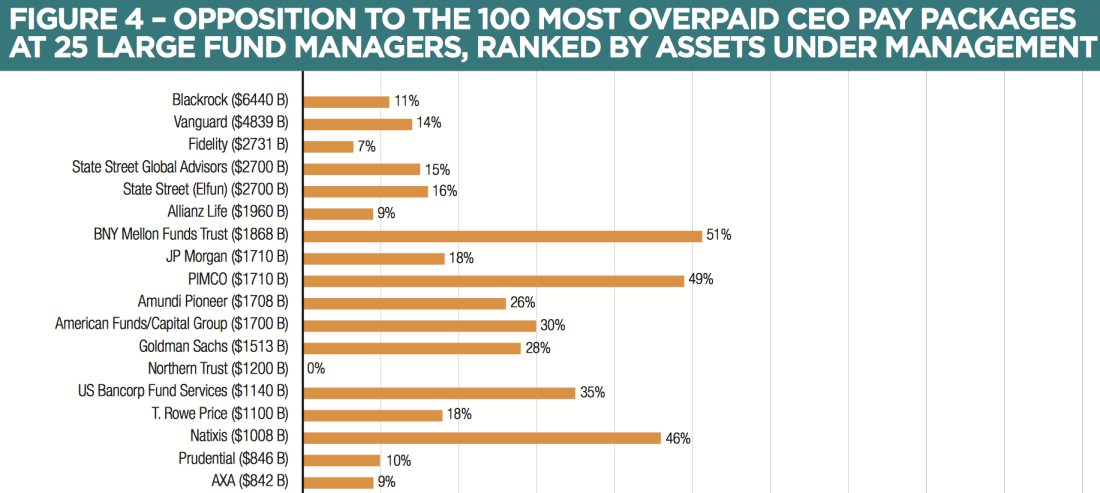
These days the peers that CEOs measure themselves against in this way are international. Bivens and Mishel acknowledge the negative influence that US pay structures and levels are having on the rest of the world. Yet just this week the latest statistics from shareholder advocacy group As You Sow on the votes of major US mutual fund groups reveal the extent to which many institutional investors bless the surprising structures and pay levels typical in the US. Even among the pay schemes enjoyed by what As You Sow deems the 100 most overpaid US executives, Northern Trust backed them all in 2018, Fidelity opposed just 7%, BlackRock 11% and Vanguard 14%:

Screen Shot 2019-02-25 at 09.19.01

These numbers are at least a toughening of positions on previous years’ stances — all of these investment houses, and 20 in total, had opposition levels in single figure percentage points in As You Sow’s 2017 report when the campaigner challenged: ‘Are fund managers asleep at the wheel?’.

Yet even a very basic set of standards with regards to executive pay leads to remarkably different voting results. A few years back I set out some basic requirements on performance linkage for my investment institution, meaning that US schemes would be opposed if any one of these triggers was breached: supposed ‘long-term’ rewards are released within 3 years of award; more than 25% of awards are time-based only and not performance-linked; and rewards paid out if they applied a total shareholder return (TSR) metric that allowed a payout for underperformance, that is if TSR was below median of the peers. This doesn’t amount to more of an insistence than that there should be at least some limited degree of genuine long-term performancing of US awards (not least given the quantum that is standard in that country), but even just applying these very simple requirements led to my employer opposing 74% of all remuneration resolutions in North America in the last full year I was responsible for those decisions.

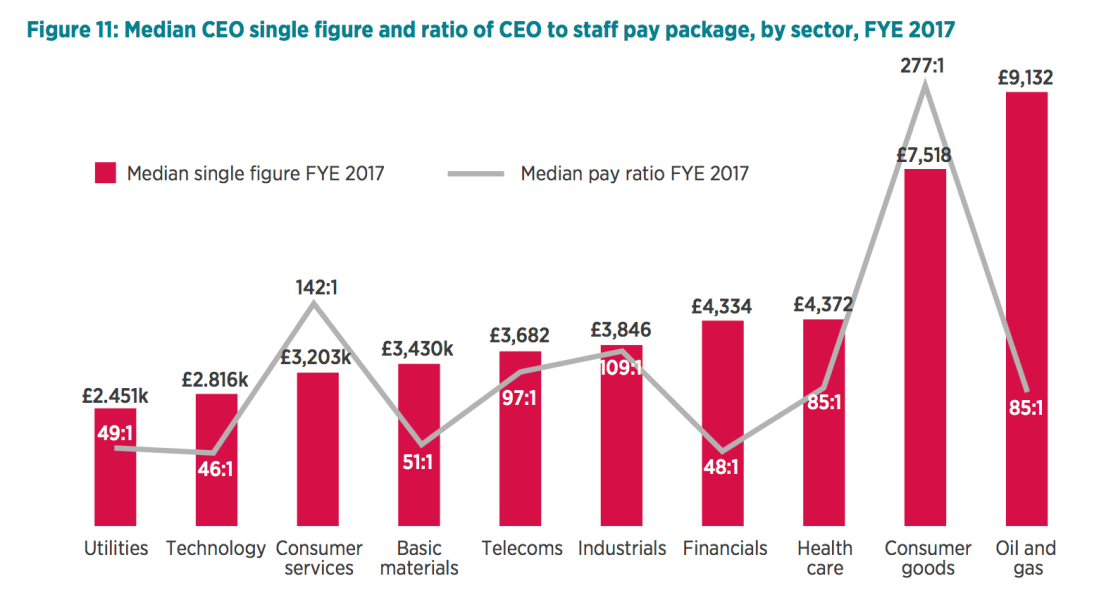
The negative influence of US pay practices and quantum is shown very clearly by statistics from UK campaigner the High Pay Centre. This chart is from their August 2018 High Pay Centre/CIPD FTSE 100 executive pay survey report:

Screen Shot 2019-02-23 at 17.05.40

Those sectors where CEO single figure pay is above £4 million are those where there is a clear international market for talent. Pay has been pulled upwards in those sectors where UK companies face global competition.

It’s also worth noting as an aside that the High Pay Centre numbers show that median UK CEO pay has stayed roughly level from 2011, when it was £3.90 million, to 2017, when it was £3.87 million. It does not appear that executive pay is becoming more of a problem, at least in the UK, even if the attention focused on the issue, and on the generosity of specific outliers, continues to become more intense.

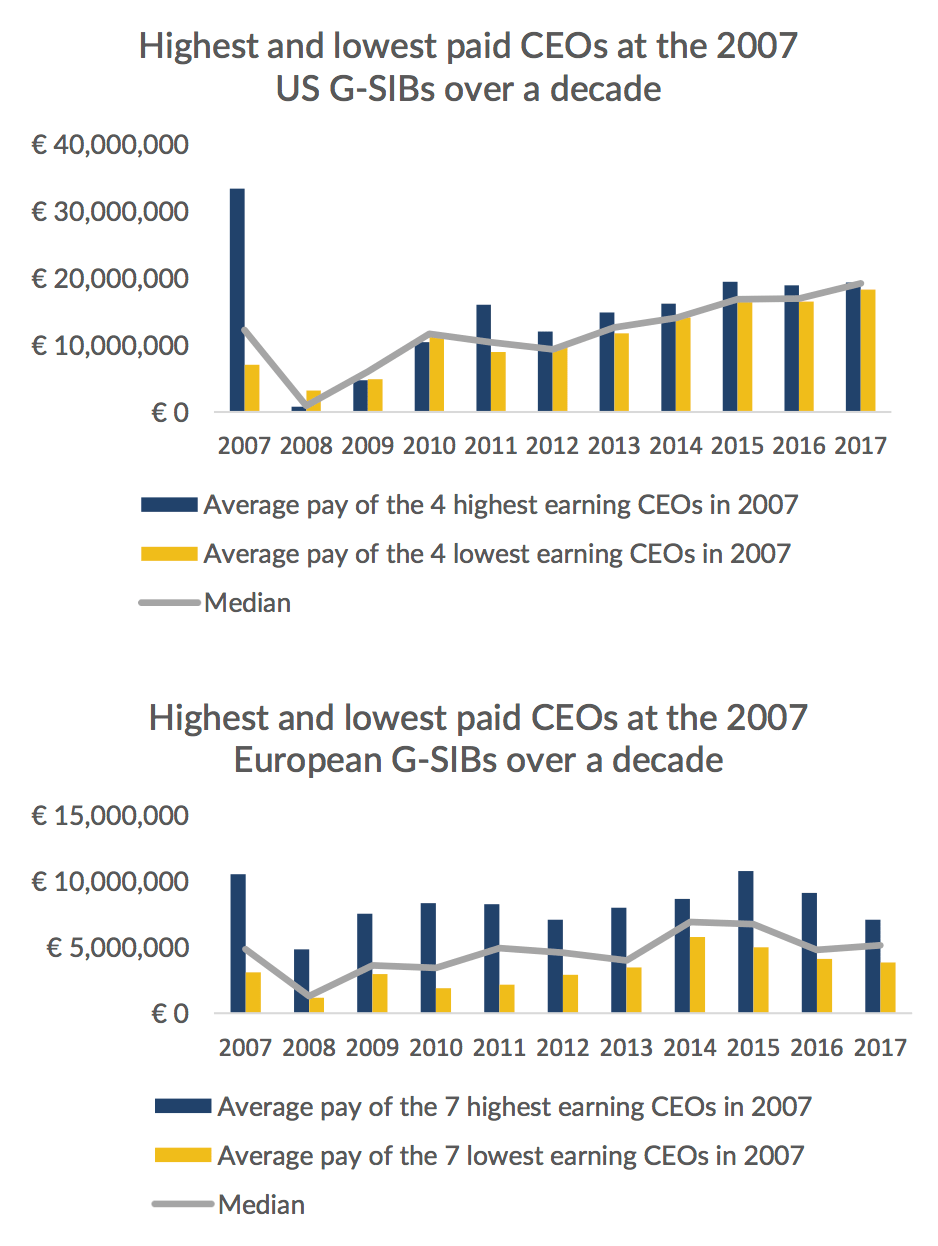
But there is a clear problem. These charts from my excellent colleagues at governance data shop Aktis tell a remarkable story*:

Screen Shot 2019-02-23 at 17.06.55

This close compression of pay at US banks — in effect they all seem to pay the same amount — strongly suggests that their directors believe that there is a going rate for the job. In short, compensation committees seem to have come to the bizarre conclusion that it is more important to pay at the same level as their peers than it is to pay according to the executives’ performance. This demonstrates the benchmarking ratchet in visible practice. Encouragingly, there is no such compression seen in the European figures; performance seems to be more of a driver of pay in the region (as well as overall quantum being lower).

Nassim Nicholas Taleb has argued (see his 2018 book Skin in the Game or Inequality and Skin in the Game) that it is this mindset that is felt to be unfairness (he uses the term inequality, but in two forms): people feel it to be unfair that time-serving should itself be rewarded. Taleb argues that no one objects to inequality that is deserved; that genuine entrepreneurs are seen to deserve wealth because their success comes from risk-taking and creativity. But merely participating in business life does not deserve huge reward — the inequality that arises from this is resented rent-seeking, he says. This just shows why fairness is a better term to use — the entrepreneur’s rewards are largely perceived as fair (unresented inequality), while the time-server’s similar sizeable rewards are seen as unfair (resented inequality).

So much for restating the problem: it’s unfair, and it isn’t working well. In many ways, things do not seem to have moved on much from nearly 20 years ago when my article Not badly paid but paid badly identified taxes, timeframes and trust as three key drivers of executive pay dysfunction. 

But we need solutions not just restatements of the problem. Here are some initial suggestions:

  • Let’s use the lens of fairness, not be shy of it. That’s why the Investment Association’s use of the term fairness in relation to executive pensions (Investors to Target Pension Perks and Poor Diversity in 2019 AGM Season) is so welcome — and the associated plan to press for changes when management enjoy different rates for their pensions than the rest of staff. Let’s do this more. One obvious candidate is the blithe assumption that seems to be made that asserting CEO salary increases can readily be justified where they are of the order of pay increases throughout the organisation; given the multipliers from incentives that the CEO enjoys the comparison is weak and doesn’t feel like fairness.
  • But the lens of fairness should not allow us to fall into the ‘price of the job’ trap. As Taleb rightly points out, it is this mindset that particularly fuels concerns about unfairness. Genuinely deserved riches can be a matter to be celebrated, but undeserved riches are not. This requires 2 things: 1. remuneration committees need to escape the benchmarking trap, and 2. they need to ensure the clarity of a link to performance is clear. As the US banks appear to have failed to do, they need to ensure that pay is driven by performance, not by the level of pay at peer organisations.
  • Instead of the oft-mentioned worker representatives on boards or on remuneration committees, the accountability to the workforce regarding executive pay could come very directly in the form of an annual remuneration committee presentation to workers representatives. This would be of the remuneration report, i.e. the decisions in the year and proposals for the year to come. I am not sure there needs to be a vote by workers, as the UK’s Labour Party appears currently to be considering; the force of having to explain decisions and the implication of needing clearly to understand the broader context for the workforce could have a remarkable, salutary effect for many remuneration committees.
  • Disclosures of pay ratios between the reward of CEOs and the average employee — flawed as they are for purposes of comparison between companies, even within a sector — should assist this salutary lesson and help encourage some sort of lid being placed on pay increases for top management. A comparison of such ratios year on year at a single company could be a powerful tool.
  • If the overall numbers are too high, and are not necessary except that others pay it, we face a difficult collective action challenge. We need to change the norm, and in part recognising what are the limits to acceptability must be part of that; investors need to play a stronger part in bringing the acceptable norms closer into the boundaries of normality and rationality. For me, a reduction in quantum is the main attraction of restricted stock based schemes, which have been the subject of ongoing debate in the UK and remain opposed by many investors. That opposition is based on the argument that such schemes are seen reduce the linkage to performance, so perhaps my backing for them is ironic given what I have said (not least the inclusion of such schemes in my simple 3 tests for poor structure in the US). But in part the answer — particularly the inconsistency with the US — is to do with quantum. I would argue that is a trade that we have to be willing to make in order to address the perceptions of unfairness such as those Taleb identifies. But if the performancing at the front end of restricted stock schemes, through the annual bonus system, is delivered effectively we may in fact get a better linkage to what better reflects genuine performance and drives better behaviours through organisations than we now get from the forward-looking performance metrics embedded currently in long-term schemes. I will return to the question of what sort of performance we should be thinking about linking to for those bonus payments shortly in a forthcoming post.

Fairness is for management often a driver of the upwards ratchet in pay. The rest of us should not succumb to this perspective, but rather should use fairness as a lens to focus in on how the appropriateness of pay can be demonstrated. Pay structures that reward time-serving will never seem fair, but reward for performance (if at a reasonable level) can. Expecting remuneration committees to be able to explain how they have done that is a minimum expectation, and being able to do so to stakeholders as well as shareholders may provide additional challenge that helps them towards delivering in practice. And calling out any failures to deliver fairness — and calling them out on a level playing field globally — is the least that we can fairly expect from institutional investors.


* the full Aktis data is discussed in this Yahoo! finance article: New study argues US bank CEOs make too much money


The Pay of Corporate Executives and Financial Professionals as Evidence of Rents in Top 1% Incomes, Josh Bivens and Lawrence Mishel, Journal of Economic Perspectives, 27 (2013)

Fair tax reflections from investors

The following briefly captures the responsible tax discussion at the recent ICGN conference in Amsterdam, a topic to which I will return more fully in later blogs. In large part this was an encouraging discussion, though there were clearly significant gaps in practical implementation.

Inevitably perhaps in a self-selecting group, investors were clear the issue matters: 89% say responsible tax is a consideration in investment decisions, and fully 95% say corporate philanthropy is not enough, that responsible companies must focus first on paying a fair level of taxes. Further, 87% believed that country-by-country tax reporting should be required of all companies — though the discussion in the room suggested that the practical experience of this was not always as valuable as the theory.

Yet, even among this enlightened group only 47% say that they definitely take responsible tax concerns into account when structuring their own investments. And while one Dutch pension scheme reported that it has stopped stocklending because it could no longer defend the dividend tax arbitrage implicit in this process any more, its representative noted that most of his peers are unaware that this is even an issue in stocklending.

It is clear that there is much work to do before fair tax is delivered in practice, and it becomes an issue that we address as well as just expecting them to.

See also: Fair tax reflections from investors II

Dirty alleyways and social norms

We are social creatures, and our attitudes and approaches are framed by the world around us. If we believe that world to be fair, we are likely to behave more fairly. The general and growing belief that the world is inequitable must therefore have a debilitating impact on many people’s approach to life.

In a series of experiments in quiet alleyways, Dutch scientists demonstrated just how susceptible we are to behaving in a way that we believe others are behaving. Sadly, we are easily persuaded to behave less well than we otherwise might.

Published in a study called The spreading of disorder the scientists reported on experiments in the small northern Netherlands city of Groningen — probably better known for its 400-year old university than for it being the Dutch host of the annual International Cycling Film Festival. 

Groningen is not a particularly dirty or unruly city, but the experiments explored the extent to which people can be influenced into worse behaviour by their environment. They are more likely to litter if the alleyway they are in has untidied rubbish and intact graffiti — 69% littering in the presence of mess, against 33% when the alleyway is tidy. The academics report that Groningen police do not enforce littering rules so they suggest that fear of getting caught is not the driver, rather that social norms are, and in a similar test found that 58% littered in a car park where a call to tidy away shopping trolleys had been clearly breached, while only 30% did where all shopping trolleys had been put away properly. 

Audible cues had a similar impact — the noise of fireworks being set off in breach of a national pre-New Year ban was sufficient to stimulate 80% littering rather than the 52% in a more obedient silent control situation. Furthermore, people appear to be more likely to trespass in breach of a clear sign instruction if they can see that another sign has already been ignored (82% vs 29%). 

The most striking of all studies are those where the academics created a temptation to steal: a stamped, addressed envelope with a visible €5 note in it was left not fully pushed into a postbox. Where the postbox was covered in graffiti, 27% of passers-by stole the envelope; where there was no graffiti but the ground was littered, 25% of passers-by succumbed to temptation to steal. Both results are significantly worse than the 13% level of theft in the clean and tidy control situation.

We are much more likely to misbehave if we believe that is the norm of those around us. We are much more likely to behave well when we understand that others do. We are social beasts.

And our actions are framed by the world around us not just in Dutch alleyways. For example, if people believe they have been cheated, they are more likely to cheat: one study found that those who received little or nothing in a dictator game (explained in Ultimatums and dictatorship: fairness shines through), or simply believe themselves to have been cheated in the game, are much more likely to cheat when reporting the results of a subsequent coin tossing game to gain an undeserved payoff. 

Another experiment is perhaps still more startling. Volunteers given expensive designer sunglasses are more likely to cheat in a self-marked maths quiz if they believe the glasses to be fakes. Those scoring well in the test earned up to $10; all were told that they were trusted to mark their own work, but the papers were later recovered and cheating identified. While 30% of those who believed they had been given genuine sunglasses cheated, fully 71% wearing supposed fakes did. Furthermore, those wearing fakes are significantly more likely to believe that others lie and act unethically; the wearers of fake glasses have their view of the world and of society significantly tinted for the worse. Given the prevalence of fake goods, this is a remarkable result — a sign that we risk the erosion of much through people’s desire for cheap substitutes to costly goods. Cheating the expensive designers may mean we lose more than we imagine we gain.

Social norms can be found on a much larger scale too. Researchers studied the honesty of people from 23 different countries, again through the medium of a self-reported test, this one involving a higher dice roll earned a greater reward. While none showed much evidence of blatant lying, there was clear evidence of some cheating through the statistically unlikely results that were reported. And these levels of (minor) cheating were greatest in those countries perceived to have the highest levels of corruption and rule violation, and lowest in countries where there is felt to be less corruption and unfairness. The researchers concluded that the results “show that weak institutions and cultural legacies that generate rule violations not only have direct adverse economic consequences but might also impair individual intrinsic honesty that is crucial for the smooth functioning of society”.

So the general belief that there is significant unfairness in the world must have a negative impact on the way that we treat each other and the fairness that we display in our lives. And no wonder that there is righteous anger when we see people avoiding taxes who are well able to pay. In contrast, if we wish to see fairness we must show fairness so that others feel it is the norm expected of us all.

One other lesson of the Dutch alleyway study is that I can no longer feel selfless when picking up rubbish on the streets around my house — I actually have a self-interest in so doing. Perhaps we also need to consider what are the metaphorical dirty alleyways of our world, and find ways to clean those up too. Surely finding some way to empower people to tidy the filth and rubbish from the world of social media would be a positive — and what a gift to us all if it no longer was an acceptable social norm to resort readily to anger online.


The studies discussed in this blogpost are:

The Spreading of Disorder, Kees Keizer, Siegwart Lindenberg and Linda Steg, Science 322 (2008)

Fairness and Cheating, Daniel Houser, Stefan Vetter, Joachim Winter, European Economic Review, Vol 56 (8) (2012)

The Counterfeit Self: The Deceptive Costs of Faking It, Francesca Gino, Michael Norton, Dan Ariely, Psychological Science 21(5) (2010)

Intrinsic Honesty and the Prevalence of Rule Violations across Societies, Simon Gaechter and Jonathan Schulz, Nature 531 (2016)

Credos and a fair return

I was reminded in a chat this week of the Credo published by US pharma and consumer company Johnson & Johnson, and in particular its all-important final sentence: “When we operate according to these principles, the stockholders [shareholders] should realize a fair return.” The word ‘fair’ appears 4 times, once in each of the short paragraphs.

What does this focus on fairness, on a fair return, look like? Of what is it the outcome? 

The Credo was created by Robert Wood Johnson, a member of the founding family and J&J’s chair from 1932 to 1963. It was written in 1943, just before Johnson & Johnson became a publicly traded company; J&J claims it as a bedrock of how the business still runs 75 years on: “Our Credo is more than just a moral compass. We believe it’s a recipe for business success.”

What is that recipe? Simply, that its customers come first, that suppliers have a right to a fair profit, that employees need to be respected and given scope to prosper, and that local communities matter; and that J&J needs to be a good corporate citizen (including expecting to “bear our fair share of taxes”). Only once all that is delivered do the shareholders gain any consideration: “Our final responsibility is to our stockholders.” It is clear that shareholders’ fair return is an outcome of running the business well and delivering value for all the other stakeholders, it is not an end in itself.

screen shot 2019-01-25 at 14.03.07
The Credo’s first paragraph, and first priority

And the consequence of this focus away from shareholder value maximisation and towards business success through delivering value to customers, suppliers, employees and the broader community? Value creation for shareholders too, with an impressive share price chart and still more impressive progressive dividend record dating back to the early 1970s.

So, long before the current debate on corporate purpose, and even long before the nonsense suggestions that US businesses are obliged to focus only on narrow shareholder value maximisation (both discussed in Accountable Capitalism, my article in October’s Governance), here was a US company going to the market with the explicit statement that shareholders do not come first, rather all other interests in the business do. And one that has amply demonstrated that the outcome of seeing shareholder value creation as an outcome not an aim is prolonged business success.

Some inevitably will criticise J&J and suggest that the Credo is mere words that deliver no substance. And of course, as a US healthcare business it faces multiple lawsuits regarding its products, a number of which it has lost. But my experience was that representatives of the company, both staff and independent board members, did talk about it differently from the way one hears from many US businesses. In particular, there was a pride in the company’s record of voluntary recalls of its products ahead of being obliged to by regulators or any certain evidence of problems — perhaps a putting into practice of the ‘first responsibility’ being to customers. It was never quite clear that problems were always avoided in the first place, but it was clear in discussions that this was a company with something of a different mindset.

I believe its Credo has something to do with that. Others might prosper by thinking in a similar way.