Lessons from Argentina, and Copperfield

As Argentina’s economic problems worsen, with capital controls reintroduced and the value of its debt fallen back to around 40c on the $, I have been reflecting again on a recent trip there. It is a wonderful country, with beautiful countryside and delightful people. My memories are clouded though by the economic lessons that are impossible not to see around you. It was unfairness visible.

I was there on the day in August of the primary elections when current President Mauricio Macri was trounced by his populist rival Alberto Fernandez. These votes didn’t mean anything in themselves other than foreshadowing the real thing, due at the end of this month. There had been huge and angry demonstrations leading up to the election date, and the streets were filled with political billboards. During the day itself, the streets seemed quiet and the main impact I felt personally was the ban on alcohol sales until 9pm on the day of any vote.

The waiter who brought me that 9pm beer was thus particularly welcome, but he was also particularly glum. The exit polls were already showing victory by 40% by Fernandez, which he regarded as a disaster. Others were more positive: I am told supporters of Fernandez flooded some streets in Buenos Aires in noisy celebration, though I didn’t witness that.

The currency markets, however, agreed with my waiter: the peso fell almost at once by 25%, and share prices by 35% (in non-peso terms, shares halved in value), putting further pressure on an economy already facing steep recession through Macri’s tough austerity programme. Unemployment is high, and inflation is creeping upwards despite administrative controls — in spite of those controls, it is running at over 50% a year.

I have never before travelled in an economy falling apart in front of my eyes. Cuba was non-functional but still people coped; everyone seemed to have some small scam going, mainly revolving around getting hard cash from the tourist market. The number of people who ought to have more productive lives who were operating as tour guides was hugely depressing. In a similar vein, I vividly remember the shelves of a supermarket in Soviet Russia holding only distinctly blue-tinged milk, and nothing else; and yet the people seemed to expect nothing better and survived. Both were messes in their own ways, but in their own ways they were steady state situations. Argentina was different.

I had only before studied the theory of shoe leather costs — the daily grinding additional burdens that arise in an economy weighed down by high inflation. But in Argentina there was no escape from seeing its reality. There were long daily queues at cashpoints to take out the meagre amount permitted for withdrawal each day — P2000, at a fee of P350-450 per transaction (those administrative measures to limit inflation are pretty blunt). The blackboards showing prices which changed rapidly, or the multiple labels on menus to reflect the fact that last week’s prices no longer reflect economic reality; or the side-stepping of both with lengthy negotiations about what price is appropriate and can be afforded on both sides. Silent queues of protest outside the offices of the failing municipal utilities. In a country of high unemployment and little opportunity, time is cheap and so gets wasted in various mundane frustrating ways. Soviet Russia used to formalise this by requiring shoppers to queue up three times to make a single purchase, should there have been anything other than blue milk to buy. This was in part a make-work scheme and in part a make-slow scheme. But Argentina demonstrated that formality is not needed and queuing can become a way of life. Mostly those queues and protests were quiet and dignified but the underlying anger was not hard to sense, and it was not hard to imagine more of those quiet protests at some point boiling over into something more — the point at which unfairness can no longer be tolerated.

One of the most poignant sights of a proud economy that is failing came at the border with Brazil — the mutual bridge proudly painted with each nation’s colours to halfway, the green and gold of Brazil glowing with a recent coat and the blue and white of Argentina cracked and peeling. The saddest sight was the bags and bags of onions seized at the border. Smuggling even this mundane a product was lucrative enough to justify the risk of being caught and all that might entail. 

But Argentina’s problem is more fundamental and mundane even than onions: with 10% unemployment and a third living in poverty life is impossible for many, but even the average middle class wage of around P30000 a month is no longer proving possible to live on. As inflation has outstripped wage rises, everything has become too expensive, so even the middle class is struggling and barely coping. Perhaps the queues at the bank would be still longer if people had more money available to them to spend. Discussing the situation reminded me of Wilkins Micawber in Charles Dickens’ David Copperfield (freshly and dazzingly brought to our screens by the magical Armando Iannucci). He states the problem with precision:

“Annual income twenty pounds, annual expenditure nineteen nineteen and six, result happiness. Annual income twenty pounds, annual expenditure twenty pounds ought and six, result misery.”

Micawber, like too many Argentines, is always the wrong side of that equation. The tragedy of Micawber is that while his sunniness in the face of what ought to be misery allows him to believe that something will turn up to unlock him from the inability to afford to live, we the readers believe that it never will (though Dickens is ever a benevolent author). That we have whole economies now operating on the false promise that something will turn up is our current tragedy — it is unfair that we seem to be lying to such people, who do not have the benefit of salvation at the hands of a kindly writer.

And sadly we cannot assume that this phenomenon is restricted to emerging economies. How else can we explain the ever-increasing personal debt levels, the use of equity in housing and rising credit card balances, that are a feature across major developed economies? While interest rates are low, significant portions of the world are now operating on the never never. While it temporarily keeps individuals’ heads above water, overall it will not make us more prosperous. Indeed, it might seem that there are pockets of troubled economies hidden within the wider, supposedly prosperous developed economies: that’s what our inequalities and unfairnesses have brought us to.

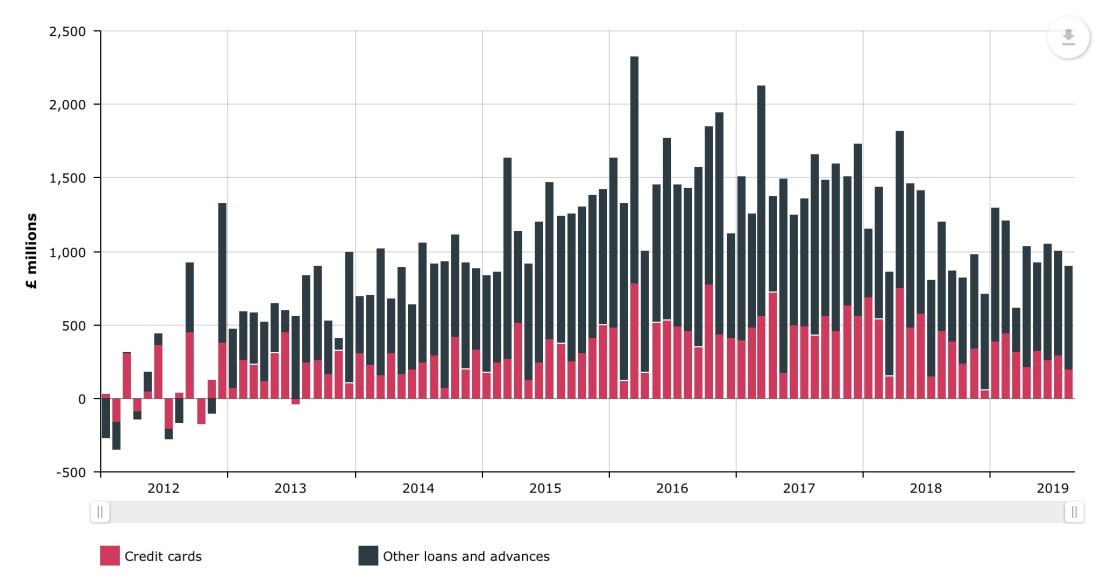
consumer credit data UK

Take the latest Bank of England figures on consumer borrowing (above). There has been no overall repayment of consumer debt since 2012, and while the monthly growth in debt has reduced marginally in recent months it still has a run-rate of around £1 billion a month, and now totals over £200 billion (this is in addition to mortgage borrowing, which also continues to grow, at around $4 billion a month, and totals some £1.4 trillion). That £1 billion a month, £12 billion a year, is a significant portion of the overall level of household expenditure in the UK, which runs at around £300 billion annually. Mr Micawber’s hopes make up around 4% of personal spending. The inequalities and unfairnesses that we all face mean that we are collectively hoping that something will turn up. False and unfair aspirations are likely to end in tears.

To return to Argentina, and the lessons that we might learn from it, I can do no better than quote from the conclusions to a recent (US) National Bureau of Economic Research working paper on Latin American populism: 

“Populists implement redistributive policies that violate the basic laws of economics, and in particular budget constraints. Most populist experiments go through five distinct phases that span from euphoria to collapse. Historically, the vast majority of populist episodes end up with declines in national income. When everything is over, incomes of the poor and middle class tend to be lower than when the experiment was launched. I argue that many of the characteristics of traditional Latin American populism are present in more recent manifestations from around the globe.”


On Latin American Populism, and its Echoes Around the World, by Sebastian Edwards, NBER Working Paper No. 26333, October 2019

Funds facilitate unfair pay

Institutional investors wave through pay practices that are unfair — to themselves as well as to others. Even the best barely manage to arrive half-way towards fairness. Funds thus fail to have fairness at the heart of what they do.

These are the conclusions of a fascinating recent presentation by Steve O’Byrne and his Shareholder Value Advisors, still available as part of an on-demand webinar (at least at the time of writing). 

It’s worth noting of course that Steve has developed a particular definition of fairness, and his own detailed statistical analysis of whether companies deliver it — and also whether investors respond appropriately. But the mere fact that he considers fairness is clearly welcome, and his analysis at the least confirms that there is a problem (as if further confirmation were needed). It’s worth also noting that he focuses purely on the US, where that problem is arguably greatest, and his main focus with regards to investors is their voting on so-called ‘say-on-pay’ resolutions, the normally annual non-binding votes to approve company pay practices.

Steve’s definition of unfairness is essentially one of excess rents — ie payouts that are undeserved, essentially because they provide rewards for performance that is no better than the industry standard. By this definition, these are unearned payments and so should not form part of any individual’s earnings. To the extent that investors are supporting payments that amount to unearned rents they are harming their own returns and signing off on skewed economics.

He has developed what he believes to be the perfect structure for a fair pay scheme, which derives awards based on TSR and the level of vesting based on returns greater than the industry. Whether everyone would deem the outcomes of these calculations ‘fair’ may be in some doubt, as the starting point is ‘market pay’, ie it assumes that generally pervading pay levels for top US executives are appropriate, in effect baking in current levels of unfairness. Nonetheless, the model does appear to deliver some greater relative fairness between executives and between companies, and it is a useful thought experiment stepping towards a broader fairness that reflects economic rationality. Steve is good enough to recognise that there is another form of ‘perfect’ pay structure to have been proposed for corporations: the Dynamic CEO Compensation model developed by excellent UK academic Alex Edmans. Both this, and Steve’s own version of perfection, have some striking similarities with the proposals for lifetime restricted stock compensation that a number of investors (notably Norges Bank and Hermes) have been trying to promote.

While there are dangers in a focus on TSR — this must always be an output of decision-making and there are dangers in bringing it into the foreground through making it a metric — over the long term it should be a reasonably fair measure. It is usually regarded by investors as the least gamable of performance measures. It is potentially subject to gaming, yes, but less so than other metrics and with fewer perverse incentives built into it. 

In some ways, it appears that investors are doing a good job: Steve identifies a high correlation between votes against US say-on-pay resolutions and the amount by which CEO pay exceeds fair levels in terms of company size, industry and relative TSR. However, he notes “extraordinarily high pay premiums are needed to get a majority ‘no’ vote” so majority opposition is only brought about by truly egregious cases. His other yardsticks on fairness include whether the CEO is paid more than 2.5x the median of the other 4 disclosed highest earners at the company and assessing pay against relative returns on invested capital. Both seem sensible measures of some aspects of fairness, though it is impossible to know if the calibration set is the right one.

However, despite this limited positive, two of Steve’s overall conclusions are pretty damning:

  • only 3 of 213 funds are halfway to what he would say is fully informed and fair say-on-pay voting (kudos to Irish Life, Calvert and to Wells Fargo, which leads the pack with a calculated 56% vote quality); and
  • three quarters of funds vote with a lower quality than the overall average, which itself is sadly below 40% of perfectly fair levels according to the calculations.

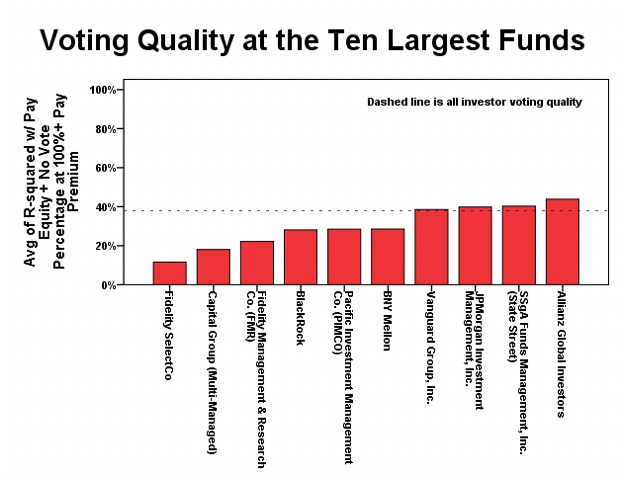
And his chart on the fair voting performance of the largest fund managers is unimpressive:

Fair pair voting

BlackRock is the only one of these for which he provides broken out data, and the 28% average according to Steve’s calculation is dragged down in particular by his analysis that the firm votes against only 7% of those situations where the CEO’s pay premium above a fair level is more than 100%.

It must be clear that this is an idiosyncratic analysis, and a particular and personal perspective on fairness. No doubt through other lenses the performance of the investment industry would appear better. But the clients of the industry, who can only dream of the rewards received by top CEOs — and would welcome small portions of the pay inflation that they have enjoyed — could certainly be forgiven for asking if this is fair. It is further evidence that too many investors continue to be content to allow the persistence of much unfairness, in effect facilitating it.

Bowling together

It feels wrong on a day of Ashes cricket to be writing of bowling in the American sense of the word, but sadly this title is a reference to ten-pin bowling not that of the wonderful Broad and absent Anderson, and the whole squad (and yes, some of the Australians are quite good at it too).

It is nearly 20 years since Harvard Professor Robert Putnam punished his seminal work Bowling Alone. This highlighted the significant decline in social capital in the US between 1965 and 1995, coinciding with a marked increase in inequality (unfairness, as this blog prefers). No longer were US citizens bowling in leagues, they were bowling more, but bowling alone. The fall in membership of almost every other social organisation — the social and community links that constitute what is meant by social capital — mirrored the decline that he used to give his work its title. 

At the time of the book’s publication, people from many other countries talked about these trends as a peculiarly US phenomenon. Most now accept that these same effects — declines in social capital and increases in inequality — are near-universal. We are all more isolated, and unfairness has increased.

I understand that Putnam is preparing a 20th anniversary edition of the book, which will include some reflections on the Internet and its impacts. Not all of these are bad and isolating in Putnam’s view; indeed, he sees some signs of new communities being created through the web, as well as the negatives of occasional egotistical narcissism. 

He is also preparing a new work, as yet unnamed as far as I know, considering not just the 30 years from the mid-1960s but comparing data from around 1900 through towards the current day. I had the fortune to hear Putnam talk about this work earlier this week at a Tortoise gathering dedicated to him. He considers again factors of social capital and inequality, and also political partisanship and cultural individualism, using a remarkable number of datapoints across each of these areas. Again and again these datapoints reveal  the same pattern, with a remarkable degree of consistency. 

The simple message is that political partisanship peaked in the 1950s, social capital around 1960 and cultural individualism (using the simple test — at least simple with the benefit of the remarkable datapools and analysis of Google Ngrams — of the frequency of ‘we’ compared with that of ‘I’ in all publications) in about 1970. The decline from these points is well known, indeed it was the core of Bowling Alone and much of what has been published in this area since (though Putnam uncovers further declines beyond his original 1995 end-point). Over the same period, inequality has risen at a remarkable rate.

The most notable thing about Putnam’s data though is what comes before 1960: it turns out that this was a peak in all the datasets, and that each factor had been increasing steadily from around 1890 (or, in the case of inequality, decreasing). We are in many cases at or around the levels last seen in 1890 (in some cases we have fallen below them); the period leading to this point was known as the gilded era in the US and was the peak of robber baron capitalism and all the unfairness that came with it.

Some may be surprised to hear that Putnam is sure that rising inequality is not the cause of the other declines. Rather, his data shows that increases in inequality are a lagging indicator of the other trends that he identifies. Thus, if we are to answer our current challenges of fairness we need to consider ways of addressing the other declines.

Putnam is eager to talk about these. He notes that the gilded age ended through social and political choice, and perhaps the fear of civil unrest (not least in the economic depression known as the Panic of 1893 — though the depression lasted until 1897). The US’s gilded age ended with the so-called Progressive Era and more generalised reforms.

The lessons that Putnam draws from that era, and what he believes lies behind the turning point in the data he identifies are:

  • genuine grassroots mobilisation is required
  • problems should be solved locally and boldly (allowing a thousand flowers to bloom), and effective solutions then shared nationally [and if culturally appropriate perhaps internationally]
  • bridges (across class, race and organisation etc) are essential
  • charismatic national leaders are only important after the grassroots process has begun

He gives the example of US public schools, which did not exist until the progressive era. In a handful of towns and cities across the midwest communities came together to ensure that every child should have around 4 years of free secondary education. This revolutionary step proved a great success and was then adopted nationally. Among other things, this supply-side revolution pump-primed the US economy by ensuring a relatively well-educated workforce — which played a key role in the economic success of the American century that followed.

There is work to be done.

Gaping chasms

The excellent Institute for Fiscal Studies has just released some exemplary work on those in the top 1% of incomes. This provides more evidence to reinforce the themes of my last blog, Gaping holes in fairness. It sparks further thought.

The IFS notes the tax advantage enjoyed by many of those with the highest incomes. Of those enjoying the top 1% of incomes, 18% of income is from partnerships, 11% from dividends and nearly 4% from self-employment. All these are taxed at lower levels than employment income. Most of these proportions are still more extreme for those in the top 0.1% of income category: 23% of their income is from partnerships, and 13% from dividends. It seems nothing other than fair that we should seek to equalise the taxation on the various forms of income, not least to dissuade structuring and avoidance (including delays in paying taxation by holding income in personal service companies and subsequently releasing it in dividends), as touched on in Simplifying tax is fairness.

But the most striking element of the IFS work is the evidence of the chasms that there now are, and the perceptive framing that we face because of it. This chart is telling:

IFS chasm 1

As the IFS says, this highlights “just how different the top 1% are from even the merely quite well-off”. The median income of all taxpayers is £22,000. Those at the 90th percentile enjoy more than double that, £59,000. But the 99th percentile kicks in at £162,000, nearly three times the level of those at the 90th percentile, and more than 7 times those at median, and therefore:

“If you are at the 90th percentile, you may well feel more like the person at the median (21.6 million adults below you in the distribution) than the person at the 99th percentile (just 4.9 million people above you).”

As the study notes, the disparities above the 99th percentile are even more extreme (the bar charts in Panel B). Remember always that these are disparities based on income tax returns, and that wealth disparities are likely to be still greater.

If anything, the regional disparities are even more striking. Half of those in the top 1% of income taxpayers now live in just 65 parliamentary constituencies, down from 78 in 2000. 30 constituencies have more than 2% of their adult population in the top 1% of income taxpayers; 17 of these 30 are in London and all but two, the IFS reports, are in the South East. Eyeballing their map suggests one of these constituencies is Aberdeen (the data is all 2014-5 tax year so predates the latest oil downturn), and the other is St Albans — which most would, I think, classify as being in the South East, though for these purposes it is placed in the East of England. In total, around 58% of all the top income taxpayers live in London and the South East, and a further 10% are in the East of England.

The skewing of the highest of incomes towards London is so extreme that the IFS points out that a London-based man aged 45-54 would be in the top 1% of income taxpayers nationally with an income of £162,000, but would need a further £560,000 in income to be among the top 1% of those of the same age, gender and location.

No wonder people’s perceptions are skewed, in just the same way as top executives’ pay expectations are framed by those of their peers. People’s thoughts are anchored by what they see around them and struggle to understand what they do not see, especially when the disparities are so great. I vividly remember the regular occasions when Justin King, then Sainsbury CEO, explained to investment analysts that they live in ‘an absolute bubble’ and that sharper pricing of everyday shopping was necessary for it to be affordable by the general population. The pricing of more expensive competitors was, he said often, ‘la-la land’ (this was long before the film of that name so did not conjure images of people dancing on top of cars).

The chasms are gaping. And our bridges aren’t working. The BBC’s recent documentary How to Break into the Elite served to demonstrate how tough that challenge is, even using the most frequently commended route of education. The programme quotes research by the London School of Economics that found a working class graduate with a first class degree was less likely to land an elite job than a middle class graduate with a 2:2, and even if they succeeded in doing so, they would earn 16% less than a middle class equivalent.

We need to shrink the chasms, we need to improve the bridges. That is only fair.


The characteristics and incomes of the top 1%, Robert Joyce, Thomas Pope, Barra Roantree, IFS Briefing Note BN254, Institute for Fiscal Studies

Gaping holes in fairness

Our businesses are missing out on putting all their best talent to use. Gaping pay gaps are evidence of failures fully to appreciate and recognise the skills and abilities of the whole workforce. They are also unfair.

Since 1975, UK employers have been barred from paying men and women differently for the same work. That was when the Equal Pay Act 1970 came into force, partly in response to the Ford machinists strike remembered to modern audiences by the 2010 film and subsequent musical Made in Dagenham, and partly as a requirement for then-imminent membership of the European Community, as was.

The 1970 Act has now been replaced by the Equality Act 2010, which brings together the anti-discrimination standards from a range of legislation, meaning that there should now be equal treatment across all ‘protected characteristics’, including age, disability, gender, ethnicity, religion and sexual orientation. There will be ongoing disputes around equal pay — and particularly around what forms of work should be deemed equal and so should fairly receive the same pay. But more disheartening is the story revealed by the gender pay gap reporting now made mandatory under a 2016 amendment to the Act. Despite this being the longest-standing area of equalities legislation, the reporting reveals that 78% of companies still pay men more than women. 

These reflections were brought on by a discussion hosted by Tortoise, a vigorous new media operation committed to slow news. This ‘ThinkIn’ covered pay gaps generally and why they are so intractable. The discussion ranged across all forms of pay gap, not only gender but also ethnicity, disability and socio-economic. All are unfair, but the latter was felt by most in the room to be the most intractable and least discussed.

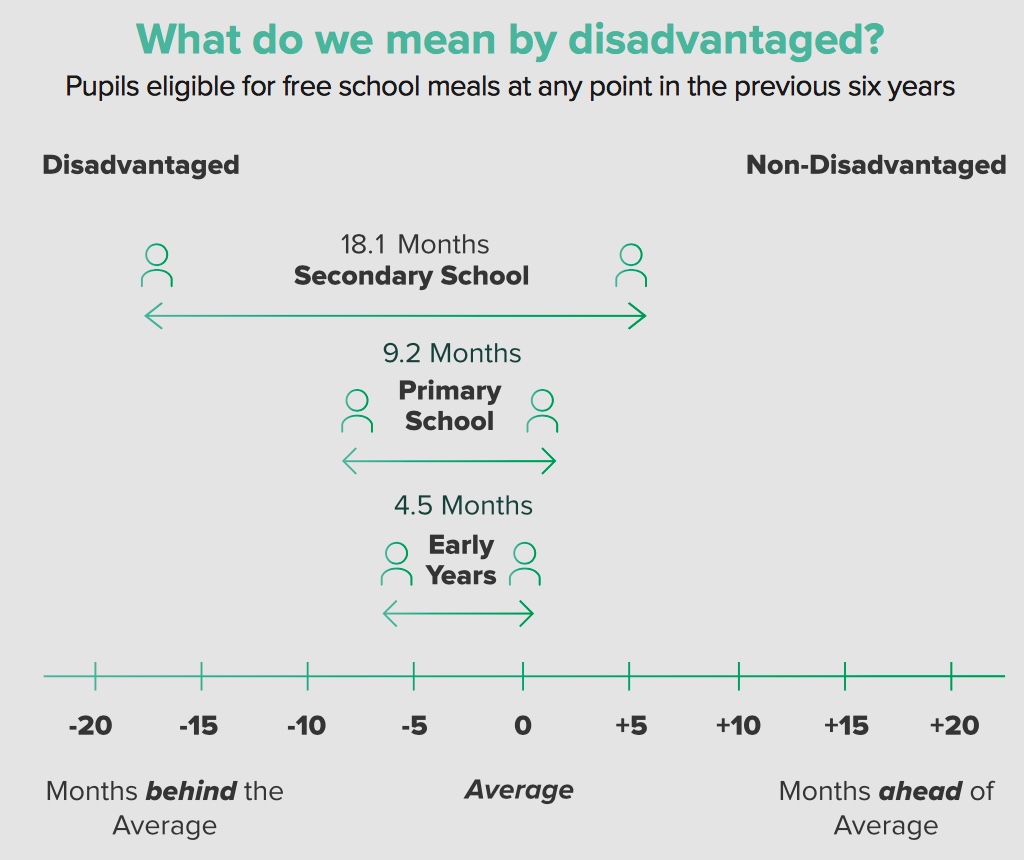
The statistics on socio-economic issues are indeed disturbing. As it happened, later the same day the Education Policy Institute released its latest annual report on education in England. This revealed the extent of the ongoing gap in school attainment experienced by disadvantaged kids compared with their peers. The EPI defines as ‘disadvantaged’ children who were eligible for free school meals at any time in the prior 6 years, and by the time they reach the end of secondary school these pupils are more than 18 months behind their better off peers (and in many UK regions it is much worse than this). The persistently disadvantaged — those eligible for free school meals for at least 80% of their schooling — are nearly a full 2 years behind.

EPI disadvantage now

According to the EPI, this 18-month or 2-year gap represents the accumulation of disadvantage over what is only a few years of life, starting in pregnancy and pre-school as well as reflecting the educational experience. When companies do not act to counterbalance these disadvantages they can only unfairly persist. The extent to which our society is failing to address this persistent unfairness is shown by the EPI’s historic data on the disadvantage gap. Though it has closed somewhat in the last decade, that progress has stalled most recently. The EPI estimates that on the trend of the latest 5 years it will take fully 560 years for the disadvantage gap to be closed. One doubts if our children have that long.

EPI disadvantage history

In a similar way, the second year’s disclosures of their gender pay gaps by UK companies also emphasise just how long unfairnesses persist if they are not addressed very directly. They imply that companies need to be working much harder to ensure that they are properly inclusive of all the talent available to them. Many companies attempt to explain their reported pay gaps by the fact that they have more men in senior positions, or more men in traditionally higher paid roles. But the key question is how to unlock and overturn this differentiation. Merely restating it shows little intent to do so. The simple fact is that such companies are not treating their employees with fairness. There are inherent biases which drive differential recruitment and differential promotion. Only when those differences are actively considered and pressed against will they be addressed.

The gap is now one of fair promotion not equal pay. Companies are in practice failing to make opportunities fairly available to all and thereby missing out on unlocking the talents of their whole workforce.

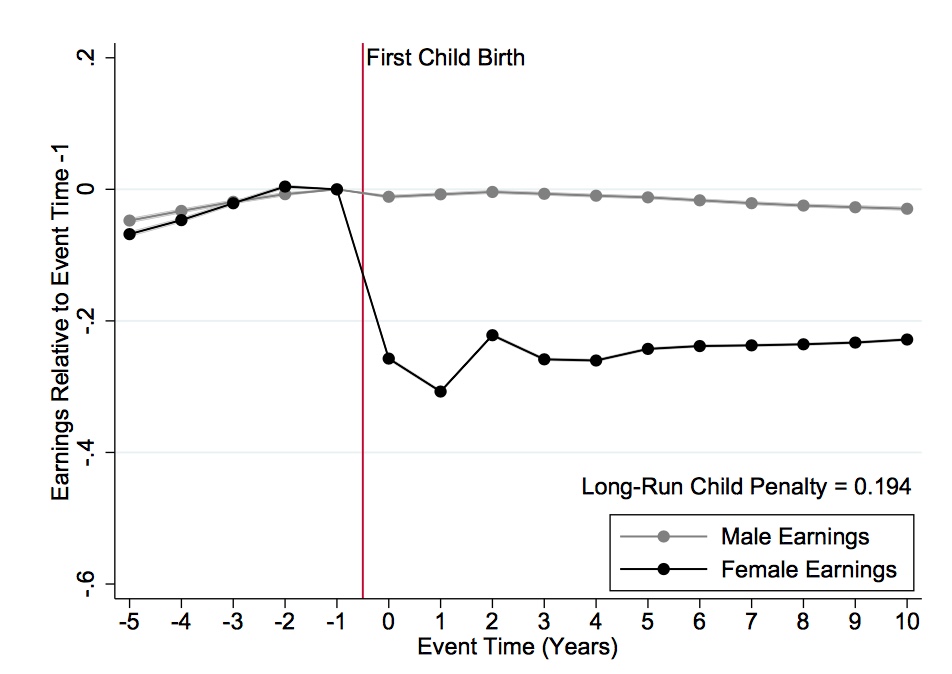
The gender pay gap is associated with childbirth and the decisions related to the care of children. Disproportionately still it is women who take on a higher burden of the childcare and work more locally and more part time. Promotion is slower for those working part time (though it needn’t be), and pay tends to be lower for those who are less willing to travel for it. Of course, not all individuals and couples reach the same decisions but the simple fact is that still at present women are more likely to take this sort of step back. This drives this particularly striking chart (based on Danish data but likely to be largely universal):

NBER child earnings

Companies can and should play a greater role in this, to retain all their most talented staff. There was much discussion at the Tortoise event of encouraging paternity leave, and equal choices by new fathers and new mothers — the comments both from a personal perspective (“demand more from your partner”) and from a corporate, with one participant revealing that their company, after a year of offering full paternity leave rights, only recently had their first individual taking them up, and then only after specific encouragement. In large part, the move to greater fairness and smaller pay gaps will require a changing of norms.

Some of those norms need to be around the willingness of hiring managers to recruit for difference and promote for difference. Another business leader at the Tortoise gathering noted that she had spent a year saying in talks around the business that she was expecting to be appointing more female heads of country operations, to no avail. It was only when she told recruiting managers that she would scrutinise each employment decision that a greater mix of appointments was made — though this was still only 10% female. Accountability matters, and challenge is needed to change norms.

Businesses need to work to remind all managers that employing people who are similar to oneself is not a model for greatest effectiveness, and that diversity is a good thing in itself for the effectiveness of teams. Just as the best boards are diverse, and the best chairs know that a large part of their role is to work the alchemy of drawing the best from a diverse group rather than hearing similar minded individuals reinforce each other, so the best teams and whole workforces are diverse. Evolution teaches us that extinction happens when species become specialised and too brittle to adapt to new changes and pressures. We know that such pressures are being placed on the global environment; that same challenge, together with the pressure of technological competition, are ratcheting up the difficult environment of the corporate world. Those that are robust and nimble enough may be able to adapt to these challenges, but one thing they are likely to need is diversity to aid their flexibility and adaptability. Fair employment approaches, and pay, are needed.


Education in England: Annual Report 2019, Education Policy Institute

Children and Gender Inequality: Evidence from Denmark, Henrik Kleven, Camille Landais, Jakob Egholt Søgaard, NBER Working Paper 24219

Fairness on the airwaves

In our days of shouting media, where partiality passes for commentary, it is hard to believe that fairness was once required of all US broadcast channels. 

Under the Fairness Doctrine of the Federal Communications Commission, all holders of broadcast licences had to deal with public interest matters of controversy in ways that were honest, equitable and balanced. Essentially, there was an obligation to hear a range of perspectives, not a single view. Those criticised had a specific right of reply.

In many ways, the Fairness Doctrine was very similar to the standards for broadcasters set by UK regulator Ofcom, which come in two parts. Section 5 of Ofcom’s Broadcasting Code requires Due Impartiality and Due Accuracy — that broadcasters should deal with appropriate fairness between different perspectives when there are differing views. And Section 7 requires Fairness, or at least bans unfair or unjust treatment of individuals or organisations by broadcasters. Editing of comments should be fair and not misleading, and relevant parties should have an appropriate opportunity to contribute. 

The Ofcom Code remains in place, but the Fairness Doctrine was abolished in 1987. A newly conservative and deregulatory FCC voted to abolish it, in the face of opposition from the US Congress — whose attempt to retain the Doctrine by codifying it was vetoed by President Reagan. Throughout the 70s and 80s there had been an ongoing debate about whether the Doctrine was a breach of the First Amendment right to freedom of speech, despite the US Supreme Court having held it to be wholly constitutional.

In that decision, Red Lion Broadcasting Co v FCC (1969), the court considered two conjoined appeals regarding the application of the doctrine in terms of fairness to individuals, essentially focused on the right to reply. The Court, in the collective judgement delivered by White J, held that such rights “enhance, rather than abridge, the freedoms of speech and press protected by the First Amendment”. The First Amendment to the US Constitution among other things guarantees freedom of speech and freedom of the press.

The Supreme Court’s decision was based on scarcity. It focused on the then technological and so regulatory limits on the number of outlets in the broadcast world. It held that in effect this regulated scarcity meant that each broadcaster that had been allowed access to the airwaves had a duty to show fairness, because the number of alternative outlets for stories was limited. The Court held, “Scarcity is not entirely a thing of the past”. 

Fifty years on, scarcity of media outlets now is. Now, we have no scarcity in bandwidth, no limit to the numbers of sources of information, which removes the main basis of the Supreme Court reasoning that fairness is central to delivering freedom of speech. Yet surely the underlying basis of their point is in fact the ability for voices and different perspectives to be heard — after all, that has to be the core of the right to reply — rather than the scope for voices simply to speak. Scarcity now comes in different forms. We all recognise the echo chambers of social media, where we tend to hear only the views that reflect our own thoughts and reinforce them, rather than a full mix of perspectives. It is a world where algorithms determine what we ought to be interested in from what we have shown an interest in, and so our world narrows in. Ironically, we have created a new world of scarcity within our unlimited technology. It is a world where fairness, in terms of access to a range of views, is squeezed out.

For all that bandwidth is no longer constrained and everyone can be a broadcaster these days, we are constrained in our ability to hear. Our new tower of babel, where everyone talks and few have the chance to listen to anything other than their pre-existing views (writes, fully recognising the irony, this blogger) leads to exactly the same limits on bandwidth, just at the level of listener rather than broadcaster. Our insights are still constrained and we still risk not hearing the other side of stories.

And so we need fairness in journalism still more than ever. We should reawaken the thinking of the Fairness Doctrine, and seek to apply it to internet channels just as much as to the broadcast world.

In the days that I was working there, Euromoney was more of a sink or swim environment than a training hub — its graduate traineeships were seen as a source of cheap labour rather than a detailed and technical training course. But it does not take much training to know what good, genuine journalism is, and what it isn’t. Simply expressing a monomanic perspective is not journalism. Getting a range of perspectives to deliver a rounded story is, in just the same way that a good journalist surprises his or her readers with a different way of seeing the world rather than just playing to their pre-existing prejudices. Good journalism gives voice to the voiceless even if that leads to discomfort for others. 

To be clear, I am not agreeing with the lazy ‘fake news’ allegation levelled by certain politicians when their pre-existing prejudices are not reinforced and their egos not fanned. Oddly, those most prone to make this assertion seem to be those with already disproportionate access to our airwaves and media. But we do need to reinvigorate much of our journalism and pay for unheard views to be voiced. 

So a fairness doctrine, or standards of due impartiality and due accuracy, are only a reflection of what good journalism should in any case entail. Broadcasters, or newspaper publishers, that peddle prejudices are not offering us journalism worthy of the name, and media providers on the internet, including social media platforms, need to consider how they too can avoid narrowing the views that we hear and instead facilitate our hearing a fairer spread of perspectives. We need broader-minded algorithms, not ones that shrink our worldview. 

We should insist on fairness — as the Supreme Court held, it is a necessary element of freedom of speech.


Bragg freedomI am grateful to Billy Bragg and his campaigning pamphlet The Three Dimensions of Freedom for highlighting the Fairness Doctrine. Particularly astute readers of various of my writings may possibly have detected what a fan I am of Bragg’s songs, not least borrowing one or two of his titles over the years.


Red Lion Broadcasting Co., Inc. v. FCC, 395 U.S. 367 (1969)

Simplifying tax is fairness

Fair Tax Week has now ended, abruptly and ironically into the alternative mindset represented by Amazon Prime day, the festival of online selling invented by the ubiquitous and dominant web sales hub.

Many don’t buy from Amazon because of its low tax payments. My personal objection to Amazon is more fundamental. Given that it makes no profit whatsoever from its core internet sales business — losses there are subsidised by oddly somnolent shareholders and the remarkable profitability of the cloud business AWS — it’s not surprising in many ways that it pays no tax. It is also not surprising that it can therefore undercut businesses that are obliged to make sufficient profits to provide a return to their investors. I’d personally rather buy from such businesses, supporting them against what is unfair competition. The fee structure of Amazon Prime looks like the company’s first proper attempt to start requiring its online shopping customers to pay something like the economic cost of the services it provides, a mere 25 years from the company’s founding.

France has chosen the same moment to renew its push for a form of formulary apportionment (see Talking with the Taxman about Fairness). Its proposal is of the bluntest form, and perhaps all the more interested for that, setting a tax rate of 3% of revenues. As discussed in that earlier post, the benefit of formulary apportionment methods, particularly ones that are based on sales, are that they remove the incentive that companies currently feel to shift their profits into other, lower taxed markets — whether through high interest or intellectual property payments, or other less transparent ways.

And this removal of incentives to manipulate may actually be beneficial for companies. As the spokesperson for Lush said at the launch event for Fair Tax Week: 

“If you’re shifting profits and fiddling figures you can’t know what is going on in your core business, you can’t know the truth about your business. You need transparent tax for a healthy business.”

One highlight of my Fair Tax Week was a further coincidence rather than a formal part of the week’s agenda: CSFI hosted a roundtable discussion on Simplifying the UK’s tax system. This featured the estimable Kathryn Cearns, newly chair of the Office of Tax Simplification, and Bill Dodwell, the OTS tax director. While Kathryn and Bill studiously avoided the use of the term fairness, it was apparent that their focus on simplification — particularly in removing loopholes, smoothing the undue impact of thresholds and removing other distortions — should generate greater fairness, or at least reduce unfairnesses, in our tax system.

Other speakers were less shy of talking directly about fairness. In particular, the issue was focused on by the two main respondents to the talk, Carys Roberts from IPPR and Catherine McBride from the IEA, among others. There were some remarkable coincidences of view across many of the participants in the discussion. Not least of these was quite a broad agreement that it is time to equalise tax on income from work and from wealth — it is one of the great unfairnesses, and a source of much wasteful structuring, that capital gains taxation and other income from wealth benefits from a lower tax rate. There is nothing progressive about that, and certainly nothing fair. 

Fair tax week

It’s Fair Tax Week, created by the Fair Tax Mark to further encourage companies to #SayWhatYouPayWithPride.

The number of companies now proudly holding a Fair Tax Mark certification has risen to 52 — no mean feat when the organisation rejects 2 in 3 applicants (it promises them anonymity so that companies are not disincentivised from applying. We are told to expect 3 major PLCs being certified over this summer.

Fair Tax Week was launched at an energising Fair Tax Conference on Friday. Fair Tax Mark  announced that it will start developing standards for international businesses, so that certification will be available not only for UK-based businesses. _20190707_181506

The event was sponsored by two of the larger companies that carry certification, FTSE 350 businesses SSE and Pennon. I was most struck by this slide from Pennon, confirming that the general public (as expressed at focus groups the company held on the topic of tax) principal aim with regard to taxation is fairness. The progress that Fair Tax Mark is making suggests that this is not as hard to identify in practice as some would imply.

Talking with the taxman about fairness

Companies feel that the ground is being shifted beneath their feet. They feel that changing demands are being made of them in many ways, only one of which is tax. We pay what the law requires us to pay, they say. The problem is that society clearly no longer believes that simply adhering to the law is enough. Society demands that companies play a proper role in funding the state and infrastructure in the countries in which they are active. Society is right: the law is not enough, we need the lens of fairness.

Society includes investors, and investors increasingly share this societal view. A reminder of the statistics from a plenary question on aggressive corporate tax planning from the PLSA conference earlier this year: 

Less than 10% believed that any tax minimisation within the law is in shareholders’ interests; nearly half worried about potential reputational risks to the company; around a third expressed concern that aggressive tax planning actually harms a company directly by undermining investment in local infrastructure and society.

This is a marked shift in mindset. A few years ago the majority of what is naturally a conservative group would have been clear that tax minimisation is in shareholders’ interests. A reminder: the PLSA conference attendees are those shareholders, as pension fund representatives they are long-term asset owners. By definition, they believe in capitalism because they are responsible for capital.

Society’s (and investors’) thinking has shifted because corporate tax planning is seen to have brought merely adhering to the law into disrepute.

Let’s consider the words one large company uses in its tax disclosures. “Traditionally, taxes generally fall due where profits are generated,” it states. This is true: corporation tax is generally levied on profits generated within national borders, or at least that is the simple starting point for what becomes more complex thereafter. The problem is that many multinationals have organised themselves in ways that mean that the second half of this company’s sentence isn’t necessarily true. It goes on: “which should be aligned with where the economic activity takes place”. But profits can be shifted so that they no longer reflect where the economic activity takes place — and very often they are.*

There are three key ways in which profits are shifted by multinationals:

  • intellectual property licensing drawing fees for the use of trademarks, patents or other IP from one country to another
  • debt structures drawing interest payments from one country to another
  • transfer pricing raising the cost of some goods or services and so lowering profits in one country and raising them elsewhere (or vice versa). There is always a transfer price to be set between companies within a multinational, but the term transfer pricing has come to be understood as manipulation of profits through the prices set (tax authorities intervene where it is clearly abusive)

In each case the structure tends to mean that these moves shift profits from relatively high tax jurisdictions to lower tax ones. Certainly this is what campaigners allege — and it is notable that multinationals tend to place intellectual property in lower tax jurisdictions and to lend money from such jurisdictions too. Both lower their overall tax burden. These steps can be taken by many companies even without particularly aggressive structures that exploit differential tax treatments by different authorities. But even without particularly aggressive planning, profits are no longer always aligned with where economic activity takes place. These structures risk unfairness — and by divorcing tax payments from economic activity, they risk the legitimacy of business.

It’s not surprising that the OECD, the club for rich countries, calls its main efforts to address aggressive tax planning BEPS, Base Erosion and Profit Shifting. Making profits more fairly reflect economic activity is the clear ambition.

One important element of the BEPS approach is to seek to address the issue of excessive debt and profit shifting through interest payments. If adopted generally, in effect this would limit interest payments to no more than 30% of EBITDA. This would help address the odd situation whereby our tax approach incentivises companies to take on more debt and so be less robust and less stable, by introducing what is sometimes called a thin capitalisation constraint. Companies would no longer be permitted to have such a thin sliver of equity capital that their debt interest payments suck out the bulk of their otherwise taxable profits. Such a change would render companies markedly more stable. Reflecting such a thin capitalisation approach within borders as well as on the international level which BEPS is considering would make more of our companies more robust and more resilient.

The potential benefits of rebalancing the current tax disadvantage of equity against debt financing is shown in a recent European Central Bank study of banks. ECB economist Glenn Schepens compared the capital ratios of a group of Belgian banks with a control group of peers. In 2006 Belgium had reduced the tax advantage of debt financing by also allowing equity financing to be tax deductible. The impact on capital ratios was marked:

tax and bank ratios

All these capital ratios seem low in our modern post-financial crisis era, but the shift in the capital structure of Belgian banks as a result of this limited change is notable. Applying a similar policy shift to the rest of the business world could lead to a remarkable shift in the long-term resilience of business. (I am grateful to my friend Peter Elwin for drawing this study to my attention).

The FT’s Martin Wolf recently proposed radical reform for corporate taxation, a form called destination-based cashflow taxation. I am simplifying, but the underlying concept is that taxes would be levied depending on sales in a country rather than production. The structure also seeks to favour local investment and local employment. The argument is that the venue of sales is more transparent and less susceptible to shifting and manipulation than production and profits. Wolf says: “The present origin-based corporate tax system, especially with deductibility of interest and insufficient deduction for spending on investment, is creating huge problems. Instead of tinkering endlessly with it, we need more radical reform.

The letter in response to this proposal written by a group of tax reform campaigners notes that this looks rather like a form of VAT and so embeds many of the regressive elements of that tax (noting that in this case it is regressive cross-border as well as within countries). Instead they propose a form of international formulary apportionment. Formulary apportionment, sometimes known as unitary taxation, has typically only been applied within national borders, such as within the US, as a way to allocate taxation between its states. In essence, the level of a company’s economic activity in a state is determined according to a formula (using some combination of the proportion of overall sales, payroll and property in the state as compared with the nation overall). Over time, the formula has shifted from generally equal-weighting these three elements to a greater favouring of sales. A sales-dominated formula is perhaps not far removed in effect from what Wolf was proposing.

Introducing an international form of formulary apportionment would be a major endeavour — reaching global agreement as to the formula and as to what is treated as a taxable unit whose profits must be apportioned would be difficult. In particular, the defined taxable unit might introduce new opportunities for tax structuring and strategies that minimise tax. I vividly remember the horror generated in the corporate world in the 1980s and early 1990s by the thought that US states might start extending unitary taxation internationally. UK companies mounted a stout defence and ensured that their government threatened the US with tax retaliation should this ever have been delivered. The stated concern was that one state, or one country, might unilaterally impose global change; the silent concern was that it might undermine the multiple existing tax strategies the multinationals then had in place. The campaign was such that the plans were set aside in spite of being deemed constitutional. But maybe they will be revived in a new and broader form.

It is hard not to agree with Martin Wolf that radical reform is needed. Something needs to give. So the ground will shift further, and companies will again complain that they do not have the certainty they desire. The answer may be for them to plant themselves in the firmer ground of fairness — such that profits genuinely are made where their economic activity takes place, or at least taxes are paid where their economic activity takes place. Until that happens, campaigners will continue to highlight the discrepancies between the level of taxes paid by companies such as Starbucks, Amazon and Apple and the level of their economic activity.


I know that I will return to fairness in taxation in future blogs. It is one of the key areas where thoughts of fairness need to be applied, and where much fresh thinking is coming — in personal and property taxation as well as corporate. I’m looking forward to the Fair Tax Conference in London next week, the launch of Fair Tax Week.


* I’m not naming this company because I do not want to be seen in any way to be singling it out for criticism. It has had its share of tax disputes but it is more than usually transparent on tax matters.


Does the tax advantage of debt impact financial stability?, Glenn Schepens, ECB Research Bulletin No. 27, September 2016