Simplifying tax is fairness

Fair Tax Week has now ended, abruptly and ironically into the alternative mindset represented by Amazon Prime day, the festival of online selling invented by the ubiquitous and dominant web sales hub.

Many don’t buy from Amazon because of its low tax payments. My personal objection to Amazon is more fundamental. Given that it makes no profit whatsoever from its core internet sales business — losses there are subsidised by oddly somnolent shareholders and the remarkable profitability of the cloud business AWS — it’s not surprising in many ways that it pays no tax. It is also not surprising that it can therefore undercut businesses that are obliged to make sufficient profits to provide a return to their investors. I’d personally rather buy from such businesses, supporting them against what is unfair competition. The fee structure of Amazon Prime looks like the company’s first proper attempt to start requiring its online shopping customers to pay something like the economic cost of the services it provides, a mere 25 years from the company’s founding.

France has chosen the same moment to renew its push for a form of formulary apportionment (see Talking with the Taxman about Fairness). Its proposal is of the bluntest form, and perhaps all the more interested for that, setting a tax rate of 3% of revenues. As discussed in that earlier post, the benefit of formulary apportionment methods, particularly ones that are based on sales, are that they remove the incentive that companies currently feel to shift their profits into other, lower taxed markets — whether through high interest or intellectual property payments, or other less transparent ways.

And this removal of incentives to manipulate may actually be beneficial for companies. As the spokesperson for Lush said at the launch event for Fair Tax Week: 

“If you’re shifting profits and fiddling figures you can’t know what is going on in your core business, you can’t know the truth about your business. You need transparent tax for a healthy business.”

One highlight of my Fair Tax Week was a further coincidence rather than a formal part of the week’s agenda: CSFI hosted a roundtable discussion on Simplifying the UK’s tax system. This featured the estimable Kathryn Cearns, newly chair of the Office of Tax Simplification, and Bill Dodwell, the OTS tax director. While Kathryn and Bill studiously avoided the use of the term fairness, it was apparent that their focus on simplification — particularly in removing loopholes, smoothing the undue impact of thresholds and removing other distortions — should generate greater fairness, or at least reduce unfairnesses, in our tax system.

Other speakers were less shy of talking directly about fairness. In particular, the issue was focused on by the two main respondents to the talk, Carys Roberts from IPPR and Catherine McBride from the IEA, among others. There were some remarkable coincidences of view across many of the participants in the discussion. Not least of these was quite a broad agreement that it is time to equalise tax on income from work and from wealth — it is one of the great unfairnesses, and a source of much wasteful structuring, that capital gains taxation and other income from wealth benefits from a lower tax rate. There is nothing progressive about that, and certainly nothing fair. 

Fair tax week

It’s Fair Tax Week, created by the Fair Tax Mark to further encourage companies to #SayWhatYouPayWithPride.

The number of companies now proudly holding a Fair Tax Mark certification has risen to 52 — no mean feat when the organisation rejects 2 in 3 applicants (it promises them anonymity so that companies are not disincentivised from applying. We are told to expect 3 major PLCs being certified over this summer.

Fair Tax Week was launched at an energising Fair Tax Conference on Friday. Fair Tax Mark  announced that it will start developing standards for international businesses, so that certification will be available not only for UK-based businesses. _20190707_181506

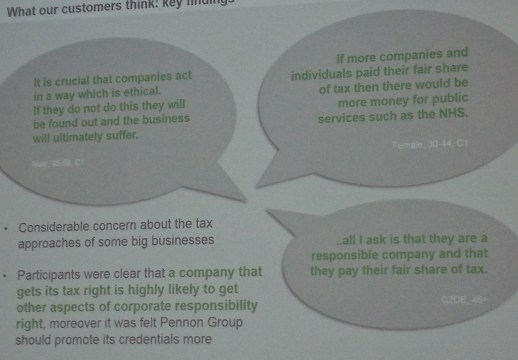
The event was sponsored by two of the larger companies that carry certification, FTSE 350 businesses SSE and Pennon. I was most struck by this slide from Pennon, confirming that the general public (as expressed at focus groups the company held on the topic of tax) principal aim with regard to taxation is fairness. The progress that Fair Tax Mark is making suggests that this is not as hard to identify in practice as some would imply.

Talking with the taxman about fairness

Companies feel that the ground is being shifted beneath their feet. They feel that changing demands are being made of them in many ways, only one of which is tax. We pay what the law requires us to pay, they say. The problem is that society clearly no longer believes that simply adhering to the law is enough. Society demands that companies play a proper role in funding the state and infrastructure in the countries in which they are active. Society is right: the law is not enough, we need the lens of fairness.

Society includes investors, and investors increasingly share this societal view. A reminder of the statistics from a plenary question on aggressive corporate tax planning from the PLSA conference earlier this year: 

Less than 10% believed that any tax minimisation within the law is in shareholders’ interests; nearly half worried about potential reputational risks to the company; around a third expressed concern that aggressive tax planning actually harms a company directly by undermining investment in local infrastructure and society.

This is a marked shift in mindset. A few years ago the majority of what is naturally a conservative group would have been clear that tax minimisation is in shareholders’ interests. A reminder: the PLSA conference attendees are those shareholders, as pension fund representatives they are long-term asset owners. By definition, they believe in capitalism because they are responsible for capital.

Society’s (and investors’) thinking has shifted because corporate tax planning is seen to have brought merely adhering to the law into disrepute.

Let’s consider the words one large company uses in its tax disclosures. “Traditionally, taxes generally fall due where profits are generated,” it states. This is true: corporation tax is generally levied on profits generated within national borders, or at least that is the simple starting point for what becomes more complex thereafter. The problem is that many multinationals have organised themselves in ways that mean that the second half of this company’s sentence isn’t necessarily true. It goes on: “which should be aligned with where the economic activity takes place”. But profits can be shifted so that they no longer reflect where the economic activity takes place — and very often they are.*

There are three key ways in which profits are shifted by multinationals:

  • intellectual property licensing drawing fees for the use of trademarks, patents or other IP from one country to another
  • debt structures drawing interest payments from one country to another
  • transfer pricing raising the cost of some goods or services and so lowering profits in one country and raising them elsewhere (or vice versa). There is always a transfer price to be set between companies within a multinational, but the term transfer pricing has come to be understood as manipulation of profits through the prices set (tax authorities intervene where it is clearly abusive)

In each case the structure tends to mean that these moves shift profits from relatively high tax jurisdictions to lower tax ones. Certainly this is what campaigners allege — and it is notable that multinationals tend to place intellectual property in lower tax jurisdictions and to lend money from such jurisdictions too. Both lower their overall tax burden. These steps can be taken by many companies even without particularly aggressive structures that exploit differential tax treatments by different authorities. But even without particularly aggressive planning, profits are no longer always aligned with where economic activity takes place. These structures risk unfairness — and by divorcing tax payments from economic activity, they risk the legitimacy of business.

It’s not surprising that the OECD, the club for rich countries, calls its main efforts to address aggressive tax planning BEPS, Base Erosion and Profit Shifting. Making profits more fairly reflect economic activity is the clear ambition.

One important element of the BEPS approach is to seek to address the issue of excessive debt and profit shifting through interest payments. If adopted generally, in effect this would limit interest payments to no more than 30% of EBITDA. This would help address the odd situation whereby our tax approach incentivises companies to take on more debt and so be less robust and less stable, by introducing what is sometimes called a thin capitalisation constraint. Companies would no longer be permitted to have such a thin sliver of equity capital that their debt interest payments suck out the bulk of their otherwise taxable profits. Such a change would render companies markedly more stable. Reflecting such a thin capitalisation approach within borders as well as on the international level which BEPS is considering would make more of our companies more robust and more resilient.

The potential benefits of rebalancing the current tax disadvantage of equity against debt financing is shown in a recent European Central Bank study of banks. ECB economist Glenn Schepens compared the capital ratios of a group of Belgian banks with a control group of peers. In 2006 Belgium had reduced the tax advantage of debt financing by also allowing equity financing to be tax deductible. The impact on capital ratios was marked:

tax and bank ratios

All these capital ratios seem low in our modern post-financial crisis era, but the shift in the capital structure of Belgian banks as a result of this limited change is notable. Applying a similar policy shift to the rest of the business world could lead to a remarkable shift in the long-term resilience of business. (I am grateful to my friend Peter Elwin for drawing this study to my attention).

The FT’s Martin Wolf recently proposed radical reform for corporate taxation, a form called destination-based cashflow taxation. I am simplifying, but the underlying concept is that taxes would be levied depending on sales in a country rather than production. The structure also seeks to favour local investment and local employment. The argument is that the venue of sales is more transparent and less susceptible to shifting and manipulation than production and profits. Wolf says: “The present origin-based corporate tax system, especially with deductibility of interest and insufficient deduction for spending on investment, is creating huge problems. Instead of tinkering endlessly with it, we need more radical reform.

The letter in response to this proposal written by a group of tax reform campaigners notes that this looks rather like a form of VAT and so embeds many of the regressive elements of that tax (noting that in this case it is regressive cross-border as well as within countries). Instead they propose a form of international formulary apportionment. Formulary apportionment, sometimes known as unitary taxation, has typically only been applied within national borders, such as within the US, as a way to allocate taxation between its states. In essence, the level of a company’s economic activity in a state is determined according to a formula (using some combination of the proportion of overall sales, payroll and property in the state as compared with the nation overall). Over time, the formula has shifted from generally equal-weighting these three elements to a greater favouring of sales. A sales-dominated formula is perhaps not far removed in effect from what Wolf was proposing.

Introducing an international form of formulary apportionment would be a major endeavour — reaching global agreement as to the formula and as to what is treated as a taxable unit whose profits must be apportioned would be difficult. In particular, the defined taxable unit might introduce new opportunities for tax structuring and strategies that minimise tax. I vividly remember the horror generated in the corporate world in the 1980s and early 1990s by the thought that US states might start extending unitary taxation internationally. UK companies mounted a stout defence and ensured that their government threatened the US with tax retaliation should this ever have been delivered. The stated concern was that one state, or one country, might unilaterally impose global change; the silent concern was that it might undermine the multiple existing tax strategies the multinationals then had in place. The campaign was such that the plans were set aside in spite of being deemed constitutional. But maybe they will be revived in a new and broader form.

It is hard not to agree with Martin Wolf that radical reform is needed. Something needs to give. So the ground will shift further, and companies will again complain that they do not have the certainty they desire. The answer may be for them to plant themselves in the firmer ground of fairness — such that profits genuinely are made where their economic activity takes place, or at least taxes are paid where their economic activity takes place. Until that happens, campaigners will continue to highlight the discrepancies between the level of taxes paid by companies such as Starbucks, Amazon and Apple and the level of their economic activity.


I know that I will return to fairness in taxation in future blogs. It is one of the key areas where thoughts of fairness need to be applied, and where much fresh thinking is coming — in personal and property taxation as well as corporate. I’m looking forward to the Fair Tax Conference in London next week, the launch of Fair Tax Week.


* I’m not naming this company because I do not want to be seen in any way to be singling it out for criticism. It has had its share of tax disputes but it is more than usually transparent on tax matters.


Does the tax advantage of debt impact financial stability?, Glenn Schepens, ECB Research Bulletin No. 27, September 2016

Fairness is a choice

Countries can choose fairness. It is not a matter of fate or national destiny. That’s deeply heartening for those of us worried by the extent of unfairness in our current world.

This is the clear conclusion of a recent paper considering the case of Sweden, now one of the most equal and fair developed economies.

In The Swedish Sonderweg in Question, Lund University economic historian Erik Bengtsson challenges the multiple theories that in some way this Swedish fairness is innate in the national psyche and was always present and/or inevitable.

There are a number of elements of his argument but the core point is reflected in this chart: 

Sonderweg data

In contrast to the argument that fairness is innate in the Swedish nation this chart makes clear that Sweden actually used to be an outlier in the opposite direction. It was much less fair than other similar countries until the dislocations of the First World War, and the differentiation that is now assumed by many to have been there forever really developed only over the second half of the 20th century.

Bengtsson discusses various ways in which this greater fairness was delivered in practice, through a deliberately chosen democratic shift in the way in which the benefits of economic prosperity were shared. 

If the Swedes actively chose fairness and have delivered it, so can others. Given that the most unequal states currently do not match the peak unfairness that Sweden experienced around 1910, there must be a way back for them too. We just need to choose fairness.


The Swedish Sonderweg in Question: Democratization and Inequality in Comparative Perspective, c1750–1920, Erik Bengtsson, Past & Present, gtz010, 27 May 2019

Why fairness matters

I have previously referred to TM Scanlon’s highly accessible monograph Why does Inequality Matter?, and wanted to highlight a couple of further elements from that book.

Scanlon identifies 6 reasons to object to particular forms of inequality, in effect accepting that some (perhaps all?) other forms of inequality are inevitable, and maybe that they are also acceptable:

  1. Inequality can be objectionable because it creates humiliating differences in status.
  2. Inequality can be objectionable because it gives the rich unacceptable forms of power over those who have less.
  3. Inequality can be objectionable because it undermines equality of economic opportunity.
  4. Inequality can be objectionable because it undermines the fairness of political institutions.
  5. Inequality can be objectionable because it results from violation of a requirement of equal concern for the interests of those to whom the government is obligated to provide some benefit.
  6. Inequality of income and wealth can be objectionable because it arises from economic institutions that are unfair.

But in effect these are the situations where inequality is unfair, and to use the language of fairness would cut through the need to define and address this question of those inequalities that are deemed acceptable and those that are unacceptable.

To my mind, the most successful parts of the book are those that explicitly do use the language of fairness. These, in particular chapters 4, 5 and 6, are where Scanlon discusses equality of opportunity. Here he talks in large part about procedural fairness, and fairness in the political system. “Political fairness requires both properly functioning institutions and appropriate background conditions,” Scanlon writes, and identifies ways in which inequality — unfairness — can undermine those background conditions and so undermine political fairness. 

Fairness matters because we as humans mind about unfairness and if we find ourselves living in an unfair world, it undermines our faith in political and economic systems. That’s what this blog will continue to seek to explore.


Why does Inequality Matter?, T M Scanlon, Oxford University Press, 2018

The growth myth

Our economies are floating on a bubble of debt. Although US Federal Reserve chair Jay Powell has most recently downplayed his comments about the risks of high corporate debt, he has only said that any bursting of the bubble will not be as problematic and systemic as the financial crisis. That’s not a high bar. He still suggests that many companies will face “severe financial strain” if there is an economic downturn. High leverage — excessive debt — will do what it does and amplify performance, meaning that a downturn will be more painful than it might otherwise be. He implies the result will be lay-offs and business failures, about which he appears relatively calm.

Others may be less sanguine. Many believe that we are now facing just such an economic downturn. Its consequences could be severe.

But perhaps that is no more than we deserve. The amplification effect of debt has been used to create growth where there would have been none, and much of the economic success that we have recently seen, such as it is, has been built on the weakest foundations. Economies have remained puffed up by extremely low interest rates, and the further puffery of quantitative easing. The resulting debt binge has skewed our economies and inflated asset prices. This has exacerbated the gulf between the haves and have-nots, boosting the sense of unfairness that many feel. Central banks have ignored this huge asset price inflation (highlighted in The centre cannot hold) because their inflation targeting concentrates only on consumer prices.

BIS on debt growth

But at least this debt binge has enabled the world economy to keep on growing, many will say. We did not grind to a painful halt in the financial crisis. Not least, most governments would express gratitude. We are all obsessed with growth, but governments feel that obsession more directly as they need growth so that the nominal value of debt erodes over time. Without growth, debt will feel a much greater and more immediate burden and it will be harder to justify delays in paying it off. Governments, like companies, are caught in a debt trap whereby they need expansion to make their debt burdens more manageable over time. With the global expansion of the debt load that BIS highlights, we’re all caught in this trap.

There’s a fairness aspect — or a lack of fairness aspect — to our obsession with growth. Henry Wallich, one of Powell’s predecessors as a governor of the Fed (from 1974 to 1986), said: “Growth is a substitute for equality of income. So long as there is growth there is hope, and that makes large income differentials tolerable.” (I should acknowledge that this quote was drawn to my attention by the marvellous Doughnut Economics).

Because of our obsessive need for growth, we seem prepared to believe myths. For example, our growth obsession is often used to trip up the financial markets — as we can see by the loss-making companies brought to IPO at inflated prices on the promise of continuing stratospheric growth. Lyft and Uber are the most recent examples of this damaging impact of our growth obsession, doomed to early share price drops as the market wakes up to the fact that they lose money and have little prospect of starting to make profits until they start charging an economic rate for their services, braking their stellar growth. It’s another example of the dangers of our focus on specific measures of performance. More than 80% of US IPOs last year were of unprofitable companies, able to offer only the promise of growth; US investors in particular seem content to see most of their returns come from share price appreciation rather than in dividends.

The bubble of debt and the growth myth are skewing our economies in other ways. I’d argue that the financial behaviours it brings about are also among the causes of unfairness. With money essentially free, those who are willing to take on sizeable debt burdens are able to outbid the more conservative, and the performance amplification effects of debt make them look like investment geniuses, able to charge more for their services. Because debt costs are taken out before tax charges, these heavy debt loads reduce companies’ tax burdens at the same time as making them more prone to failure. These behaviours build further unfairness into our economies. 

Take as one example infrastructure businesses and utilities. Pension funds are keen to invest directly in such businesses because this enables them to get close to the underlying steady cashflows that they should offer, a good match for pension liabilities. Yet too often they have been unable to buy these businesses because they have been outbid by intermediary fund managers which have been willing to add significant debt loads to them, enabling them to pay more not least because the debt is structured to minimise the tax cost. Pension schemes can only then invest by paying significant fees to these intermediaries. These juiced up returns look like more economic activity, more growth, but really all that has happened is that more leverage has been added to the system, making it less able to withstand shocks and limiting incentives for long-term investment. Government finances have also been made less robust because more business activity has been shielded from the tax system by debt. In other words, our obsession with growth has been used as a mechanism that has generated further unfairnesses.

The damage done to Thames Water as a business — as well as to the Thames itself, which was the recipient of nearly 2 billion litres of raw sewage in 2013 and 2014 — by its former owners was not reflected in the returns that they enjoyed, even taking account of the million-pound fines they faced. Australian bank Macquarie made returns of 15.5-19% over the 11 years of its control of the business having bought it in 2006 for £5.1 billion and selling it in 2017, by which time it was loaded with £11 billion in debt (these are FT numbers; it is worth noting that Macquarie instead points to the 12.3% internal rate of return on its Macquarie European Infrastructure Fund, itself a generous performance from what are steady assets).

Because growth has been invented and has deliberately helped to skew the unfairnesses in our society, it is no longer working in the way Wallich said it should. It is for many no longer offering a “substitute for inequalities of income” because it doesn’t offer hope. For many, hope has been squeezed out and they see economic growth as something that happens to others and benefits others. In many cases, they are right to do so. This is making our current unfairness intolerable.

In a 1972 New York Times article, A World Without Growth?, Wallich wrote dismissively of ecologists’ criticism of resource depletion and damage to the environment from ongoing growth, putting it in the context of Malthusian views of the impending end of the world, which did not come to pass as imminently from 1798 as the English reverend predicted in An essay on the Principle of Population. Even Wallis might have been shocked from this confidence by the recent Intergovernmental Science-Policy Platform on Biodiversity and Ecosystem Services (IPBES) report on the damage to ecosystems and impending mass extinctions with 1 million species under immediate threat; he might have wavered a little at the thought that some of our currently most productive land is predicted to offer no more than 50 or 60 years of harvests. Economic growth now, more than ever, seems to have reached fundamental limits.

Wallich argued in his article that the power of economics means that as resources are depleted their price increases and automatically they are used more wisely or substitutes are found. What we are finding is that we need a substitute for the growth myth. It no longer offers us an answer to unfairness, because people are seeing through the false growth that is the best we seem able to generate at the moment. And it is leading us to increasing instabilities, both in terms of debt and in terms of ecology.

“Somewhere in the dim future, if humanity does not blow itself up, there may lie a world in which physical change will be minimal … hopefully a much more humane and less materialistic world,” wrote Wallich. “We shall not live to see it.” Let’s hope he’s wrong about that.


Doughnut Economics, Kate Raworth, Cornerstone 2017

The Deaton Review: the IFS inequalities project

The Institute for Fiscal Studies (IFS) launched a 5-year project yesterday to consider inequality. Funded by the Nuffield Foundation, the review is to be chaired by Nobel Laureate Sir Angus Deaton. Its formal title is Inequalities in the twenty-first century.

Deaton says that the use of the term inequalities rather than inequality is deliberate, highlighting the breadth of ambition of the project. This is helpfully reflected in the launch document’s initial consideration of not just income inequality, but also inequalities of health, in family life, between genders, between generations and of geography. Oddly, there is no in-depth discussion of wealth inequality, which is in many ways more pernicious than income inequality. One hopes this is more a reflection of a wish to ensure things other than purely financial measures were given due weight than an ignoring of this crucial issue. Certainly the word wealth is mentioned several times even if it is not discussed.

From this blog’s perspective particularly welcome is that fairness is considered specifically. As the launch document rightly states: “There is ample evidence that people’s perceptions of inequality depend on what they think is fair.”

In this context, it is highly significant that Deaton declares that the review is aiming to understand what bothers people about inequality rather than just spend time considering datapoints loved by economists. He also clearly shares this blog’s view that democratic capitalism is under threat, because of inequalities (he says), or because of unfairness (in my view).

The launch document goes on to say: “to understand whether inequality is a problem, we need to understand the sources of inequality, views of what is fair and the implications of inequality as well as the levels of inequality”. Perhaps tellingly it leaves the following question hanging: “what if inequalities derived from a fair process in one generation are transmitted on to future generations?”.

This is an ambitious project. We will watch with interest.

Opportunity knocked

Having talked about the decline of the middle classes it is only fair that I should discuss the working class. The recent State of the Nation report from the Social Mobility Commission provides a substantive basis to do so.

SMC class pay gap

The Social Mobility Commission conclusions are profoundly depressing for those who want to live in a fair country. The Commission says:

“People from working class backgrounds are 80 per cent less likely to get into professional jobs. Even when they do, class plays an important role in pay; within professional occupations, those from working class backgrounds earn 17 per cent less than people from professional backgrounds. Ultimately, class plays an outsized role in a person’s ability to move up the income and jobs ladder, and there has been no measurable improvement in recent years.”

Layered on top of this class unfairness, the Commission confirms a further and depressing gender unfairness as well:

SMC prof underpay

Contrary to the country that most of us aspire to live in (and perhaps a few still imagine us to be), we are not a country of equality of opportunity. Rather, the Commission confirms, poverty is currently in our nation an inherited trait, and that, transparently, is not fair. Poverty should not be a heritable condition. The fact that this is a truth seen in most other nations of the world does not absolve us of the challenge of trying to address it.

Equality of opportunity has a long pedigree in theories of just and fair societies. Perhaps inevitably given that I have chosen to write about fairness, I pay a good deal of attention to the work of John Rawls, and I favour his restatement of his core philosophy in Justice as Fairness. In effect this reworks his original A Theory of Justice (1971) to respond to the various comments and criticisms he received. My paragraph references are thus all to Justice as Fairness.

Rawls’ second principle of justice has at its heart the need for fair equality of opportunity. This for him is one of the baseline foundations for a fair and just society. And this goes further than apparent equality of opportunity — what Rawls calls formal equality of opportunity. In order actually to deliver this genuine equality of prospects across society, Rawls argues (13.2), “A free market system must be set within a framework of political and legal institutions that adjust the long-term trend of economic forces so as to prevent excessive concentrations of property and wealth, especially those likely to lead to political domination.”

The risk otherwise is clear, Rawls states (15.1): “Very considerable wealth and property may accumulate in a few hands, and these concentrations are likely to undermine fair equality of opportunity, the fair value of the political liberties, and so on.” The truth of this statement has been only too vividly illustrated by the Ivy League college admissions scandal in recent months, where the wealthy in effect paid for their children to access what are supposedly the most intellectually exclusive institutions. But even without this particular scandal, we know that Rawls’ prediction has come to pass.

Equality of opportunity, even Rawls’ fair equality of opportunity, does not lead to equality of outcomes. But it should lead at least to fairness, and it is a fair society that most of us would like to live in. As TM Scanlon says in his thoughtful but highly accessible monograph Why does Inequality Matter?, “equality of opportunity, even if it is achieved, is not a justification for unequal outcomes, but only a necessary condition for inequalities that are justified in other ways to in fact be just”. 

Scanlon also notes how easily psychology tricks us. It is commonplace for those who have achieved something to believe that their achievement is deserved and reflects something intrinsic in themselves. It is rare that people recognise that their initial advantages and pure luck have played a significant role in their achievements — and rarer still that they acknowledge it even if they do recognise it. The mere popularity of the nonsense peddled by Ayn Rand indicates just how readily people believe that success arises from inherent greatness rather than pre-existing conditions and chance. We would be better served if more wannabe Atlases shrugged less often and honestly looked at the world around them, and the shoulders of genuine giants on which they have the good fortune to stand. Perhaps then they might note their sheer good fortune that means they have succeeded while others of equal talent and equal determination have not.

Branko Milanovic is perhaps the greatest cynic about equality of opportunity in the current globalised world. As Milanovic says in his Global Inequality: A New Approach for the Age of Globalization: “there is currently no such thing as global equality of opportunity: a lot of our income depends on the accident of birth”. In an earlier work, The Haves and the Have-Nots, Milanovic estimates that fully 80% of a person’s income is determined at birth: roughly 60% by the country of birth, and 20% by the income class of its parents.

The global fairness challenge is a broader one. That much still depends on accidents of birth within a country is more shocking but also perhaps more tractable. The Social Mobility Commission shows us sadly that we still have far to go.


State of the Nation 2018-19: Social Mobility in Great Britain, Social Mobility Commission

Justice as Fairness: A Restatement, John Rawls, Belknap Press of Harvard University Press, 2001

Why does Inequality Matter?, T M Scanlon, Oxford University Press, 2018

Global Inequality: A New Approach for the Age of Globalization, Branko Milanovic, Belknap Press of Harvard University Press, 2016

The Haves and the Have-Nots, Branko Milanovic, Basic Books, 2011

The centre cannot hold

The middle class is disappearing, the OECD says. Having flourished for decades, those of middle income are facing a squeeze that is causing many to struggle. More recent generations are increasingly unlikely to have the opportunities that middle incomes allow, says the club for rich countries in the report Under Pressure: The Squeezed Middle Class, released earlier this month.

There is perhaps no clearer sign of fairness becoming unbalanced, the middle class being the centre of the fairness balance. Archimedes said give me a fulcrum and I will move the world; as the economic fulcrum of those enjoying middle incomes become squeezed, it is becoming harder to predict how our economies will move. Certainly, the OECD reports, “The middle class feels that the current socio-economic system is unfair”.

Some will not weep for the middle class. Perhaps this will be especially true in the UK, where only 40% admit to being middle class — in spite of the middle income portion of society being as large here as it is in other developed economies. Using as its metric those earning 75%-200% of the median national income, the OECD calculates that an average of 61% of the population in developed economies are middle class (it is around 50% in Chile, Mexico and the US, and 70% in the Nordics; it is as low as a third in South Africa).

That 61% figure is the mid-2010s number; in the 1980s it was 64% — and it has seemed to decline by a percentage point a decade, with those leaving the centre moving both up and down the income scale. These averages mask some striking results in individual countries, with a much bigger fall among the middle class in Sweden and Finland, and and increase in Ireland, France and Denmark.

The statistics imply that life is getting harder. Half of middle-income households report struggling to make ends meet — as well as the three-quarters of lower income households. Fully 40% are financially vulnerable, either being already in arrears or being unable to cope with unexpected expenses or falls in income. Perhaps this is not surprising when fully 20% of middle income households spend more than they earn: 

Middle class overspend

The OECD, not a natural scare-mongerer, suggests that we should be worried. It is not sanguine about the shift we are experiencing:

“The investment of the middle class in education, health and housing, their support for good quality public services, their intolerance of corruption, and their trust in others and in democratic institutions, are the very foundations of inclusive growth.”

The middle class have too much to lose to riot and rebel, the OECD implies. Yet now the anchor of property ownership cannot be taken for granted: “in many countries, being middle class is traditionally associated with owning a home, so soaring house prices have touched on the very meaning of being part of the middle class”. Things fall apart, the centre cannot hold.

BoE wealth QE inequalityHouse price increases far in excess of income rises are a remarkably global phenomenon. The biggest increases were before the financial crisis (after all, they were one driver of it) but rather than unwinding since, the policies of central banks in terms of low to non-existent interest rates and the generosity of quantitative easing have served to freeze and even bolster the disparity in outcomes that the rise in property prices has driven, as shown in this chart from the Bank of England. It is only fair to note that this is the absolute wealth effect; the percentage effect for each income decile appears much more evenly balanced. But perhaps percentage terms are not the fairest way to consider these issues. The absolute absolutely does matter.

I suggest there are elements of middle class decline more important than property ownership. Psychologically, I would argue that the middle class is defined most by an aspiration for one’s children, that they should have a better life than their parents. Yet, it appears, it is this aspiration that is most under threat. Now, according to the Risks that Matter report, 60% of parents in the OECD list the risk that their children will not achieve the level of status and comfort that they have as one of the top-three greatest social and economic long-term risks. In several countries, this rises to 70% or more — including in Austria, France, Greece, Italy and Slovenia. The coincidence with the rise of populist politics is obvious.

We should be careful about overstating these latest dynamics. Recently released research from the LSE, based on a remarkable detailed database of more than a century of probate (inheritance) records, suggests that in effect the middle class never existed at all. Neil Cummins concludes: “the median English person died with almost nothing throughout. All changes in inequality after 1950 involve a reshuffling of wealth within the top 30%.” Cummins probate wealth

This is obviously a wealth measure rather than an income measure, but it does show that in practice there may be little recent loss of an anchor of wealth. However, the loss of an expectation that one’s children will be better off does seem to be a recent phenomenon. And that investment in the future is perhaps the greatest wealth that the middle classes have ever possessed. 

On tackling this perceived unfairness, the OECD’s policy prescription is clear: “The main tool to foster fairness is the tax and benefit system”. Noting that middle income earners have less scope to minimise their tax burden than those at the top of the income bracket, the OECD suggests: “policies should consider effectively lowering the net tax burden on middle-income households while maintaining the sustainability of public finances. In many countries, the income tax system could be made more progressive, in particular for top income earners, and fairer for the middle class … the tax burden should be shifted from labour to broader bases, including income from capital and capital gains, property and inheritance.” The OECD also proposes policies to tackle the challenge of the rising cost of living, and the increasing labour market vulnerability felt by the middle classes.

It’s a long and ambitious list. We will have to see whether any of it is achievable, but without some steps this unsettling of the balance of fairness will persist, and its consequences will be significant.


From WB Yeats’ magnificent The Second Coming (1919, still fresh and vital a century on):

Things fall apart; the centre cannot hold;
Mere anarchy is loosed upon the world,

The best lack all conviction, while the worst
Are full of passionate intensity.


Under Pressure: The Squeezed Middle Class, OECD 2019

The distributional impact of monetary policy easing in the UK between 2008 and 2014, Philip Bunn, Alice Pugh and Chris Yeates, Bank of England Staff Working Paper No. 720, March 2018

Risks That Matter survey report, OECD 2018

Where is the middle class? Inequality, gender and the shape of the upper tail from 60 million English Death and Probate Records 1892-2016, Neil Cummins, Economic History Working Papers No 294, the LSE (2019)

Money is not the answer

Cecil Graham: What is a cynic?
Lord Darlington: A man who knows the price of everything, and the value of nothing.
Cecil Graham: And a sentimentalist, my dear Darlington, is a man who sees an absurd value in everything and doesn’t know the market price of any single thing.
Oscar Wilde, Lady Windermere’s Fan (1892)

Perhaps this blog is simply a call for more sentimentalism in our excessively cynical world, though perhaps we should aim for fair values rather than absurd ones — remembering that fair value is not always the current market market price.

Just as we trip ourselves up when we insist on trying to simplify complexity into a handful of handy financial metrics, so we make a mistake that money is the sole motivator — or even an appropriate motivator — for senior executives.

In a wonderfully blunt article a few years ago, the Harvard Business Review highlighted the fact that the work of CEOs is peculiarly ill-suited to performance-related pay. Stop paying executives for performance, the article stated, “from a review of the research on incentives and motivation, it is wholly unclear why such a large proportion of these executives’ compensation packages would need to be variable”. The article highlights flaws in measurement systems (and sadly notes the tendency to fraud or manipulation that is further encouraged by this), but also discusses the behavioural aspects of motivation and what it is effective for individuals to focus on. The delivery of creative and complex tasks is hampered by contingent pay, and performance in areas of complexity can be limited by a narrow focus on specifically defined areas of performance (these areas are often defined only because they are the aspects that are readily definable). Furthermore, intrinsic motivation (our own internal drivers to do a good job and deliver) is crowded out by extrinsic motivation (money).

The benefit of variable incentive pay is sometimes said to be a lower cost of removing an under-performer. But this doesn’t seem to happen in practice as departing executives appear to take not just a notice period’s worth of salary but also of incentive pay. The HBR authors argue that executive pay should not include any incentive element at all, but just be on a fixed salary basis.

The point about intrinsic and extrinsic motivations is seen all around us. By defining things in financial terms we undermine other motivations, and a broader understanding of the world. Rather than enhancing behaviour, we can worsen it.

A famous example is the experiment at a group of day-care centres in Haifa which sought to encourage parents to be more prompt in collecting their children by applying fines for lateness. The result was an increase in the level of late pick-ups, not a decrease. The fee turned guilt and embarrassment at inconveniencing others into just another financial transaction, and clearly many parents simply concluded that it was a price worth paying. And once this norm was developed, withdrawing the fines did not change the established behaviour. As the authors put it, A Fine is a Price. We should be wary of putting prices on things on the assumption it will deliver the behaviours we might be seeking.

There are multiple further examples of this negative motivation arising from establishing a price for something that should not be priced. For one, Boston’s Fire Department shifted from allowing staff unlimited sick days and in fact docked pay for those taking more than 15 such days in a year. Rather than reducing sick days, this had the effect of seeing them double. And in Switzerland, the willingness to have nuclear waste repository sited locally was seen to reduce when citizens were offered compensation.

Even just a switch of language is enough. Those playing versions of ultimatum games have very different behaviours as to whether they are introduced as ‘Wall Street’ or ‘Community’ games. Perhaps unsurprisingly generosity — or rather, fairness — is reduced simply by referring to the game as a ‘Wall Street’ game. I have noted in a publication for the RSA the way in which investment training tends to override even some of our most basic tendencies; even investment-associated words seem enough to do so.

Money carries a message, and it undermines voluntary cooperation. So we need to be wary of the modern tendency to use language that renders all of us consumers of services rather than citizens and parts of communities; this framing will change our behaviours, and it is unlikely to be for the better. We are less likely to hear the motivations of fairness and more likely to focus on our own interests. Our resulting behaviour may not be what we want, and we may find ourselves operating in ways that seem contrary to many of our natural instincts, including the instinct of fairness.

I am going to finish this blog with one further example of the negative implications of the financialisation of relationships that are better if approached from a community perspective. It is an example that I feel particularly personally.

Blood donations are an area where monetary rewards have had remarkable negative consequences. For example, Richard Titmuss in The Gift Relationship: From Human Blood to Social Policy (New York, The New Press, 1997), discusses how blood donations in fact fell after payments for blood donors were introduced. But another consequence of payment is that quality may be reduced also. Only now is the Infected Blood Inquiry, under the able charge of Sir Brian Langstaff, looking into the background and impact of the use of tainted blood products in the UK in the 1970s and 1980s. One conclusion from the Inquiry seems likely to be that, as a consequence of the payment system in the US, participation in donations was higher among those at the margins of society, including drug users and prisoners, and that this led to a prevalence of HIV and hepatitis among the blood products that were imported and given to UK patients.

DSC_1000
My photo of the memorial sculpture created as part of the commemoration which marked the first day of the Infected Blood Inquiry

A good friend of mine was only a child when he was given tainted factor 8 to help treat
his haemophilia. Nearly 5000 haemophiliacs were given contaminated products, infecting them with HIV and/or hepatitis C. My friend was one of those infected with HIV, at the height of the AIDS scare, and though he lived much longer than any prediction then allowed, he is among the more than half of these people who have subsequently died.

Forgive me therefore a little sentimentalism on this issue.


Stop Paying executives for performance, Dan Cable and Freek Vermeulen, Harvard Business Review, 23 February 2016


A Fine is a Price, Uri Gneezy and Aldo Rustichini, Journal of Legal Studies, vol. XXIX (January 2000)

The cost of price incentives: an empirical analysis of motivation crowding-out, Bruno Frey and Felix Oberholzer-Gee, American Economic Review, 87 (1997)