
Plague and planning: a long history of English unfairness

A historical meander through the countryside for the holidays

The quintessential vision of England is of a village set in rolling countryside. Depending on the topography, this may be hills cropped by sheep, or less frequently other farm animals, or flatter lands growing cereal. But whatever the countryside, the village is consistently there (whether or not, like former prime minister John Major, we include in our image cricket and warm beer and spinsters cycling across the village green). We imagine these villages as images of fairness and justice, representing the ordinary people of England, strong, independent and free.

But those villages have not always been there. And they do not always represent fairness, independence or freedom (even if we can set aside modern concerns about incomers pricing out locals). Any settlement and community is the creation of a set of decisions. Some of those decisions were by ordinary folk choosing to come together for their own reasons. But many times what are now viewed as symbols of peace and tranquillity were created by force at the whim of the local landlord, a feudal founding created to control the population and ensure that it was productive – to the benefit of the seigneur.

The bucolic beauty that we tend to take for granted was often an emblem of power and an assertion of unfairness. The same villages have also over centuries witnessed further episodes of the ebb and flow of power, and of fairness. We tend to imagine these places unchanged forever. They are not.

It used to be thought that there was a ‘village moment’ in England, when villages suddenly appeared in the landscape. My use of the term ‘seigneur’ was deliberate, for this ‘moment’ was for decades ascribed to the Norman invasion of 1066 and the following years, when newly created feudal lords established villages as power bases to control the population and its work effort. It is not just that the Domesday Book (which dates to 1086) provides us with the first consistent written record of the existence of English villages (though often it refers to individual farmsteads or small hamlets that later developed, or were developed, into villages).

This belief in a particular moment of village creation was reinforced by the archaeological digs of abandoned (or shrunken) mediaeval settlements, which “showed very little evidence for occupation earlier than the eleventh or twelfth century” as Carenza Lewis and colleagues explain in their key work Village, Hamlet and Field. But the belief eroded as further investigations, not least of settlements that continue to exist, tended to extend the moment to a rather broader period: they “seemed to push forward the origin of the large nucleated village to the period between about 850 and 1200”. It’s tempting to suggest that the disproportionate representation of the Norman-created villages among those that were subsequently abandoned is a sign that their artificial creation meant they were less sustainable than those created organically by a population choosing to move closer together, but I suspect that’s a little pat.

While landscape historians have pushed back the creation of many villages, it is undoubtedly true that many others were created soon after the Norman invasion, by those new feudal landlords: “lordly authority was clearly a key motor in the planning of settlements,” explains Oliver Creighton in his Designs Upon the Land. He further says: “The well attested phenomenon of seigneurial village planning, which in many cases extended to embrace field systems, can be taken as further evidence for the expression of lordly authority.”

These Saxon and mediaeval creations were of course not the first villages, though they were the first of a scale that we would recognise, and the first to include a village church (typically seen as the signifier of the distinction between village and hamlet). There were Neolithic villages – examples of these can still be seen at Scara Brae in Orkney, Carn Euny in Cornwall and Ty Mawr on Anglesey (preservation is better in remote places). But life generally remained scattered until towards the end of the Anglo-Saxon period.

These were not the first villages, but these were the first that we might recognise today. And, whatever the timing of their creation, all were under tight command and control arrangement, “a tightly managed landscape” says Trevor Rowley in the classic Villages in the Landscape. “The manorial court was responsible for the regulation of internal field boundaries, the precise amount of grazing and rights of gathering on the common waste, and it also had responsibility for the trackways and streams. The manor courts collectively administered rules of husbandry, watched over local customs of tenure and inheritance and enforced local peace and order. By 1300 we would have looked on a landscape which was intensively used at a subsistence level.” This was not a fair landscape: most lived the hardest of subsistence existences while a small handful prospered.

As Rowley summarises: “the permanent nucleated village so familiar to us today was a factor not of ethnic or cultural change, but of economic and social forces. It was brought about by a complex combination of increasing population and increasing authoritarian control through the manorial system”.

And it wasn’t only the villages, but the landscape more broadly. Creighton takes a particular interest in parkland, land taken into private ownership as a venue for hunting. He points out that taking land out of agricultural production and creating parks was not an economic decision, but a social one driven by concerns of status. “The right to empark was a jealously guarded privilege and badge of lordly authority,” he writes. “The huge outlay involved in the creation of parks and the challenges of maintaining them, combined with the minimal financial returns that accrued, shows that they were not geared to maximise profit by cold, hard businesslike patrons.”
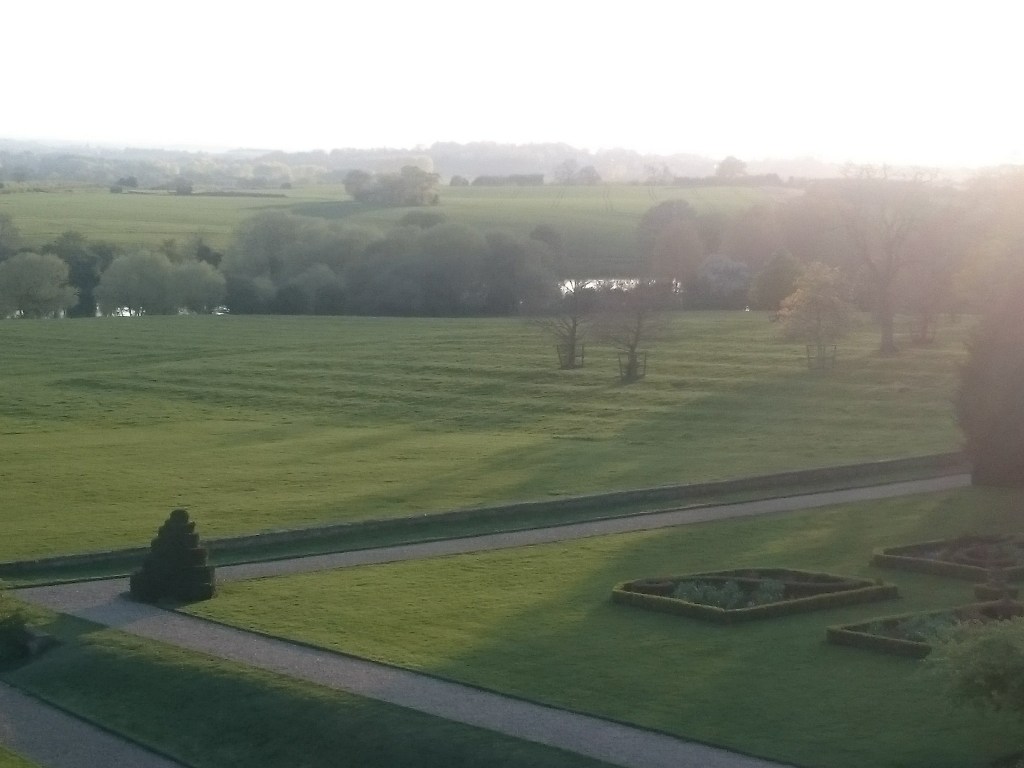
Ridge and furrow – a relic of mediaeval communal shared fields – within the private walled grounds of the National Trust’s Canons Ashby, Northamptonshire. An example of the historic privatisation of shared land

This contrasts of course with the much later enclosure movement when the wealthy took land out of common usage by the general population and asserted their direct ownership of it (often with the formal endorsement of acts of parliament – the law being used to enforce the demands of the powerful). Enclosure coincided with the agricultural revolution, making the productivity of the seized lands more than recompense the cost of the creation of the hedges, walls and fencing – and of the policing of the protests from the dispossessed population. Susanna Wade Martins in Farmers, Landlords and Landscapes reports that after enclosure, “Productivity could sometimes be doubled and rents went up by an equivalent amount.” That wasn’t the case with mediaeval seizures.

Parks in the mediaeval era were just as contested as the enclosed lands, though. As Creighton points out, “Many parks were recorded for the first time not when they were licenced or created, but when they were first broken into.” He suggests that poaching may have been just an assertion of continuing rights to seek food in emparked land.

Alongside this privatisation of land, from 1250, the elite turned more aloof, power and wealth enabling them to distance themselves from ordinary folk. Increasingly, the wealthy kept themselves apart, both in the siting of their own property and in the design of their buildings also. Creighton says: “an increasingly aloof aristocracy … was progressively increasing the social distance between the household and the world beyond the walls… This is part of a pan-European phenomenon evident at key lordship sites in France, Germany and Scandinavia and, in turn, part and parcel of a broader phenomenon of the increased privatisation of space, as manifested particularly clearly in the changing function of the hall and modes of domestic planning that enabled individuals to spend more time in individual rooms.” This period seems to coincide with a trend towards moated sites for elite dwellings – typically a symbolic separation rather than offering any degree of protection. This trend towards status symbols and separation was reflected in food also, for example it is at this period when the eating of more exotic birds becomes an activity for the elite, and the poor were excluded from certain foods.

This move is not to be taken lightly. In his The Archaeology of Power, John Steane discusses the ceremonial role of the lordship’s property, in particular the community role fulfilled by his hall, “the architectural expression of the household”. He quotes from William Langland, the 14th century supposed author of Piers Plowman, who criticises those lords whose halls have become a “sorry, deserted place” because “the rich nowadays have a habit of eating by themselves in private parlors”. The implications of the harm caused to community and society as a whole by this withdrawal are significant.

This was an age of remarkable unfairness. The majority toiled, a few did well – and increasingly turned their backs on the toilers, living very separate lives. It took a devastating event, or series of events, to reawaken fairness in our country. Those events were the repeated scourges of the Black Death (which first swept across Europe in the years either side of 1350), devastating the population and bringing enormous changes in its diseased wake.

I wrote in my last post about the impact of the Second World War in sweeping away some of our nation’s then ossified unfairness and injustice. And I noted that we must hope that it doesn’t take such an event to sweep aside the unfairness that has built up again in our society. The Black Death was a still more lethal and traumatic event that led to an even more remarkable reversal of inequalities. According to James Belich’s analysis in his remarkable and epic history of the consequences of the plague era, The World the Plague Made, around half of Europe’s population died from the initial outbreak of the plague (he spends a whole chapter justifying this conclusion, which is greater than the usually quoted one-third, a death toll that would have been remarkable enough).

As Belich explains, this halving of the population dramatically increased the value put on labour – meaning that the poorest suddenly began to be paid more. The poorest may have doubled their available spending capacity (even the smallest increment in pay for someone operating at subsistence levels will enable this), as well as giving them more leisure time; others fared better in absolute terms. The decrease in the availability of labour, and the increase in its cost, led to a productivity revolution – and with the same capital goods now shared between a halved population there was significant scope for such a productivity shift. This, together with increases in money available across the economy, led to a boom in demand for what had previously been luxuries available only to the few. Trade boomed, deploying the same shipping capacity for the benefit of the halved population. Many were freed from subsistence farming and agricultural patterns shifted to favour more specialisation.

Belich argues that it was the plague that led to Europe’s imperial dominance of the globe over subsequent centuries. One vehicle for this, he suggests, is that the fairness of the post-plague era lingered long enough in folk memories that it made ordinary people willing to risk everything to travel to far off lands in search of a better life, a life more like the less unequal era post-plague.

Those with Scottish and Irish heritage will no doubt baulk at this, pointing to the enforced movements caused by those great historic injustices the Clearances and the Great Hunger (the capital letters just a nod to their cultural significance) – and others will point to other causes in other lands. There’s truth that many travelled the world (and do so now as well as then) because their homeland no longer offered them a home, but both events came later than Belich intends. He is thinking about the start of the European imperial era, in the fifteenth and sixteenth centuries, when the journey itself was extremely hazardous, with around 30% dying even before they reached their destination – let alone the challenges of the precarious imperial outposts that were created. Those of course are the odds of those who travelled freely as free people, not of those who were enslaved, nor those of the indigenous peoples whose lands were taken from them.

European people travelled in spite of these odds, Belich believes, because they remembered the freedom and fairness that followed the horrors of the Black Death. A small hope for fairness will inspire many to action.

As we walk the countryside, we should recognise how it offers insights into past unfairness, and not the simple bucolic beauty that is all we sometimes see.

I am happy to confirm as ever that the Sense of Fairness blog is a purely personal endeavour.

Village, Hamlet and Field: Changing Mediaeval Settlements in Central England, Carenza Lewis, Patrick Mitchell-Fox, Christopher Dyer, Windgather Press, 2001

Designs Upon the Land: Elite Landscapes of the Middle Ages, Oliver Creighton, Boydell Press, 2009

Villages in the Landscape, Trevor Rowley, Dent, 1978

Farmers, Landlords and Landscapes: Rural Britain 1720-1870, Susanna Wade Martins, Windgather Press, 2001

The Archaeology of Power, John Steane, Tempus Publishing, 2004

The World the Plague Made: The Black Death and the Rise of Europe, James Belich, Princeton University Press, 2022

Unveiled: fleeced by power and business as usual

Business as usual is where – for the time-being at least – the money is, and in our world that means it is where the power is. That power gives business-as-usual a gravitational force even when good sense and science call out for change, and even when in the long-term it’s a losing game financially. Power leads us astray, and fairness requires that we find some counterbalance to this force. Only then will change come.

We see this gravitational force of business-as-usual most powerfully in the world’s climate negotiations. The vast majority of the world’s scientists tell us that we have no time to lose and that economies and business must change. The Pacific island nations and developing economies more generally (without the money that might pad them from the increasing physical impacts of climate change) are increasingly urging change. Unusual and devastating weather patterns are being felt worldwide. We cannot continue to pump the same levels of CO2 and other climate-changing gases into our atmosphere.

A carbon-constrained future will look economically very different, and the companies that prosper in its business-as-usual will differ from those that look good now. Yet the status quo predominates in the political process. Most strikingly, governments of the world have been content to allow petrostates to co-opt the climate COP process. The last two Conferences of the Parties Serving as the Meeting of Parties to the Kyoto Protocol (no wonder the COP abbreviation is preferred) have been held in the UAE and Azerbaijan, respectively the world’s 9th and 25th largest oil producers and perhaps more importantly with at least two-thirds of their economies dependent on fossil fuel industries. The chair of each conference was a senior executive in that country’s oil industry. It can be little surprise that agreements for rapid change to our fossil fuel-dependent economies have not been forthcoming.

The greatest thought experiment in fairness is John Rawls’s idea of the veil of ignorance. Those designing a just society must sit behind a veil of ignorance so that they are unaware of where they will fit in that society: this makes it most likely to be fair to all, Rawls argues. In our unveiled world, those with power, meaning those with money, continue to set the rules – and knowing that they will benefit, they continue to skew the world towards the status quo, which means in their own favour.

This favouring of the rich and powerful is of course nothing new. My latest secondhand bookshop purchase was a collection of three plays by the deeply unfashionable JB Priestley. Published in 1945, it is eager to make clear its obedience to wartime strictures. “This book is produced in complete conformity with the authorised economy standards” it reads. Like his most famous play, An Inspector Calls, there’s an undercurrent of class resentment and frustration with a status quo that keeps power in the hands of the old and frustrates youthful ambition and opportunity. We don’t always see those tensions in modern depictions of the interwar years, not least because they and we know all too well the changes that were to come as the war swept away past structures and strictures.

All three plays are terribly dated, displaying the careless heavy misogyny of that age, and an odd metropolitan superiority. But one still has interesting elements. Called The Golden Fleece, it is set in the eponymous hotel in Cheltingate Spa, a scarcely disguised Cheltenham. The title also has a second meaning, referring to the wealth generated from taking advantage of others (the play’s original title, Bull Market, at least to modern ears carries some of the same connotations of trickery). The Golden Fleece centres around a debate between those who feel justified in taking such advantage because that’s how the world works and those who are unwilling to do so because it would be better if it didn’t. It involves some stock market manoeuvrings that are certainly no longer legal, and seem barely credible even at the time (though that may simply be failures in the playwright’s understanding, or elisions in his story-telling).

Youth’s frustrations at age and tradition in the 1930s come out clearly from the ambitious young doctor, railing at a gouging tendency in private health (this was, of course, before the creation of the National Health Service). Talking about his doctor boss, Alec says: “He may look like a harmless old pussycat, but really he’s a pest and a menace. Instead of being a man of science, which he pretends to be, he’s something between an old charlatan and a rich old woman’s butler. He doesn’t speak or even think the truth. He doesn’t care about anything but fat fees and fat dinners. He’s an example of what’s wrong with this pussy-footed, rich old man’s country.”

But the core of the play’s arguments come from the mouth of a different character, who calls himself William Lotless. “Money! Money! It’s a servant that’s become a master,” says the scoundrel trader, for once using his skills for good – though rather tempted by the excitement to act just for the joy of it. Tongue loosened by alcohol but with his thoughts made staccato, he goes on:

“Money – was intended to be simply a sign, a token, a convenience – something like a – well a railway ticket. That’s all. But what’s happened to it? Got all out of hand. Become a source of power. The way we allow people to handle money as power, it’s just as if we let ‘em handle battleships and bombing squadrons for their own private benefit.”

Military images abound in a play written in the first months of the war. It’s impossible to read it now without thinking of the coming destruction of all that is established. It feels like, and is, a wholly different world from our own.

We know that the 1950s and 1960s brought strong economic growth that was broadly shared across the population. It may not have been entirely fairly shared (certainly not, for example, between the sexes), but economies operated largely to the benefit of all, not the few. The existing order was overturned by the war. Let us hope it doesn’t take such a destructive dislocation to shift the pull of the current business as usual; we need a veil of ignorance, or some other way to escape our ready tendency to listen harder to those who already have power through money, as that traps us in a business as usual that isn’t working.

I am grateful to my colleague Nick for the conversation where we linked COP to Rawls.

I am happy to confirm as ever that the Sense of Fairness blog is a purely personal endeavour.

See also: Power leads us astray: fairness lessons from Grenfell
Squid Game ‘fairness’
Sea level rise: the most unjust transition

The Golden Fleece, JB Priestley, 1940

A Theory of Justice, John Rawls, 1971

Justice as Fairness: A Restatement, John Rawls, 2004

Shortsighted failings lead to health unfairness

As a wearer of glasses since childhood, it comes as no surprise to me that human beings generally are shortsighted. I mean that not in the sense that we all need to wear glasses (though statistics on the way that our phone-obsessed indoor lives appear to be driving an epidemic of myopia mean that we may be headed that way), but in the sense that we avoid overloading our brains by only paying attention to what is near at hand.

We tend to ignore the distant, geographically, in terms of time, culturally, socially or emotionally, and we have to work hard if we want to lean against that natural tendency. We pay more attention to the near-at-hand, to people who look and sound like us and people who coincide with us geographically and timeously. This is a natural response: it is one of our common heuristics, methods of avoiding informational and other overloads. “human kind/Cannot bear very much reality,” as TS Eliot has it in his extraordinary Burnt Norton, one of his Four Quartets.

But that shortsighted, narrow-minded view means we miss much that matters. When we are facing global risks, parochialism is a dangerous mindset. Among other things, it seems increasingly that this human tendency continues to hamper our response to very real global health challenges.

Take mpox (the rebrand from monkey pox was perhaps an attempt to make it seem like less of a distant issue). There has been dramatically greater UK media coverage of a household of 4 mpox patients suffering from the more infectious and more potent Clade Ib version (a clade is an individual branch on the genetic family tree) of the virus, first revealed at the end of October, than there has of the almost 50,000 cases, and over 1000 deaths, in an outbreak in Africa, particularly in the Democratic Republic of Congo, over the last several months. A more still recent single case in Leeds alone has also gained greater coverage. The same is true in the US: a single case in California revealed in the late November has received notably more attention than the global situation.

The World Health Organisation declared mpox a public health emergency of international concern back in August, and reconfirmed that view at the end of November. Despite that, only a couple of days ago did WHO authorise the first vaccine for children against it – young children are particularly susceptible given it passes through close contact. Happily, in its farsighted wisdom Japan is funding 3 million doses of this new vaccine, developed by KM Biologics. As an aside, it’s worth recognising suggestions that the upsurge of mpox may be related to a health success: the eradication of smallpox has led to the vaccination programme against that disease ending, removing its suppressive effect on other poxes.

It’s as if we’ve learned nothing from the Covid pandemic: that in a global world there is no such thing as a localised virus outbreak, no such thing as a disease that will not travel. Even a virus that needs close contact like mpox will travel, though clearly much more slowly than airborne Covid and the like. And viruses adapt – just as bird flu has seemed to, leading to an infection of a Canadian teen who had no known contact with wild birds. It took that revelation for the Canadian government to invest significantly in bird flu research, something that it announced just the day after the teen’s infection was revealed. Outbreaks that may seem containable can rapidly become something more. Our response always seems to be a belated one, only when the danger is very near at hand.

Fairness argues that we should care about outbreaks of viruses that affect other communities in our shared world, but so does selfish good sense. We need not be so shortsighted.

I am happy to confirm as ever that the Sense of Fairness blog is a wholly personal endeavour.

I am once again grateful to the investment world’s Jiminy Cricket, Raj Thamotheram, for continuing to nudge me on matters of health and fairness.

Association between digital smart device use and myopia: a systematic review and meta-analysis, Joshua Foreman et al, Lancet Digital Health, Vol 3, Issue 12, December 2021

Burnt Norton, The Four Quartets, TS Eliot

UKHSA detects first case of Clade Ib mpox – now renamed Latest update on cases of Clade Ib mpox, UK health Security Agency, 30 October 2024 and subsequent updates

California confirms first Clade I mpox case, US Centers for Disease Control and Prevention, 16 November 2024

WHO Director-General declares mpox outbreak a public health emergency of international concern, World Health Organisation, 14 August 2024

Second meeting of the International Health Regulations (2005) Emergency Committee regarding the upsurge of mpox 2024, World Health Organisation, 28 November 2024

The eradication of small pox may have the set stage for the mpox outbreak, All things considered, NPR, 25 November 2024

Statement from the Public Health Agency of Canada: Update on Avian Influenza and Risk to Canadians, Public Health Agency of Canada, 13 November 2024

Government of Canada invests in research on avian influenza A(H5N1), Canadian Institutes of Health Research, 14 November 2024

Debilitating poverty

Being poor brings many disadvantages. A lack of money squeezes options and reduces opportunity. It hampers health and makes ambition harder. But the effects aren’t just direct and physical. They are psychological too. Researchers are beginning to uncover just how debilitating being poor is for effective thinking.

The answer to the question posed in the title Do Financial Concerns Make Workers Less Productive? was a resounding yes. Not only did poor workers whose money troubles were temporarily alleviated produce more, they also made fewer mistakes in production, despite operating more quickly. There is a clear business productivity benefit from this poverty alleviation; and in work that pays piece rates – where workers are paid for their useful output in numbers of products – this alleviation of worry also enabled them to earn more.

In a world of unfairness in which many are kept poor, these are significant findings. In a world seeking greater growth, where growth has been held back by stagnant productivity, they are still more important.

The increase in productivity shown was much greater than that brought about by an increase in the piece rate paid (which in a control experiment was done alongside a cut in base pay so that overall earnings were steady). There was a small increase in output following the piece rate increase, but it was less than a tenth of the change brought about by removing money worries – and there was no discernable increase in the quality of production, meaning this piece rate change delivered much less than a twentieth of the improvement in productivity that alleviating poverty did.

It’s worth noting that the researchers were able to discard alternative explanations of why these workers become more productive. In particular, they specifically discounted the possibility that improved nutrition of the poverty-relieved workers was the cause, because of the speed of the effect of the early payments and the lack of difference in nutritional intake in that short period. The effect is a psychological one: workers who don’t need to worry constantly about money are more productive.

This means that our economies are being held back by workers who are less productive than they could be, simply because they do worry about money on an ongoing basis. GDP growth is being artificially depressed and poverty alleviation could help it recover. This represents a business, investment and economic opportunity.

These findings are depressing. But it’s worse to find that growing up in poverty also has debilitating effects on children.

A recent study finds that poor students underperform their usual standard on maths tests that use real-world scenarios involving money, food or social interactions. It’s not a small effect, either: their performance is on average 18% lower than it is on questions overall – and, the researchers note, it would look even worse if they compared performance against just those questions that are more neutral.

These results were surprising to the researchers, who were expecting to see outperformance in these more practical questions, revealing hidden talent among poor students (they use the jargon low SES, socioeconomic status) that may be untapped by traditional education. That’s the reason why such questions have increasingly been used in modern testing: they are thought to be more accessible to all students. But the result of this study indicates that accessibility comes at the price of triggering distracting thoughts for poorer young people. As the chart shows, performance is worst with regard to questions that refer to money specifically.

Another recent study also found evidence of underperformance on money-linked questions by poor students. It puts this down to ‘attention capture’ as the researcher identified an effect not only on the specifically money-linked questions but also underperformance on more neutral questions asked subsequent to them. It seems as though the question reminds the students to worry about money, and they then can’t shake off the concerns.

These results amount to another example of apparent meritocracy in fact acting to limit the opportunity of those who start with less. As the Fictional Money, Real Costs paper states:

“Examinations are an efficient mechanism to benchmark and rank a population based on a specific set of skills. The notion that they are fair, however, has increasingly been questioned. A significant concern is that performance differences reflect inequities in the testing process itself, rather than differences in underlying skills, and thus may contribute to the intergenerational transmission of existing inequality.”

See also: Meritocracy’s unfair
Business and investment’s fairness challenge – and opportunity

I am happy to confirm as ever that the Sense of Fairness blog is a purely personal endeavour

Do Financial Concerns Make Workers Less Productive?, Supreet Kaur, Sendhil Mullainathan, Suanna Oh, Frank Schilbach, National Bureau Of Economic Research Working Paper 28338, January 2021

Math items about real-world content lower test-scores of students from families with low socioeconomic status, Marjolein Muskens, Willem Frankenhuis, Lex Borghans, npj Science of Learning, vol 9, art 19 (2024)

Fictional Money, Real Costs: Impacts of Financial Salience on Disadvantaged Students, Claire Duquennois, American Economic Review 2022, 112(3): 798–826

Business and investment’s fairness challenge – and opportunity

“We need a major repair that is not going to be found in the traditional economic models that consider the social impact of our decisions as something to be fixed ex post through social policies and redistribution. It needs a major change in the economic narrative, that brings equality and sustainability objectives on an equal footing with productivity and growth when measuring success. And it needs to bring in the private and the financial sector to change the way they define and measure their objectives and actions ex ante.”

So said Gabriela Ramos, Assistant Director-General for Social and Human Sciences of UNESCO, at the launch of the mouthful that is the Taskforce on Inequality and Social-related Financial Disclosures, or TISFD – an organisation she will co-chair – at the end of September.

Ramos went on to express the hope that the TISFD disclosure framework “will encourage organisations to consider the broader impact of their operations in an ex ante manner and make the social implications of business models transparent … We need to integrate the private sector and the financial sector in the solution because with that we can drive meaningful change that aligns economic progress with positive social impact.”

One of her fellow co-chairs, Arunma Oteh, former World Bank Vice President and Treasurer, and former Director General of Nigeria’s Securities and Exchange Commission, took the opportunity of the launch webinar to invite the investment and business communities to take part in the development of the TISFD standards: “By participating in this process businesses and financial institutions in my view will gain a deeper understanding of how social and inequality issues contribute to systemic risks that can affect financial markets and the global economy.”

Her aspiration is clear: “By standardising how organisations report on social-related issues we can also empower all stakeholders to hold businesses and financial institutions accountable for their social impact.”

These are not small ambitions. It’s clear that the new Taskforce will throw down a gauntlet for both business and the investment community, to think more deeply about the negative implications of business models and investment for society, and particularly the danger that the current approaches further foster inequality. In the language of this blog, the ambition is to instil a greater sense of fairness in business and investment.

Fortunately, there are a few voices from the world of business talking about these issues. Professor Scott Galloway, a successful tech entrepreneur – with an unusual humility for someone with that background – turned educator, is typically excoriating in a recent blog on the US minimum wage: “We have epidemics in the US — depression, anxiety, high blood pressure, homelessness, obesity, and poverty — among young people, particularly men. (Though it’s worth noting here that the majority of people making the minimum wage in the US are women.) The most powerful means of addressing these ills, and the ‘deaths of despair’ that follow, is a good job at a fair wage that acknowledges the nobility of work. In addition, a good job creates incentives and illuminates a path to wealth creation and economic security.” He is clearly referencing the work of economist Angus Deaton, and in doing so highlights the opportunity for investors: economies with fairer pay will prosper more. But Galloway is an unusual figure, in multiple different ways.

Peter Bakker, CEO of World Business Council for Sustainable Development (WBCSD), and former CEO of Dutch logistics firm TNT, talked about the creation of the TISFD arising out of earlier work of the Business Commission to Tackle Inequality: “One of the key conclusions out of that work is that the way that business makes decisions today, the way that businesses are managed, the way that capital markets look and value businesses, does not incorporate the social- and inequality-related risks, the dependencies and the impacts that business actually has on society and on people in it.”

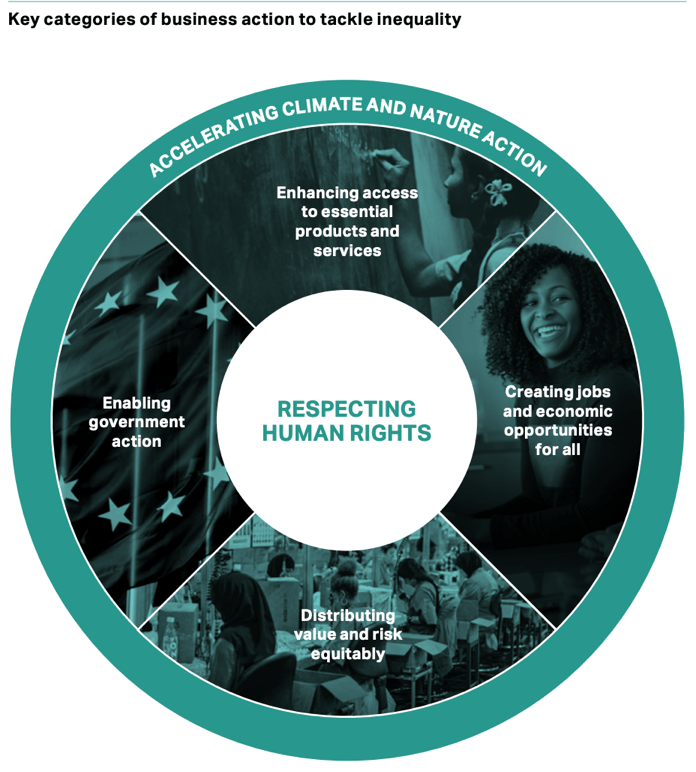
This image from the Business Commission to Tackle Inequality’s flagship publication shows the breadth of what that group sought to encompass. If anything, the breadth of the challenges that TISFD is intending to cover is still greater. The inclusive – even eclectic – nature of the issues covered by the new group readily demonstrated by the failure (at least so far) to find a streamlined name for the Taskforce. It represents the combination of separate groups, one considering inequalities and the other social issues. Of course there are multiple cross-overs between these areas but clearly neither group felt able to compromise over the name.

As well as the spread of its ambitions, the inclusive nature of the TISFD is also shown by the breadth of the backgrounds of the co-chairs. The fourth co-chair is Sharan Burrow, the redoubtable former General Secretary of the International Trade Union Confederation. She noted that TISFD’s aim goes far beyond disclosure: “If we think about it as an end process which is just disclosure then we’re not actually considering what the recommendations must do, which is actually to put up front the sorts of issues that ought to be taken into the business model, the externalities, the risks that must be accounted for in planning.”

Bakker agreed: “Do not make the mistake that TISFD is about disclosures or reporting, because that’s the mistake that everybody always makes in the sustainability world. The reporting bit is the end of a process in which better decisions are made and that’s how you influence the social impacts towards a more positive outcome.”

Bakker went on, and laid down the crucial challenge particularly for the investment world:

“It is partly corporate decision making, partly corporate disclosures, but it’s also about how financial markets will then pick up this decision-useful information and provide incentives for a much fairer and more equal and inclusive world.”

We will see if investors are ready to rise to this challenge.

See also: Deaton’s economics: fair criticism?

I am happy to confirm as ever that the Sense of Fairness blog is a purely personal endeavour

Taskforce on Inequality and Social-related Financial Disclosures

TISFD Launch Webinar, September 27 2024

Doing the Minimum, No Mercy/No Malice blog, Professor Scott Galloway, September 13 2024

Business Commission to Tackle Inequality

Tackling inequality: An agenda for business action, Business Commission to Tackle Inequality, May 2023

Is lobbying fair?

All participants in society have a right to make their views known, and to seek to influence politicians and other decision-makers. In fact, in many ways it is hard to see how politicians and regulators can fairly balance the interests of affected parties without hearing their perspectives. But that need for fair balance is crucial: those reaching key decisions need to hear all perspectives, and they need to be active in thinking whether they are actually doing so, or whether in practice they are hearing only from those with the loudest voices (often a function of having the greatest financial resources) or the most vested of interests – who will always be the ones with the greatest incentive to use all available powers of persuasion.

And decision-makers need to listen thoughtfully and actively to all perspectives in the full knowledge that there is a human tendency to give greater weight to the views expressed by the already powerful and successful. The wealthy have excess influence, through the greater resourcing they put behind expressing their views, but also because their apparent success (let’s remember, it may only be apparent success) lends them greater standing. The voices of ordinary citizens, who may be more fundamentally affected by political or regulatory decisions, are always relatively downgraded. And that’s even before we consider the recent phenomenon of fake grass-roots organisations that purport to represent ordinary folk but instead again promote the interests of the wealthy who fund them – so-called astroturf initiatives.

Even before an assassination attempt, it was clear that we faced oddly febrile times politically, with polarisation and starkly angry social media noise. That surely raises the stakes for all political lobbying, and should require caution by the powerful. It doesn’t seem to have done so far.

These are the reflections inspired by applying fairness considerations to some remarkable analysis of corporate lobbying by the good people at ACCR (the Australasian Centre for Corporate Responsibility). ACCR specifically invited me to think about their analysis of Shell’s lobbying activities – and the apparent gaps in that company’s transparency about it – which came out in March. Forgive me that it’s taken a while to think this one through.

Recent elections may have been fair, perhaps sometimes in spite of their electoral systems. But not all democracy is as well-established or transparent – and even long-standing democracies are not clean of allegations of impropriety (think of the UK’s pandemic era PPE-purchasing scandal, party funding from Kremlin-adjacent oligarchs or the grubbiness of minister Robert Jenrick signing off a housing development shortly after sitting next to its promoter at a Conservative fundraising dinner – in doing so overruling the planning process and the day before a new regime came into force that would have required the developers to pay the local authority £30-50 million to help fund local schools, community centres and other amenities).

Particularly where democracy and transparency are weaker, the powerful have additional influence, and perhaps excess influence. Fairness ought to dictate that they should wield that greater influence with greater circumspection. They should also be more transparent in their activities. Where they do not and are not, they will inevitably create concerns about the propriety and fairness of their actions. Any limit on full transparency may also invite concerns about whether their lobbying efforts are in fact in line with their stated policies.

That’s why ACCR’s findings on Shell are so troubling to an investor, and citizen: the research and shareholder advocacy NGO identifies multiple developing economies where the oil major has been active in lobbying organisations without being fully transparent about it – the title of the research says it all, really: In the dark: gaps in Shell’s climate lobbying disclosures. Given that such a high proportion of the oil company’s future activity will be in these developing economies, this failure to be fairly transparent represents a particular gap.

Source: ACCR, In the dark: gaps in Shell’s climate lobbying disclosures

As the chart shows, the research identifies at least 80 associations of which Shell is a member which conduct climate or energy lobbying which the company does not itself disclose. 45 of these are in emerging economies, and in many of them Shell takes a leading role. The 80 undisclosed memberships are in addition to 98 on which the company does make some disclosure.

The ACCR research identifies ways in which Shell’s emerging economy lobbying has influence both on the demand-side for fossil fuels and on the supply-side. This may be unsurprising given ACCR’s broader analysis of Shell’s strategy and capex indicates the scale of the company’s gamble on gas as a transition fuel. The lobbying includes support for increases in long-term LNG demand in southeast Asia; opposing transition from fossil fuels in China, Mexico and South Africa; expanding production across emerging economies including Brazil, Kazakhstan, Malaysia, Nigeria and Tanzania; and arguing for new exploration as a driver of economic development in Columbia and Namibia. As the study shows, the money spent on this is not visible to shareholders and other stakeholders:

Source: ACCR, In the dark: gaps in Shell’s climate lobbying disclosures

This invisibility bars shareholders from holding the company to account for this expenditure of money and raising questions about its consistency with stated policies. The invisibility also bars citizens from questioning the influence that corporations generally may be having on political and regulatory decision-making.

This company-specific analysis sits within a broader context regarding corporate lobbying and political influence – and I am not in any way intending to imply that Shell is worse than other companies. Investors want more transparency: it’s been notable this year how many shareholder proposals there have been at companies, from the US and elsewhere, seeking further visibility of corporate lobbying activities (some specifically regarding climate change, some lobbying more generally). For example, 41% of the non-founders of Alphabet supported such a proposal, as did 28% of Nippon Steel’s shareholders, 40% of those at Goldman Sachs and 45% of those at Morgan Stanley (once the holdings of Japan’s MUFG are set to one side). Again, I am not intending to imply that Alphabet, Goldman, Morgan Stanley or Nippon Steel are in any way particularly extreme offenders in this regard.

The issue of lobbying and political influence is most notably an issue in the US. Corporate governance guru Bob Monks has long railed at the negative influence of large companies on that country’s politics, and the commensurate limited constraints on corporate power exerted by politicians. He did so in his 2007 book Corpocracy, spectacularly subtitled How CEOs and the Business Roundtable Hijacked the World’s Greatest Wealth Machine – and How to Get It Back. This focuses ire on a US Supreme Court decision, First National Bank of Boston v Belotti, that enabled companies to engage in campaigns on state legislative ballot initiatives – the first step opening the door to full involvement in the political process by businesses. He writes: “today even the political process is largely in the control of corporate masters who fund campaigns, back “debates,” and stymie in every way conceivable their own regulation.”

In the book, Bob further said: “the Belotti decision appears on its face sufficiently absurd as to suggest that reversal is just a matter of time.” For once, Bob’s general prescience failed him, as Belotti was not only not reversed, it was in fact moved further onwards, this time in a federal law context, in the Supreme Court’s later decision in Citizens United v Federal Election Commission. And that case predates the latest successful corporate attack on regulation, facilitated by the Supreme Court: last month’s decision to overturn the 1984 precedent of Chevron v Natural Resources Defense Council, in effect removing the right of regulators to regulate without express Congressional authority.

Bob railed more strongly in 2022’s The Emperor’s Nightmare, a book that is subtitled Saving American Democracy in the Age of Citizens United. Citizens United was the 2010 Supreme Court decision that fully extended the right to free speech assured by the First Amendment to the US Constitution to corporate entities, in effect removing all limits on corporate spending on lobbying and political campaigns. It’s a fundamental human right, but corporations are not humans, only enjoying the benefit of legal personality, so it seems an odd decision to extend the First Amendment right to companies. As the dissenting opinion in the case, written by Justice John Paul Stevens, states: “A democracy cannot function effectively when its constituent members believe laws are being bought and sold.”

Bob spoke even more bluntly in his speech this week to the International Corporate Governance Network (read on his behalf in his absence by CEO of ValueEdge Advisors, Rick Bennett) accepting his Lifetime Achievement Award from that organisation. Entitled ‘American oligarchs prevail’, the speech began “American exceptionalism has been lost…” and identified the decisions in Belotti and Citizens United as the moments at which that loss started and accelerated.

Politics is about finding a fair balance between different interests. The powerful will always want influence – and power and wealth are automatically accorded respect and given extra weight in the way the balance is struck. But fairness requires that the balance is not struck in a way that is biased towards those corporate interests. Fairness further requires visibility and honesty from corporate actors about their activities – and their shareholders are asking for it. Bob Monks argues that bias is now firmly established in the US, and he calls to action investors to lean against this; perhaps that bias, and its pernicious effects, are less well established elsewhere, but without transparency it’s hard to tell.

At the very least, we need visibility on lobbying and the ability to hold it to account, and so limit its influence – probably both as investors and as citizens. Sadly, ACCR’s analysis suggests that such transparency is far from universal. That’s far from fair, and it risks propagating further fundamental unfairness in policy-making.

See also: Was the election fair?

Meritocracy’s unfair

I am happy to confirm as ever that the Sense of Fairness blog remains a wholly personal endeavour.

In the dark: gaps in Shell’s climate lobbying disclosures, Australian Centre for Corporate Responsibility, March 2024

Corpocracy: How CEOs and the Business Roundtable Hijacked the World’s Greatest Wealth Machine – and How to Get It Back, Bob Monks, Wiley, 2007

First National Bank of Boston v Bellotti, US Supreme Court, 435 US 765 (1978)

Citizens United v Federal Election Commission, US Supreme Court, No. 07-2240, 2008

Chevron USA Inc v Natural Resources Defense Council, US Supreme Court, 467 U.S. 837 (1984)

Overruled by: Loper Bright Enterprises v Raimondo and Relentless Inc v Department of Commerce, US Supreme Court, No. 22–451, 28 June 2024

The Emperor’s Nightmare: Saving American Democracy in the Age of Citizens United, Bob Monks, De Gruyter, 2022

Fairness in the blood

“When citizens have concerns that something has gone seriously wrong, fairness should mean that they get answers.”

The report (all 7 volumes and 2500 pages of it) have the words unethical, unconscionable and wrong echoing throughout – sometimes in the same sentence. This is the devastating report of the Infected Blood Inquiry, released last week, and it is a tough read from which few in authority emerge well. Particularly tough is Volume 2, which relentlessly relays individuals’ stories, mostly in their own words. Unethical, unconscionable, and wrong; in many cases, actions were simply inhumane, indeed cruel.

I had the privilege of being at the launch of the report. Though I am not a core participant in the scandal, being neither infected nor affected in the way the Inquiry’s terms have been drawn, I have followed it closely and witnessed both its start in 2018 and this closure. A good friend at university was one of the 380 haemophiliac children infected with HIV along with their Factor VIII treatment. Thanks to the miracle of antiretrovirals, he survived to 30 but the threat of death – and the stigma attaching to HIV and Aids through crucial years of his life – blighted Dave’s time with us.

The launch a week ago today certainly did provide some closure. As I said to the Inquiry staff, it was clear from the mood in Westminster Central Hall that afternoon that people felt they have been heard and that the truth has now been fully revealed – though, sadly, in both cases this was for the first time.

The quote that heads this blog is from Sir Brian Langstaff’s masterly speech at the launch. The relevant segment is worth reproducing in full:

“The failure of clinicians to tell people of the risks of infection from blood or blood products; the failure to tell people of the availability of alternative treatments; the failure to tell them that they were being tested for HIV or Hepatitis C; and sometimes, the failure even to tell them, or to tell them promptly, that they had been infected with HIV or Hepatitis by their treatment; the failure to explain these devastating diagnoses privately, in person and with sensitivity; these failures were widespread, they were wrong, they were unethical.

“The failures in decision-making that led to the original infections were then compounded by institutional defensiveness, and that’s a pattern of institutional defensiveness that must stop.

“When citizens have concerns that something has gone seriously wrong, fairness should mean that they get answers. People infected with blood and blood products did not. Instead, their trauma has been compounded by the lack of recognition of what happened to them and by a lack of accountability.”

Sadly, too often we have found in recent times that ordinary citizens have had serious wrong done to them and that rather than getting the answers that fairness demands, they have faced assertions that nothing was wrong and a closing of ranks by those with power. I have previously discussed the Post Office/Horizon IT scandal; similar failures of candour have become apparent in other cases. There is a natural human tendency to support and protect your own, both people and organisation. There is a natural human tendency to believe that your organisation has done the right things and not the wrong – perhaps particularly so when the consequences of those wrongs are so devastating. It is these human tendencies that lead to the institutional defensiveness that Sir Brian refers to. For organisations with such power over the lives of ordinary people, such institutional defensiveness must be wrong. Fairness requires that we have systems and leadership that leans against these human tendencies.

I don’t underplay the recommendations that Sir Brian makes with regard to future monitoring and treatment of those still suffering from their infections, for memorials to those who have suffered and in particular on reinforcing the safety culture in health services, notably through the duty of candour and by giving patients greater voice. But the apparent general problem means that his recommendations regarding the defensive culture in the Civil Service and government are perhaps of broad urgency and could have the widest impacts. In essence, though put in careful and lawyerly language, Sir Brian is pressing for statutory duties on both Civil Servants and politicians in government, specifically a statutory duty of candour. His relevant recommendations in full are:

  • The Government should reconsider whether, in the light of the facts revealed by this Inquiry, it is sufficient to continue to rely on the current non-statutory duties in the Civil Service and Ministerial Codes, coupled with those legal duties which occur on the occasions when civil servants and ministers interact with courts, inquests and inquiries, as securing candour.
  • If, on review, the Government considers that it is sufficient to rely on the current non-statutory duties in the Civil Service Code, it should nonetheless introduce a statutory duty of accountability on senior civil servants for the candour and completeness of advice given to Permanent Secretaries and Ministers, and the candour and completeness of their response to concerns raised by members of the public and staff.
  • The Government should consider the extent to which Ministers should be subject to a duty beyond their current duty to Parliament under the Ministerial Code.

I do not think it an accident that the chapter of the report that discusses the government response over decades to the concerns of those infected is called ‘Lines to Take’. The words ‘lines’ is remarkably close to the word ‘lies’, which is what the three key lines proved to be (that the infected had received the best treatment available, that infections were inadvertent, and that screening was introduced as soon as possible). When Sir Brian said at the launch that “all of those claims were untrue” (just following the segment quoted at length above) he received one of the longer of many periods of applause. These lines – lies – were pursued for years even after they had been proven wrong, and the long delay in setting up the public inquiry re-emphasised the institutional defensiveness (Sir Brian makes helpful recommendations on that too).

The memorial sculpture as created at the opening of the Inquiry; by the report launch, it had doubled in size as more individuals had added vials containing their own messages over the years of the Inquiry process.

He doesn’t quite say it explicitly in his recommendations, but it is clear that Sir Brian himself believes that there should be a statutory duty of candour on all civil servants and ministers, that they should not simply be expected to tell the truth but the whole truth, and to flag up the chain where they believe this hasn’t been done. Leadership must welcome such challenge, and not blame those who raise concerns (even if wrong) but rather blame those who know of a matter of concern and do not raise it. He accepts that in some circumstances telling the whole truth may have to be constrained by the public interest, but he expects this to be limited and he believes all those involved need to help “ensure that Government as a whole is candid”.

It’s terribly sad that this needs to be said – that a Civil Service and Government need to face calls and requirements to be candid in their dealings with ordinary citizens. But it is very clear, from this scandal and others, that it does indeed need to be said. And, as Sir Brian says, it is clear that fairness requires nothing less.

See also: Money is not the answer

Unfair trials: justice in the dock

The scandalous Post Office

I am happy to confirm as ever that the Sense of Fairness blog is a wholly personal endeavour.

Infected Blood Inquiry Report, May 2024

Sir Brian Langstaff’s speech, 20 May 2024
I am told that there is no plan to publish a written form of Sir Brian’s remarks, but this is the YouTube recording; the section I quote in detail appears from around minute 51.

The fairer CFO

The excellent people at the Board Intelligence Think Tank – a small unit, led by the wonderfully energetic Scarlett Brown, attached to a provider of technology to assist board information and so decision-making – have produced a great paper setting out the changing role of the Chief Financial Officer in business. It’s the latest in an ongoing project exploring the CFO’s role in relation to sustainability. In particular, the paper highlights the ways in which those in these crucial business roles need to consider fairness. Most vitally, it includes a 5-point ‘fairer future toolkit’.

At its heart, this fairer future toolkit calls on CFOs to think about value in their business beyond the short-term financial. Instead, it urges them to think about broader relationships that will foster value for their company over the longer-term. After all, their role, just as every other director of a business, is to promote the success of the company – not simply drive short-term financial returns, let alone inflate the share price. Slightly abbreviated versions of the five points of the toolkit are:

  1. Measure & report on social value
  2. Make non-financial metrics matter
  3. Flex your spending muscles
  4. Take a long, hard look at your tax strategy and conduct
  5. Use your voice to tell a different story

The paper is powered by interviews and roundtables with more than 150 CFOs from across the full range of businesses, and its driver is a recognition that the role of the CFO has changed and is changing. No longer a pure numbers role, especially not simply in relation to just the financial numbers, the CFO has for some time needed to be thinking about risks and strategic planning – and the need to recognise the importance of stakeholder relationships in both. With the advent of more systematic requirements for reporting of sustainability factors, this need to think more broadly is only growing.

There are close parallels here with a recent blog from recruiters Odgers Berndtson on the private equity industry. Not least given the big rise in the cost of debt, the authors argue that private equity needs to move on from its focus on financial engineering and short-term returns to the opportunities for value creation through operational performance, particularly through investing in people. “PE leaders should shift the focus from pure cost-cutting to operational efficiency, allowing for long-term profitability without sacrificing jobs,” they say. Later they add: “As scrutiny on PE practices grows, we expect more demand for leaders with proven experience of balancing financial returns and responsibility.”

There are quotes throughout the Board Intelligence paper from the CFOs of an impressive array of businesses, and there are fuller versions of many of the interviews from which these come at the home page of the think tank’s broader project on CFOs’ role in building a fairer future.

There is clearly most agreement on the first two of the five points. On 1, which in full is “Measure & report on social value (even though it’s hard)”, Andy Agg, Group CFO of National Grid, says: “It makes complete sense to apply the finance function’s skillset to non-financial data. It provides reassurance that it has been subject to the same series of robust controls and standards that we apply to financial data.” And on 2, “Make non-financial metrics matter – for everyone”, Jeff Davies, Group CFO of Legal & General, says: “CFOs are recognising that it’s their responsibility not only to report against things like sustainability or diversity and make sure the numbers are accurate, or help decide what the target should be, but also to help the company achieve those targets.”

If this sounds to some like a power grab, actually I’ve heard the same from corporate heads of sustainability – many of them welcome having passed over responsibility for reporting to finance and agree it’s the better place to carry that burden. However, it may still be early to be talking about the ‘same series of robust controls and standards’ as applicable to emergent metrics as to the financials. Having worked closely with a client on attempted assurance of its Task Force on Climate-Related Financial Disclosures (TCFD) report, neither the measures nor the assurance of them are yet mature.

It appears that the second two points of the toolkit are more contentious – or at least that fewer CFOs of purely commercial organisations are prepared to go on the record about them. Key to 3, “Flex your spending muscles (for good)”, is responsible and long-term relationships with the supply chain (I’ve written previously about the economic madness of late payment by large business). “Supply chain fragility is an issue post-Covid. But the strong relationships we built with suppliers through the pandemic — by making sure we were communicating with them and paying promptly or earlier — have really helped us now,” says Brad Greve, CFO of BAE Systems.

It’s a shame more CFOs don’t seem willing to talk about responsible tax (another topic on which I’ve written previously). It shouldn’t be controversial to discuss and deliver on 4, “Take a long, hard look at your tax strategy and conduct”. Sadly, it still seems an area on which corporate executives acknowledge the need to change, but rarely go on the record about. But as Joel Ripley, CFO of Schroders Personal Wealth says: “If you don’t pay your fair share of tax, what’s the point of being environmentally responsible? It’s in the CFO’s gift to make sure our company’s tax conduct is responsible and ethical.” Happily, at least off the record, other CFOs do seem to recognise their role in this area.  “They see their role as setting the right tone for the company’s tax conduct — deciding if it is responsible and ethical, and taking action when it falls short,” the report states.

The fifth and final point of the toolkit, “Use your voice to tell a different story” is perhaps the most interesting because it is less immediately tangible than the others – but may be all the more powerful because of that. The influence of the CFO is vast in most organisations and can be used to help the business focus on what matters, especially if the CFO chooses to focus on areas that are not traditionally the purview of finance. “The CFO can raise the profile of sustainability and responsible business simply by being a visible part of the debate. I’m on the steering committee for our ‘Do What Matters’ plan. As CFO I have to be able to clearly articulate the business case for pursuing these objectives, while also demonstrating commitment to these aims in investment allocation,” says Declan Hourican, CFO of TSB Bank.

The Board Intelligence paper is clear evidence of a great deal of fresh thinking, and it is certainly thought-provoking. Hopefully CFOs broadly rise to its challenge to address their opportunity to help deliver a fairer future.

See also: What’s the purpose of purpose?

Demanding supply

Talking with the taxman about fairness

People matter – but not like that

I am as ever happy to confirm that the Sense of Fairness blog is a purely personal endeavour.

What does the CFO’s changing role mean for you?, Board Intelligence Think Tank, 17 April 2024

What is the role of the CFO in creating a fairer future?, Board Intelligence Think Tank

How to balance returns and responsibility in private equity, David Bell, Pieter Ebeling, Annemarie Depue, Odgers Berndtson, 30 April 2024

The fairness, the entire fairness, and nothing but?

So, we know that the pay award to Elon Musk by Tesla’s board, to a value that turned out to be over $50 billion, was not entirely fair. The Delaware court has told us this, applying the wonderfully named ‘entire fairness doctrine’. But in proposing that shareholders again approve the award, the Tesla board says that its reinstatement is a necessary step to be fair to Musk.

This is set up as a battle of fairnesses. Is it? I’ll try to break the answer to that question down.

Proxy Statement arguments

When reading the Tesla Proxy Statement, it appears that the board doesn’t believe it has a case to answer, even though it has lost one. Robyn Denholm, in her chair’s letter that opens the Proxy Statement, says that restoring Musk’s pay award “is a matter of fundamental fairness and respect to our CEO”. Further, the voiding of the scheme was “fundamentally unfair, and inconsistent with the will of the stockholders who voted for it”.

None of the damning Delaware court findings (essentially that there was no negotiation process with Musk on the pay scheme, those board members charged with the process of developing the pay plan were not fully independent of him, that some of the performance metrics were not in fact stretching, and that shareholders were misled in the company’s communications, so that their approval of the deal was void) are in any way addressed by the Tesla board in their formal communication. The Proxy Statement explicitly confirms that there has been no attempt at a renegotiation of the pay scheme with Musk. The sole nod to the court’s findings is the creation of the new so-called ‘independent Special Committee’.

This new ‘independent Special Committee’ is not worthy of at least one of those words given that the ‘committee’ was personned by just a single director, Kathleen Wilson-Thompson. Director Joe Gebbia withdrew from the committee when its remit was expanded from the question of whether Tesla should redomicile to Texas (discussed further below) to also include Musk’s pay. “Mr Gebbia explained that he was stepping down from the Special Committee out of an abundance of caution because of the potential for unfair attacks based on perceived conflicts of interest. He stepped down entirely of his own accord,” the Proxy Statement reads.

The Proxy Statement does note that the Delaware court found failures in its processes and invites shareholders to read relevant parts of the Tornetta decision (and publishes that decision in full as an appendix). But it does not directly respond to those findings, which are damning about the board’s behaviour and processes. In failing to deliver ‘entire fairness’, the court found that the board failed to deliver both a fair process and a fair outcome. The Proxy Statement doesn’t seek to demonstrate the fairness of either, only that the proposed remuneration scheme was unusual and unusually stretching in the US (such as including features which are unusual in the US but pretty normal in non-US markets such as a five-year time horizon and extended shareholding periods). The court strongly doubted the need for such a scale of award in order to retain Musk’s services for Tesla – which had seemed a strongly motivating factor in the board’s decision-making. After all, Musk owns more than 20% of the company and this shareholding represents well over half of his net worth.

On that issue of Musk’s major shareholding, the Proxy Statement’s main argument that the pay scheme needs to be resurrected is that Musk has received no reward for the extraordinary market capitalisation increase of Tesla over the period since 2018. This absence of any recompense is the source of its argument that fairness requires the scheme to be revived. It does ignore the fact that as 20% shareholder, Musk’s overall wealth increased by more than $100 billion as the value of the business grew from around $55 billion to $650 billion (even for a brief while over $1 trillion) over the life of the scheme. For the board, this share value appreciation is apparently not sufficient to satisfy fairness – though the court explicitly noted it as a reason why setting aside the pay scheme was an equitable remedy.

The Proxy Statement summarises the Tornetta findings but does not directly respond to them. In effect, while the board says it intends to appeal the findings, the proposal to the shareholders is simply to confirm the pay scheme without addressing any of the fairness questions raised by the court. So in order to unpick things more fully we need to consider the Delaware court’s judgement and the evidence that it considered.

The entire fairness doctrine is brought to bear because Musk was found to be a controller of Tesla, and the pay scheme amounted to a conflicted-controller transaction. Such transactions can only be pursued if that is done in an entirely fair way – both the process and the outcome need to be fair. Let’s look at each.

Was the process fair?

While it summarises much of the Tornetta decision, the Proxy Statement provides none of the detail of the questions raised about the independence of the individuals charged with leading the ‘negotiations’ on the scheme.

It’s important to note that while the Delaware court reflects evidence about the question of directors’ independence, it reached no absolute conclusion on this point directly because it found that the entire fairness doctrine applied because of its finding that Musk is a controller of Tesla. It did, however, make findings about whether the directors were beholden to Musk. Investors are likely to draw conclusions regarding independence from the court’s finding that directors were either “beholden” to Musk or “acted beholden” to him with regard to the pay scheme.

The court sums up its finding about the effective independence of the board in the pay scheme process: “Put simply, neither the Compensation Committee nor the Board acted in the best interests of the Company when negotiating Musk’s compensation plan. In fact, there is barely any evidence of negotiations at all.” The form and shape of the pay scheme were largely what Musk had suggested to the chair of the compensation committee at the start of the process, with only minor amendments over the time between that and its approval.

These directors’ main go-between to Musk, who also drafted most of the documents the company leant on to argue that its decision-making was fair, was Tesla’s general counsel. This individual, Todd Maron, was Musk’s former divorce lawyer who held back tears both during his deposition and at trial, in discussing the pain of his 2019 departure from Tesla, and the depth of his positive feelings about the company and its executives.

The Delaware court makes clear that the process of developing the pay plan, including a precipitant timetable, and then a slightly slower but still aggressive timetable, were driven by Musk, not by the committee. The court raises significant doubts as to the independence of the process by which the proposals were tested on institutional investors as they were progressed (for example, it states: “the script reads like a loaded questionnaire intended to solicit positive stockholder feedback and not a method for gaining objective stockholder perspectives on a potential new plan”).

The court also found key gaps in the proxy statement disclosures on which shareholders based their decision to approve the 2018 plan. These included failures to disclose questions about independence of directors from Musk, the nature of the discussions of the plan (particularly their origin as a proposal from Musk himself), and the ease with which Tesla believed it could achieve the operational targets (they were instead stated to be “very difficult to achieve”). Investors were not fully and fairly informed by the 2018 proxy statement, so their approval of the pay scheme isn’t sufficient to overturn the findings of unfairness.

The process was not fair, in multiple ways.

Was the outcome fair – essentially, was the quantum fair?

Musk set the scale of the pay scheme award, initially calling for 15% of the company in 1% increments and then later seeking 10% on a fully diluted basis. The board chose 12% because it preferred to calculate based on issued shares rather than the more complicated diluted basis. No one throughout the process seemed to question this order of magnitude of award. Again, this was not a fair and independent process, but is the outcome, the quantum, fair?

Looking at the current circumstances provides helpful context on this. Musk seems again to be directing matters, including directing the scale of any future awards. In the Proxy Statement, Tesla states that Musk has indicated he would expect any replacement incentive, should the current proposals fail, to be of a “similar magnitude to the 2018 CEO Performance Award”. Oddly, it is clear from the rest of the discussion of the potential costs of such a possible award, that this doesn’t mean a similar order of value in dollars, but an award of the same number of shares: 303 million (at least, this is the equivalent number of shares following repeated share splits). This would have a value at award date of around $25 billion rather than the value at award date of the 2018 award of a still extraordinary $2.3 billion (according to the Proxy Statement, $2.6 billion according to the Delaware court).

As a brief aside on that slight discrepancy in the reported fair value at grant of the awards ($2.3 billion or $2.6 billion – though what’s $300 million between friends?), one of the key interventions by compensation committee chair Ira Ehrenpreis, who was leading the board’s supposedly independent working group on the pay scheme, seems telling. The court reports “a request from Ehrenpreis for “creative options” they could employ to “solve for getting a bigger discount” on the publicly reported grant date fair value”. This appears to be one of the drivers for the unusual (at least in the US context) five year holding period for the shares. The sense that the numbers presented to shareholders were subject to manipulation to put the proposals in the best light, rather than presented fairly and straightforwardly, seems strong.

The Delaware court states (my emphasis added): “With a $55.8 billion maximum value and $2.6 billion grant date fair value, the plan is the largest potential compensation opportunity ever observed in public markets by multiple orders of magnitude—250 times larger than the contemporaneous median peer compensation plan and over 33 times larger than the plan’s closest comparison, which was Musk’s prior compensation plan.” The mooted replacement award would be 10 times larger than this, i.e. more than 2000 times the now-increased median.

Oddly though, the Delaware decision reports that at trial, Musk stated “unequivocally that he would have remained at Tesla even if stockholders had rejected a new compensation plan”, because of his heavy investment in the company “both financially and emotionally”. And the Delaware court reports that there is no evidence that the compensation committee even considered the question of whether additional pay for Musk was needed, given his existing share ownership in the company; this question was put to them belatedly in the process by their compensation consultant, but apparently not discussed. “The most curious thing about this question is that there is no evidence that any director deliberated over it, and it did not appear in any other Board or committee materials,” the court states.

Even though the board’s stated intent was to keep Musk as a fully engaged CEO, the terms of the pay scheme in fact permitted him to stand down to the role of chief product officer.

So this extraordinary quantum of award was not necessary to retain and motivate its recipient, and it was not in practice designed to do so. There was no negotiation over quantum, nor even any real discussion of it. In these absences, the quantum cannot be said to be fair.

Broader applications of fairness

Investors shouldn’t place too many expectations on this case for setting broader precedents on the willingness of the US courts to intervene on matters of executive pay. The judge states that “A board of director’s decision on how much to pay a company’s chief executive officer is the quintessential business determination subject to great judicial deference.” The entire fairness doctrine was triggered in this case by Musk’s dominance of the board’s decision-making. Even in a market where corporate culture facilitates unusual dominance by corporate leaders, Musk’s position at Tesla is unusual.

Instead, at most US companies, the burden of determining what is and isn’t fair will remain with the board, and with investors. The Delaware decision may lead to a little more circumspection among US corporate boards, but it won’t lead to a transformation.

Instead, we will need to continue to rely on investors to try to hold the line on what level of executive pay is fair. As I’ve discussed previously, many don’t have a great record on that. And it’s notable that the Tesla case itself was not sparked by any institutional investor; rather it was brought in the name of an individual, Richard Tornetta. Institutions should be grateful to Tornetta, to the collective tune of over $50 billion, for raising questions about the pay deal. The case was legally a derivative action, so that while it was brought in the name of a single shareholder it was actually carried forward in the name of the company itself, on behalf of all shareholders, and the value of the decision accrues wholly to Tesla.

What might the investor approach be to the forthcoming AGM?

Investors will be faced with a number of key resolutions at the AGM, now set for June 13.

Investors will have to decide whether they can support the re-elections of the board. This may be particularly challenging given the court’s finding that directors are either “beholden” or “acted beholden” to Musk in relation to the pay scheme. The two directors up for election (Tesla being one of the unusual companies in the US with a so-called classified board, meaning not all directors stand for election each year) are James Murdoch, whom the court found to be “beholden” to Musk given their close personal relationship, and Kimbal Musk, Elon’s brother.

The second key decision at the AGM is the plan to shift the domicile of Tesla from Delaware to Texas. The so-called ‘independent Special Committee’ also worked on this resolution. We are told this proposal is not as a fit of pique because of the Delaware court decision, though Musk polled his X (ex-Twitter) followers on the domicile question almost immediately after that court decision. The board takes up 40 pages of the Proxy Statement to explain the detail of its entirely independent thought processes which have ended up in making the same proposal to shareholders as Musk had asserted the company would following the 87% support of his poll of followers.

Given how effective the Delaware court has just proven to be in protecting shareholder interests, it would be surprising if institutional investors welcomed a move to the unproven corporate law jurisdiction in Texas (as the Proxy states, “Texas’s business courts were just created and will not start hearing cases until September 2024”). Further, those shareholders who care about the existence of multiple share classes and the differential voting rights often associated with them may be interested to note that the draft articles of the intended Texas reincorporation include the creation of a separate class of preference shares, with the board having explicit powers to determine all characteristics of these shares as and when issued, including voting rights (Tesla currently only has one share class). Investors will need to consider if they trust this board to exercise that broad discretion fairly and well.

There are a number of shareholder resolutions, perhaps most notably one considering the Tesla policy on freedom of association and collective bargaining, and one regarding anti-harassment and discrimination efforts.

But inevitably, the main focus of attention will be on resolution 4, which seeks to reinstate the Musk pay scheme. While the Proxy Statement sets this up as a battle of fairnesses, in perhaps a first for this blog, I suggest that shareholders – at least institutional investors – do not in fact need to think about fairness when considering this proposal. They just need to think about their fiduciary duties.

It seems to me impossible to understand how any investor motivated by fiduciary duties can vote in favour of the proposed resurrection of the pay scheme. Whether it was right in the first place – and the court’s holding that it was not entirely fair is robust, and oddly unchallenged in its details by the Tesla board – the proposal now is to make an award to an individual for value that has already been created (and some of which has since dissipated given more recent share price falls). The proposal will create no new value for shareholders, rather it is simply to give money away for no benefit. That is not a fiduciary-led decision. While it is still called a 100%-performance linked award, there is no performance still to be delivered.

The clients to whom those fiduciary duties are owed may well seek particularly robust justifications from any fund manager that decides to vote in favour of making a gift – especially such a sizeable gift.

One further unfairness?

As a final brief comment, at some time this summer (most likely), the Delaware courts will assess the fees due to Bernstein Litowitz Berger & Grossmann LLP for their work on the Tornetta case. The law firm has claimed around $5.5 billion for protecting shareholders from the cost of more than $50 billion through the pay scheme; that is calculated by looking at percentages of awards previously allowed as costs for lawyers, but is clearly an extraordinary sum (it amounts to some $275,000 for each of the near 20,000 hours apparently worked on the case). Whether the courts – and shareholders – regard this as fair, let alone entirely fair, remains to be seen. The Proxy Statement notes one benefit of the reinstatement of the pay scheme as being that this legal cost would not be faced; whether that’s true, and whether it is sufficient justification for the board’s proposal, seems highly debatable.

See also: The madness, let alone unfairness, of US executive pay

The Gini in the executive pay bottle

The unfairness of dual class shares

I remain happy to confirm that the Sense of Fairness blog is an entirely personal endeavour.

Tornetta v Musk, C.A. No. 2018-0408-KSJM, 2024 WL 343699, Delaware Chancery Court, January 30 2024

Tesla proxy statement (DEF 14A), Securities and Exchange Commission, April 17 2024

Bernstein Litowitz Berger & Grossmann LLP on Tornetta v Musk

Tornetta v Musk is the Rule of Law at Work, Holger Spamann, Harvard Law School Forum on Corporate Governance, February 27 2024

The Bill comes Due, Ann Lipton, Oxford Business Law Blog, February 2 2024

Deaton’s economics: fair criticism?

It is remarkable that the International Monetary Fund, one of the bastions of our modern economic construct, should be so willing to test and challenge current economic thinking. But that is what it does in publishing a striking short blog by respected economist Angus Deaton. Deaton is best known for his remarkable work on the US epidemic of what he has dubbed deaths of despair and he also led a recently-completed eponymous review of inequality for the Institute of Fiscal Studies. Deaton offers what amounts to an apologia for modern economics, and suggests some routes that may be more productive for the future. Not only might they be more productive, I would suggest that they are also likely to be fairer.

In the blog, Deaton questions mainstream economics. He does so from a remarkably mainstream position. He won the Nobel Prize in 2015, and is a professor at Princeton. His criticism of the failings of current economics, and not least of current economic education, should therefore hit home.

The core of Deaton’s points are made in crisp discussions under a handful of bullet-point headings. These are: power, philosophy and ethics, efficiency, empirical methods and humility (doesn’t our entire world need a whole lot more of that last?). He comes most crisply to his point in the first of these: “Without an analysis of power, it is hard to understand inequality or much else in modern capitalism.” But the bullet points reflect a continuity of thought, not separate ideas. He complains at the loss of ethical thought from economics and its replacement by an emphasis on efficiency and a simplifying focus on the financial: “We often equate well-being with money or consumption, missing much of what matters to people.”

Under efficiency, he states:

“Many subscribe to Lionel Robbins’ definition of economics as the allocation of scarce resources among competing ends or to the stronger version that says that economists should focus on efficiency and leave equity to others, to politicians or administrators. But the others regularly fail to materialize, so that when efficiency comes with upward redistribution—frequently though not inevitably—our recommendations become little more than a license for plunder.”

I think that quote bears rereading.

Applying these five approaches as a new lens for approaching questions, Deaton reaches a range of fresh conclusions – or rather a reduced level of certainty – about a number of different issues. These include: unions, free trade, global poverty and immigration.

But though it is not among these bullet-points, or the issues about which Deaton now has less certainty, to my mind one of the most notable single words in the piece is ‘efficacy’. Deaton says: “today we [economists] are in some disarray. We did not collectively predict the financial crisis and, worse still, we may have contributed to it through an overenthusiastic belief in the efficacy of markets, especially financial markets whose structure and implications we understood less well than we thought.” Normally economists and investors talk about market efficiency, and certainly the financial crisis was in part due to overconfidence that markets are efficient, that they will find the right prices for things. The efficient market hypothesis – which many investors take as a certainty, even though it is merely an hypothesis, and even though there would be no ability of active investors to outperform if it were true (admittedly many are more lucky than genuinely generate outperformance, but nonetheless it is still possible to outperform a market). The crisis showed that market pricing can often be very wrong and the use of market prices as a foundation for valuations can be risky.

Deaton is clearly referencing the Efficient Market Hypothesis (and the use of ‘efficiency’ as one of his bullet-point headings makes more notable his decision not to use the term in his comment about the disarray of modern economics), but he is actually making a very different point. He is asking whether markets are always efficacious, whether they work and always add value to human society. And his clear view is that they are not always, and do not always. We should listen, particularly those of us who work in financial markets.

Deaton has never minced his words, but here he is remarkably cruel about his profession. He says he does not want to get into the question of corruption among his peers, though he notes that allegations “have become common in some debates”. But he does state, bluntly: “economists, who have prospered mightily over the past half century, might fairly be accused of having a vested interest in capitalism as it currently operates”. In a blog that clearly has real concerns about the operation of modern capitalism, that fair comment is one that should hang over the profession, challenging all to rethink with the confidence and honesty that Deaton has.

See also: Meritocracy’s unfair

I’m happy to continue to confirm that the Sense of Fairness blog is a purely personal endeavour.

Rethinking my economics, Angus Deaton, International Monetary Fund blog, March 2024

Rising morbidity and mortality in midlife among white non-Hispanic Americans in the 21st century, Anne Case, Angus Deaton, Proceedings of the National Academy of Sciences, Vol 112 No 49, December 2015

Deaths of Despair and the Future of Capitalism, Anne Case, Angus Deaton, Princeton University Press, 2020

Deaton Review of Inequality, Institute of Fiscal Studies