Women in leadership boost performance

An excellent Private Sector Opinion document from the IFC, a meta-analysis of the research revealing the business benefits of diversity on boards and among management teams.

screen shot 2019-01-14 at 16.45.55

It was an honour to provide the Foreword for this document:

“The ongoing discussion about diversity—and, more broadly, about the importance of environmental, social, and governance performance—plays to a growing sense that the business world should be less distant from the population as a whole and that there is a growing need to be energized by a sense of fairness. A business world that more fully reflects its community and customers is more likely to be seen as fair and trusted.”

Tales of local heroes

It’s a question of scale. Like Gulliver in Lilliput, it is almost impossible for large organisations to conceive of the impact that they may have on small ones. Sometimes that impact can be devastating.

This thoughtful, mournful article reveals that we are all potential giants in the Internet world, sometimes able to damage without being aware of it.

The article discusses the demise of what was said to be the greatest burger joint in America. It is more than worthy of the investment of time in reading it. While the editorial note that now heads the page adds a further set of factors regarding the demise of Stanich’s, the core theme and tone of the story focuses elsewhere and holds some interesting truths.Screen Shot 2018-12-28 at 17.23.23

The article discusses the impact that all those clickbait lists that all internet users love can have — and the tendency that the readers of such lists often have to use them as checklists while ignoring what may be just around the corner.

It talks about individuals who serve local communities and do not want any more than that. It highlights though that the scale of modern media reach is such, and our checklist culture is such, that it is hard for the really good community businesses not to be impacted when their greatness is recognised.

It is impossible not to sympathise with the ceviche chef Jose Luis de Cossio who stopped serving ceviche when a selection as best restaurant made it impossible to serve his community. I personally love ceviche (as so much that comes from Peru), but some of my favourite restaurants have been those just around the corner from home.

We see the same harm from checklist behaviours in the damage that the weight of tourists have on some of our most beautiful places. Barcelona, Venice and Dobrovnik to name but three fantastic cities now struggle to manage the numbers wanting to visit. I’m not suggesting that it was all better when few could afford to travel — and I personally fully intend in due course to make it to the one of these three that has not been marked off my personal checklist. But it is amazing how narrow-minded we are; I am told that the National Trust now limits its core maintenance activities to 100 metres from its car parks because in a bizarre version of the pareto principle 90% of visitors do not walk further than 80 metres. We simply do not look beyond the near at hand or the obvious.

And in the Internet world the near at hand and obvious is frequently provided by clickbait lists rather than the evidence of our own senses. Our willingness to seek out for ourselves is too often supplanted by the ready reckoners provided by others.

In one of my favourite ever Letters from America the great Alistair Cooke began by saying there was something that he ought to talk about and something he must talk about (the delightful Workers, Arise! Shout ‘Fore!’ from December 1974). This blog is written in the same spirit. Having happened across the article on Stanich’s it has worried away at me and required me to share it. While not directly on fairness, it nevertheless seems relevant to some of the ways forward regarding our economic system, and the challenges that we currently face. 

I suspect that localism and appropriate scale will turn out to be part of the answer of having an economic system that works for all. In order to foster the success of local business, the Stanich’s story reminds us that localism is challenging in an internet world — just as the web offers an outlet for small manufacturers and artisans, internet success will challenge production levels and quality standards. Perhaps the challenges of scale was ever with us, but with global reach within easy reach, we may find Gulliver crushing more Lilliputians than he sustains.


Web address for the story of Stanich’s:

https://www.thrillist.com/eat/portland/stanichs-closed-will-it-reopen-burger-quest

Just transitions and gilets jaunes

A fair approach to climate change policy

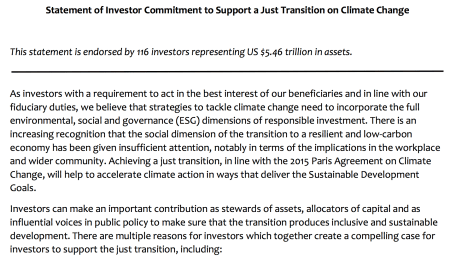
A former colleague asked me a few months ago about the Just Transition on Climate Change. We chatted about fairness and justice and its implications. In the end, their investment institution did not sign up to the investor statement in this respect. And that put them in perhaps a minority among ESG-minded investment institutions, for when the Investor Statement to Support a Just Transition on Climate Change was launched in the outskirts of the Katowice climate change summit, the latest COP or conference of the parties to the UN Framework Convention on Climate Change, it was signed by 116 investment institutions with some $5.46 trillion assets under management.

The concept of a Just Transition in effect means taking into account social issues in the approach to climate change. In the increasing way of these things, the investor statement is no more than a signal and in effect commits the investment institutions to nothing in particular. Rather, they assert that they will integrate just transition concepts into one or more of their investment approach, capital allocation, company engagement activities, public policy campaigns or transparency. We shall see whether it will indeed change behaviour.

Screen Shot 2018-12-15 at 11.01.24The Just Transition idea originates with the organised labour community: in 2013 the International Labour Conference adopted a set of conclusions seeking to ensure that labour issues are embedded in any move towards a more sustainable economy. As paragraph 4 reads:

“A just transition for all towards an environmentally sustainable economy … needs to be well managed and contribute to the goals of decent work for all, social inclusion and the eradication of poverty.”

Nick Robins and others at the excellent Grantham Research Institute on Climate Change and the Environment deserve particular credit for bringing this issue to the fore in investor thinking. But perhaps the activities of the gilets jaunes in Paris and across France have made the need for fairness and justice in climate change policy more apparent to all.

The catalyst for the street protests by campaigners without any formal leadership and self-identifying by wearing the high-vis vests that all French drivers must carry was an increase in fuel duties. But the disquiet that they were so vigorously expressing seemed rather more broad-reaching. Not least, the sharply retrogressive tax changes that President Macron had implemented — and is now rapidly withdrawing. 

Once again it is fairness that needs to be applied. Of course, the Paris Agreement already captures climate change fairness of one form: by insisting on different CO2 reduction trajectories for developed and developing economies it understands that the current levels of atmospheric CO2 are largely the results of past industrialisation by developed economies and recognise that it would be unjust — and politically impossible — to bar developing economies from economic development by applying constraints equally.

In some ways the concept of the just transition is a smaller scale reflection of the same concept of fairness: the burden of the fundamental economic changes that carbon constraints will wreak need to be borne by those with the greatest means to pay, rather than those with least flexibility and resources. At present, because carbon taxes largely fall equally across the income distribution, their effect is in practice regressive and so they appear unfair — an impact made more immediate given that many of those hit most hard by the economic dislocations caused by a carbon transition will be among the less well-off.

In part the response to this challenge will need to be hypothecation of tax revenues. I suspect this is an issue I will return to in future blogs, but hypothecation is the explicit allocation of tax revenues to spending in a particular way. Governments, and particularly treasury departments, don’t like hypothecation because it reduces their freedom of action and constrains them to certain forms of spending. Our politicians would much rather have ongoing budgetary flexibility, a large pot of unconstrained money from which to allocate to what they deem the political necessities of the time.

But this is precisely the point: hypothecation introduces a little more tension into government’s relationship with the people and so ensures a fuller sense of accountability. Hypothecation of taxes to spending commitments can help maintain the licence to levy tax. A hypothecation of green tax revenues to explicitly progressive tax relief could help mitigate unfairness that these taxes impose. Even if it did not entirely remove opposition to such taxes it could significantly draw its sting.

It increasingly looks like whatever emerges from Katowice will not be a strong agreement, limited by a bizarre coalition of the unwilling, Kuwait, Russia, Saudi Arabia and the US, who refuse to acknowledge the implications of the recent IPCC report encouraging a 1.5 degree rather than a 2 degree world (and rather than the 4.5 degree world that our current trajectory seems set to take us to). These four countries share little apart from wealth built on economic fossil fuel dependence. They may succeed in delaying concrete responses to climate change, the effect of which will be an increase in the eventual cost, and imposing a greater burden on those least able to bear it — because the physical impacts of climate change thus far seem to fall disproportionately on the poorest countries and the poorest communities. 

That isn’t just, and it isn’t fair.

An unfairness of chimpanzees

No, this is not the official collective noun for our closest animal relatives. Unlike the wonderful unkindness of ravens*, the proper collective for a group of chimps is a troop or family — or occasionally a cartload or whoop.

But the collective noun for chimps might as well be an unfairness, because that tendency is what they seem regularly to display. Their failures of fairness put humankind’s successes into relief and perhaps demonstrate still more why we need to uphold fairness in order to continue to prosper.

Unlike homo sapiens, chimpanzees are close to a form of homo economicus, the theoretical human who behaves according to the selfish logic that underlies traditional economics: operating to their own narrow individual benefit, unmoved by any sense of altruism, or of fairness. 

Chimps have been challenged with a form of the ultimatum game. Two chimps have access to trays of a range of different splits of goodies. Only one can choose the tray and so allocate the goodies; only the other is able to pull the tray so that each can access the allocation chosen.

Whereas humans have shown that there are levels of allocation that are unacceptable, and so the second participant might reject some sets of choices in splitting the goodies, doing without a benefit if the split seems unfair, the experiments show that chimps will take whatever they are offered as long as it is not nothing. Unlike humans who care for fairness, it seems chimps obey the expectations of traditional economists and will accept the smallest of benefits, knowing that they are better off for having done so. The concept that the chosen split is not fair, and that might influence whether it should be accepted or not, seems simply alien to our chimp cousins.

This reflects the lack of cooperation shown by chimpanzees in the wild. While they appear to hunt in packs, close analysis of what goes on reveals that this is simply the combination of a series of individualistic selfish motivations of each chimp seeking to catch their red colobus monkey prey. The chimp who makes a successful kill at the end of a hunt does not share the proceeds fairly with other participants. Rather it tries to sneak off with the body, and shares it not according to the level of participation by others in the hunt but instead allows shares to be taken according to the scale of begging and harassment from those who crowd around.

This selfishness has been replicated in scientific studies, to the extent of it preventing the participating chimpanzees from getting food at all. The challenge set is of food being placed some distance away from their cages which can only be brought within reach if two chimps work collaboratively to pull ropes to draw the food nearer. The study found that while two chimps will cooperate to drag two separate items of food towards them, they actually avoid collaboration if the reward has not already been separated into two parts. It is not unfairness they cannot face, as they will cooperate even if the two separated rewards are notably unbalanced, it is the fear of receiving nothing because the weaker knows it will lose out to the stronger once the single meal is within reach. Thus the chimps expend no effort and gain nothing — the contrast with the ability and willingness of humans to cooperate, and then to share fairly, is striking.

There are some studies that suggest this sense of selfishness among our brethren is not universal and that they may enjoy some sense of fairness. Studies where the participating chimps have a choice of fellow participants show more success in cooperation — and that chimps choose fellow participants who are better at cooperating and shun those that fail. But even these studies show that the levels of collaboration fall far short of what can be expected by even the youngest humans (this collaboration is explored wonderfully in Michael Tomasello’s Why we Cooperate, Boston Review 2009).DSC_1008
Perhaps most shockingly, while human mothers will starve themselves in order to feed their children, chimpanzee infants tend to be given the worst of the food that their mother is eating: the peelings, the husk, the shell rather than the more nutritious part of the fruit. Even where chimp infants are trying to get good food from their mother, they are more likely to be rejected than fed. Even in the most intimate relationships, chimpanzees are selfish and don’t act fair.

In this failure of cooperation by our very closest relatives (and chimp DNA is all but identical to that of humans) may well lie human’s crucial evolutionary advantage: that we are willing to work together and trust each other to share the rewards with some level of fairness. We thus take at least a portion of the benefit of our efforts, and as a result enjoy a larger collective pie to share between us.

It is not that fairness is a uniquely human trait — I had the privilege two years ago of witnessing humpback whales collaborating to take it in turns as a pod to chase fish down a narrow funnel of sea between the cliffs (known in the delightful Newfoundland dialect as a tickle) into the mouth of one of their group, with the taking of turns and sharing of effort just being a natural response for them — but it is so fully embedded in who we are that we struggle to understand why our closest animal relatives can possibly fail to follow the same obvious steps. Some of how our modern world works seems to act more chimpanzee than human, and to stifle those natural instincts. It is this that this blog is seeking to explore, and to try to understand what we might choose to do about it.

It is an unfairness of chimpanzees, but it is a fairness of humans — and we need to remind ourselves of that, and take the full benefit of it.


* Though ‘an unkindness’ is wonderful, it’s odd that there’s a collective noun at all for ravens as they are largely solitary beasts, more likely to be found in pairs than more, and indeed seem to suffer stress when in groups. Genuinely, an unkindness.


Studies evidencing the unfairness of chimpanzees:

Chimpanzees Are Rational Maximizers in an Ultimatum Game, Keith Jensen, Josep Call, Michael Tomasello, Science 05 Oct 2007: Vol. 318, Issue 5847

Meat sharing among the Gombe chimpanzees: Harassment and reciprocal exchange, Ian Gilby, Animal Behaviour 71 (4) (2006)

Tolerance allows bonobos to outperform chimpanzees in a cooperative task, Brian Hare, Alicia Melis, Vanessa Woods, Sara Hastings, Richard Wrangham, Current Biology 17(7), April 2007

How chimpanzees cooperate in a competitive world, Malini Suchak, Timothy Eppley, Matthew Campbell, Rebecca Feldman, Luke Quarles, Frans de Waal, Proceedings of the National Academy of Sciences, 113(36), September 2016

Food transfer between chimpanzee mothers and their infants, Ari Ueno, Tetsuro Matsuzawa, Primates 45 no 4 (2004)
Fairness for customers

Peter Drucker, the management education guru, was clear: “The purpose of business is to create and keep a customer.” There is no business without being able to serve a customer and deliver something to them that they value more than the cost of creation and delivery — that is what profit is, after all.

It is a shame that profit has become a dirty word, given that it is just the measure of the value that a business adds for its customers — or should be.

So customers matter, and businesses that want to prosper for the long-run must nurture their customer relationships. Hence the importance of a recent discussion ‘What does it mean to be honest and fair with customers’ fostered by the reliably thoughtful Blueprint for Better Business.Screen Shot 2018-11-18 at 18.22.38

Customers are central to any business, and serving customers well is vital for any business that wants to prosper for the long-run. Yet Citizens Advice recently used its new powers to launch a so-called super-complaint, requiring the Competition and Markets Authority to investigate the penalty that loyal customers apparently pay. According to Citizens Advice, who call it a systematic scam, customers who stick with their existing suppliers for mobile, broadband, savings, home insurance and mortgages, are losing more than £4 billion a year — in effect being overcharged by nearly £900 each. 

Loyalty does not pay, it seems — so why would any customer be loyal to such businesses? Not least, there is a clear benefit to companies from loyal customers as the cost of winning new business is always a significant one. Sharing part of that cost with those who are retained business might be a better way to engender trust and be seen to be acting fair. But without this spirit of fairness in relation to their customers, some businesses might find that they will not retain them — and that cost risks being far greater than any fine from the CMA.

For me perhaps the most powerful element of the write-up of the Blueprint discussion
 is the acknowledgement that being called consumers may not drive the right dynamic among customers: “The goal of activating ‘more conscious consumerism’ does not play to human instincts to collaborate – the data shows that when we identify as a person, a householder, a neighbour, we act more in group interest and have greater trust in the collective, than if we are approached and described as a ‘consumer’. The language matters.” It usually does.

Helping our customers to be active participants in long-term business success may be a bold step but perhaps it is one that every fair-minded corporation needs to take. After all, Drucker’s maxim includes keeping customers as well as creating them.

Blueprint is planning an event to discuss fairness in more depth, to be held at the RSA on March 9th 2019.

The meaning of fairness

A number of people have challenged me in recent weeks to define fairness, arguing that it is hard to put too much weight on such an amorphous concept.

Now, I well understand the value of clear definitions and the precision of rules — not least, I studied law, and edited legal journals for several years — but to my mind it is precisely in the imprecision of fairness that its value lies.

Largely, we all know fairness when we see it, and we certainly know unfairness. In many ways, that is the point: human beings have an innate sense of fairness and we mostly aspire to achieve it. The sense of fairness is largely consistent across societies and seems to also be over time. Scientists have shown it is apparent in children as young as 12 months, and is demonstrated across all age-groups. The sense of fairness truly can be said to be an innate sense.

As one of the participants at the Blueprint for Better Business roundtable discussion (see Constrained Resources) said, “The word equality deadens conversations”. She pointed out that the precise nature of the term equality, and the spiky expectation that it creates, makes it a limiting factor on dialogue. Certainly, a lot of discussions seem to waste time on whether the aim of those railing at inequality is absolute equality — when saying that the aim is fairness would avoid such wasted debating efforts. The imprecise concept of fairness allows space for active and vigorous discussion, and so for concrete progress to be made.

So don’t ask me for a definition of fairness. To my mind, it is better that we do not have a precise one, because the delight is that we all understand what we mean by the term — and, we all clearly and certainly understand what unfairness looks like.


Studies evidencing a sense of fairness among very young children:

The developmental foundations of human fairness, McAuliffe, Blake, Steinbeis, Warneken, Nature Human Behaviour, 2017

The developmental origins of fairness: The knowledge-behavior gap, Blake, McAuliffe, Warneken, Trends in Cognitive Sciences, 18(11), 2014

Fairness Expectations and Altruistic Sharing in 15-Month-Old Human Infants, Schmidt, Sommerville, PLoS ONE 6(10), 2011

Egalitarianism in very young children, Fehr, Bernhard, Rockenbach, Nature 454, p1079-84, 2008

Ultimatums and dictatorship: fairness shines through

We all know that human beings are not rational. Yet the economists’ myth of homo economicus, the economically rational human being, persists in theories and in how much of our financial system works. However, it is clear that most people are not narrowly rational in the way the myth would indicate. Instead, most favour fairness.

The leading example of an experiment which gives the lie to the myth of homo economicus, and which has been tested over years in multiple experiments around the world, is the ultimatum game.

The ultimatum game works like this. One individual is given the scope to split a pot of value between themselves and another, and to present the other with a portion of the total. The recipient simply has the choice to accept this sum, or to refuse it. Refusal means neither party receives anything. Our plain understanding of economics would tell us that the recipient should accept any offer above zero, because they have nothing else to gain and will gain something, even if it is a paltry sum, by accepting. Refusal cuts off their nose to spite someone else. In the world of homo economicus, the recipient would accept any positive offer. 

The problem is, many people do simply refuse benefits, and many refuse even substantial ones — as high as 35%, even 40%, of the original sum. This refusal is a rebuke to the unfair divider of the pie in the first place, a punishment for a failure to be fair. In the real world of a fair humanity, the punishment of unfairness is seen as worthwhile, even though it means sacrificing even substantial personal benefits.

Economists were so affronted by this result and the way in which it challenges the idea of homo economicus, that they have tested and retested the experiment and developed variants to help understand what comes to them as a surprise. The evidence is that this tendency to fairness holds true across societies, around the world. There is a variation between what tends to be seen as acceptable (there are some societies where offers greater than 50% of the original are made, and even some where they have been refused — hyper-fair societies these might be called) but the simple fact is that mostly most everywhere people want to be fair to each other.

These findings about fairness appear to hold even when basic needs are substituted for money. A team at the Wellcome Trust Centre for Neuroimaging played a version of the ultimatum game offering water to a group that they had made thirsty through a saline drip. All believed that they were playing the game with peers, sharing out a 500ml bottle of water. In fact, those carrying out the study played the part of the proposer and all participants were offered an eighth of the total, just 62.5ml. Most rejected this unfair offer even though they knew it meant they could not slake their thirsts for another hour.

The dictator game avoids the second half of the ultimatum game. Instead, an individual is given a pot to be split between themselves and one other person. The recipient is just that, and can have no influence whatsoever on what they receive and what the dictator retains. Unsurprisingly, the levels of sharing of the pot are much lower in the dictator game, and awards of nothing are much more common (if the game is played repeatedly, usually these become the most common). But this sharing of nothing is far from universal, and awards of even half of the pot are not unusual even in the dictator game. Operating (in the ultimatum game) with two individuals having a role to consider what is fair leads to a more even allocation of the pot, but the dictator game shows the power of fairness within a single human brain where the individual can face no negative consequences but their own conscience. Fairness appears to be a communal activity but one whose importance drives many of us to internalise it fundamentally.

Punishment seems to be a reinforcing element of the communal process of fairness. In a sense, the recipient’s decision in the ultimatum game can be seen as a decision to punish the person making the offer. Punishment proves very powerful in other experiments. One form of unfairness is to free-ride on others, contributing nothing to a community but taking the benefit of others’ generosity — or greater sense of fairness. Free-riding is what homo economicus would do. A further set of experiments show that most people are willing even to spend further for the community benefit by paying to punish those who do free-ride. Inevitably, the result of such punishment of free-riders is that they contribute much more towards the level of the community norm, and all benefit as a result. The experiments show that even the threat of such punishment is enough to change the behaviour of many free-riders.

But in the absence of scope to punish free-riders the fair behaviour of the group as a whole rapidly begins to erode. Most people offer their fair cooperation conditionally and if they find that they are simply exploited they will withdraw it, accepting that the norm for this group is low fairness and cooperation. The group as a whole suffers more as a result. But if the conditional cooperation is reciprocated across the group (perhaps with the benefit of the threat or reality of punishing free-riders) then it becomes a firmly self-reinforcing norm.

Fairness is fundamental to how people in fact act. We are not homo economicus, but rather the evidence shows that we want to live in a fair society. In future blogs we shall explore how we can build an economy that works with the grain of this human spirit, rather than counter to it.


Some further reading on ultimatum and dictatorship games:

An experimental analysis of ultimatum bargainingWerner Güth, Rolf Schmittberger, Bernd Schwarze, Journal of Economic Behavior & Organization, Volume 3, Issue 4 (1982)

Human responses to unfairness with primary rewards and their biological limitsNicholas Wright, Karen Hodgson, Stephen Fleming, Mkael Symmonds, Marc Guitart-Masip, Raymond Dolan, Scientific Reports, volume 2, Article number 593 (2012)

On the Nature of Fair Behavior, Armin Falk, Ernst Fehr, Urs Fischbacher, Economic Inquiry 41(1):20-26 (2003)

Fairness and Retaliation: The Economics of Reciprocity, Ernst Fehr, Simon Gachter, Journal of Economic Perspectives, Volume 14, Number 3 (2000)

Fairness and survival in ultimatum and dictatorship games, Andrew Schotter, Avi Weiss, Inigo Zapater, Journal of Economic Behavior & Organization, vol. 31(1) (1996)

PRI on income inequality

The UN-linked club for institutional investors the Principles for Responsible Investment has just published a paper on income inequality and what investoScreen Shot 2018-11-04 at 16.32.55rs might do to respond.

It is very welcome to see PRI taking interest in this issue. It would be even better if their work encompassed the more pernicious and troubling wealth inequality and not just income inequality — after all, the evidence suggests that wealth inequality troubles people rather more than income inequality, not least because of its persistence. PRI suggests that investors should consider active intervention on:

  • employee relations and the structure of labour markets
  • corporate tax policies
  • executive pay

This work would be still better if it applied the broader concept of fairness, not simply inequality. Applying a fairness lens to these issues offers a helpful way forwards, and considering the fair treatment of workers, fair taxation and what is a fair level for senior executive pay are good focuses.

We could extend this further, though, and the corporate world might take strides forward if investors paid fuller attention to the issues of fair treatment of suppliers, the fair allocation of returns from business success more generally, and a fair voice in public policy matters, among other key issues.

There is much work for investors to do in this space.

PRI’s page on income inequality and what investors might do to respond