No, this is not the official collective noun for our closest animal relatives. Unlike the wonderful unkindness of ravens*, the proper collective for a group of chimps is a troop or family — or occasionally a cartload or whoop.
But the collective noun for chimps might as well be an unfairness, because that tendency is what they seem regularly to display. Their failures of fairness put humankind’s successes into relief and perhaps demonstrate still more why we need to uphold fairness in order to continue to prosper.
Unlike homo sapiens, chimpanzees are close to a form of homo economicus, the theoretical human who behaves according to the selfish logic that underlies traditional economics: operating to their own narrow individual benefit, unmoved by any sense of altruism, or of fairness.
Chimps have been challenged with a form of the ultimatum game. Two chimps have access to trays of a range of different splits of goodies. Only one can choose the tray and so allocate the goodies; only the other is able to pull the tray so that each can access the allocation chosen.
Whereas humans have shown that there are levels of allocation that are unacceptable, and so the second participant might reject some sets of choices in splitting the goodies, doing without a benefit if the split seems unfair, the experiments show that chimps will take whatever they are offered as long as it is not nothing. Unlike humans who care for fairness, it seems chimps obey the expectations of traditional economists and will accept the smallest of benefits, knowing that they are better off for having done so. The concept that the chosen split is not fair, and that might influence whether it should be accepted or not, seems simply alien to our chimp cousins.
This reflects the lack of cooperation shown by chimpanzees in the wild. While they appear to hunt in packs, close analysis of what goes on reveals that this is simply the combination of a series of individualistic selfish motivations of each chimp seeking to catch their red colobus monkey prey. The chimp who makes a successful kill at the end of a hunt does not share the proceeds fairly with other participants. Rather it tries to sneak off with the body, and shares it not according to the level of participation by others in the hunt but instead allows shares to be taken according to the scale of begging and harassment from those who crowd around.
This selfishness has been replicated in scientific studies, to the extent of it preventing the participating chimpanzees from getting food at all. The challenge set is of food being placed some distance away from their cages which can only be brought within reach if two chimps work collaboratively to pull ropes to draw the food nearer. The study found that while two chimps will cooperate to drag two separate items of food towards them, they actually avoid collaboration if the reward has not already been separated into two parts. It is not unfairness they cannot face, as they will cooperate even if the two separated rewards are notably unbalanced, it is the fear of receiving nothing because the weaker knows it will lose out to the stronger once the single meal is within reach. Thus the chimps expend no effort and gain nothing — the contrast with the ability and willingness of humans to cooperate, and then to share fairly, is striking.
There are some studies that suggest this sense of selfishness among our brethren is not universal and that they may enjoy some sense of fairness. Studies where the participating chimps have a choice of fellow participants show more success in cooperation — and that chimps choose fellow participants who are better at cooperating and shun those that fail. But even these studies show that the levels of collaboration fall far short of what can be expected by even the youngest humans (this collaboration is explored wonderfully in Michael Tomasello’s Why we Cooperate, Boston Review 2009).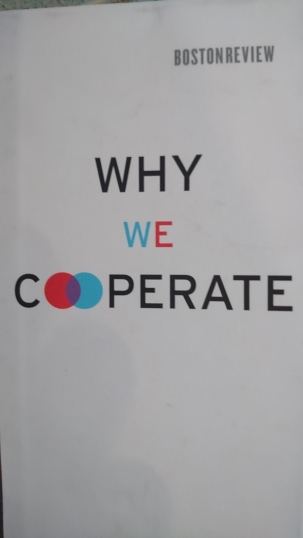
Perhaps most shockingly, while human mothers will starve themselves in order to feed their children, chimpanzee infants tend to be given the worst of the food that their mother is eating: the peelings, the husk, the shell rather than the more nutritious part of the fruit. Even where chimp infants are trying to get good food from their mother, they are more likely to be rejected than fed. Even in the most intimate relationships, chimpanzees are selfish and don’t act fair.
In this failure of cooperation by our very closest relatives (and chimp DNA is all but identical to that of humans) may well lie human’s crucial evolutionary advantage: that we are willing to work together and trust each other to share the rewards with some level of fairness. We thus take at least a portion of the benefit of our efforts, and as a result enjoy a larger collective pie to share between us.
It is not that fairness is a uniquely human trait — I had the privilege two years ago of witnessing humpback whales collaborating to take it in turns as a pod to chase fish down a narrow funnel of sea between the cliffs (known in the delightful Newfoundland dialect as a tickle) into the mouth of one of their group, with the taking of turns and sharing of effort just being a natural response for them — but it is so fully embedded in who we are that we struggle to understand why our closest animal relatives can possibly fail to follow the same obvious steps. Some of how our modern world works seems to act more chimpanzee than human, and to stifle those natural instincts. It is this that this blog is seeking to explore, and to try to understand what we might choose to do about it.
It is an unfairness of chimpanzees, but it is a fairness of humans — and we need to remind ourselves of that, and take the full benefit of it.
* Though ‘an unkindness’ is wonderful, it’s odd that there’s a collective noun at all for ravens as they are largely solitary beasts, more likely to be found in pairs than more, and indeed seem to suffer stress when in groups. Genuinely, an unkindness.
Studies evidencing the unfairness of chimpanzees:
Chimpanzees Are Rational Maximizers in an Ultimatum Game, Keith Jensen, Josep Call, Michael Tomasello, Science 05 Oct 2007: Vol. 318, Issue 5847
Meat sharing among the Gombe chimpanzees: Harassment and reciprocal exchange, Ian Gilby, Animal Behaviour 71 (4) (2006)
Tolerance allows bonobos to outperform chimpanzees in a cooperative task, Brian Hare, Alicia Melis, Vanessa Woods, Sara Hastings, Richard Wrangham, Current Biology 17(7), April 2007
How chimpanzees cooperate in a competitive world, Malini Suchak, Timothy Eppley, Matthew Campbell, Rebecca Feldman, Luke Quarles, Frans de Waal, Proceedings of the National Academy of Sciences, 113(36), September 2016
Food transfer between chimpanzee mothers and their infants, Ari Ueno, Tetsuro Matsuzawa, Primates 45 no 4 (2004)



 The
The 

 rs might do to respond.
