Readers (at least those that read the small print at the foot of every blogpost) will know that the Sense of Fairness blog is a purely personal endeavour. But naturally I am sometimes inspired to write things by events in my working life.
So it is this week, following a gathering on Tuesday hosted by fund manager Impax on the role of corporate culture in business performance. Naturally, the firm has a product to sell and wants to demonstrate its prowess in identifying share price performance drivers in what is still a surprisingly under-researched area.
Impax showed us striking charts showing stronger performance by companies with better culture, on the metrics that they have been able to garner from company reporting and more independent sources on employee satisfaction such as Glassdoor. Note that of course I am not making any investment recommendation.
Perhaps more striking than the performance statistics were the anecdotes from active fund manager Charles French, who relayed stories from the front line of asking CEOs about culture. As I too used to find when I asked my favourite “How are your people?” question, the range of responses to questions about culture tells you a great deal about the attitude and mindset of bosses. Some literally have nothing to say and do not know how to begin an answer; others become energised and demonstrate very clearly how much of a focus for them is inspiring their staff. You are left in no doubt which bosses – and so businesses – you would prefer to work for.
The event also featured a presentation and panel discussion on corporate culture. The panel featured a couple of my favourite people who have done great work on corporate culture, Tina Mavraki and Annabel Gillard. Most striking for this blog were a pair of word clouds within the initial, energising presentation from Jenny Segal, whose headline offer is ‘Building better workplace cultures through creativity and understanding motivation’.
She had asked a representative group of people what motivated them at work. Fairness appears with reasonable prominence, as do a series of other words that have concepts of fairness attaching to them:
As noted in a previous post, there are very different motivations for workers at companies which have a clear purpose and seek to inspire their staff. It’s unsurprising that unfairness at work is demotivating.
Jenny also asked people what makes a good boss. Again, fairness clearly matters:
Another striking comment from the panel came from Christine Cappabianca, one of Impax’s quant team, who leads their work uncovering data on culture. Clearly the reporting dynamic around diversity, equity and inclusion factors – one of the areas she has been mining for insight – varies around the world and is shifting notably at the moment. One of the shifts that she expects to happen as diversity is downplayed is that the language of fairness will see more use, as it’s a much less divisive way of capturing the intent of these programmes. That fits with the the most forward-thinking research in this space.
Fairness matters, viscerally, to people. It’s not surprising that its presence fires us up at work and that its absence demotivates. The best managers know this viscerally too.
Inequality is getting in the way of delivering value through corporate purpose statements. It’s an unusual form of inequality – inequality of inspiration, perhaps due to cynicism that arises from unfair treatment of the workforce.
The debate on the value of company purpose statements goes on. Fans of the approach believe it offers companies a route to providing a clear message to their investors and to their workforce about what the company stands for and is seeking to deliver, serving as a rallying point to shape their interactions. For those unpersuaded, corporate purpose looks like more of a fad, a set of at-best fine words that make no difference to how the company has always operated.
Such cynicism is perhaps encouraged by the poor quality of so many corporate purposes. One thing I am repeatedly struck by when reading the shortlisted annual reports of companies considered for the IR Society awards is that even at these companies with apparently exemplary reporting, several have weak or meaningless purposes. Many are so abstract as to be empty fluff while others are strikingly mundane or focus on financials. Few actually strike the right balance of providing a rallying point for shareholders and employees and assisting their decision-making, including notably assisting decisions about what the company, and individual employees, should not do. These are central elements of what an effective purpose should be.
Recent analysis suggests that this failure to inspire employees may mean corporate purpose fails to deliver on its potential.
The debates on purpose were opened up again at a conference late last year entitled Modern Capitalism and Corporate Purpose, hosted by Copenhagen Business School and organised alongside the ever-excellent European Corporate Governance Institute (ECGI). ECGI recently published a user-friendly summary ably written by my friend George Dallas. One of the key speakers at the conference was Claudine Gartenberg, assistant professor of management at the University of Pennsylvania’s much admired Wharton School. Dallas reports her being still more dismissive than I am about many existing corporate purpose statements, calling them both “twaddle” and “word salads of nothing”.
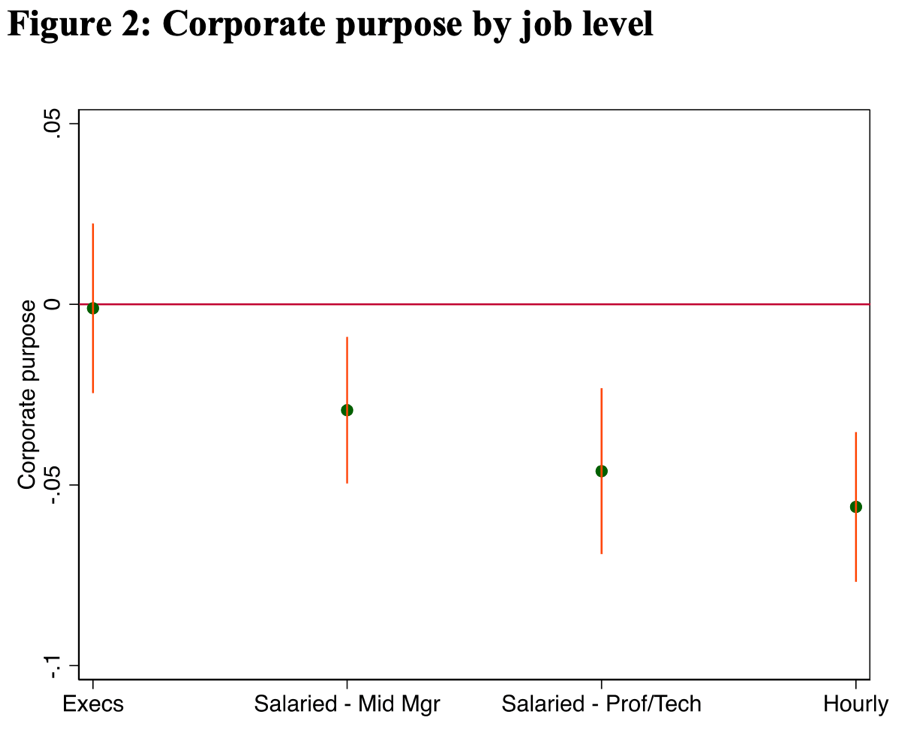
Gartenberg discussed the key results of a recent study into purpose at both public and private companies. This found that employees of public companies have a lower sense of purpose than those of private companies, and the difference is driven by more junior employees (ie middle managers, professional salaried staff and hourly workers rather than those at the executive level). And, as the chart shows, this situation of what she calls ‘purpose inequality’ is reflected in a rapid deterioration in the sense of purpose as you go down the seniority grades in these organisations:
In an earlier paper, Corporate Purpose and Financial Performance, Gartenberg showed that it is clarity of purpose in the middle ranks of an organisation that can lead to company outperformance. That has to make sense: clarity of purpose can assist with board decision-making (perhaps particularly about activities that the company as a whole should not be doing), but really the value of purpose lies in its providing inspirational rallying power for employees, and helping them in their day-to-day decision-making. Where corporate purpose statements fail to inspire employees they will not convince others and will be only so much ‘twaddle’.
The fact that the evidence on purpose inequality indicates that there is not just a step-change in faith in corporate purpose below the executive level, but a steady deterioration as the study considered more junior members of the workforce, is suggestive that in part staff consider their own treatment when thinking about the corporate purpose. A company that isn’t fair to its own workers isn’t likely to inspire them to believe that it is animated in all its actions by a higher purpose – meaning that it is much less likely to achieve its purposeful aims.
A similar finding in a different industry with different ownership structures strongly suggests that this finding of detrimental effects from limited faith among the broader workforce in purported purposes can be seen as potentially broadly generalisable. This evidence is from the legal profession, and comes from work by LexSolutions and the Law Firm Maturity Index. This shows a sharp disconnect between the faith in a law firm’s stated purpose as seen through the eyes of its leadership (partners, directors or board members) and of its broader staff base (professional lawyers below partner level, generally referred to as associates) – and an apparent correlation between this and these individuals’ sense of wellbeing.
“This suggests a causal connection between the reality of a firm’s purpose and the health of its people…Low levels of wellbeing that arise from primarily pursuing a financial purpose may eventually lead to burnout or staff turnover.” [my emphasis]
Gartenberg’s evidence regarding the differences in employee attitudes in private companies in comparison with public ones (and ones with high levels of private equity ownership) is also telling. It suggests that generally employees are less persuaded that purpose is meaningful in the latter organisations, perhaps as they suspect that the profit motive will always be allowed to override all other considerations. Thomas Thune Andersen, chair of Denmark’s energy business Orsted, which has transitioned into renewables, who also spoke at the conference, tended to agree with this. He clearly felt that the support of the government as a majority shareholder had enabled Orsted to deliver on its purpose. Andersen was cynical about the short-termism of mainstream institutional investors.
If owners tend to be driven by things other than corporate purpose, and are not keen to encourage companies to establish purposes and be driven by them, then it is not surprising that the workforce will doubt the sincerity with which the company operates. Of course there are many investors that do have some confidence in the power of purpose and its value for long-term shareholders as well as stakeholders. But it seems that their voices are overwhelmed by a broader market of institutions that are less convinced – at least in the US, where Gartenberg’s work was carried out.
Purpose won’t deliver on its potential positive effects unless it is believed in by those within the company. But purpose inequality won’t be overcome by fiat, but persuasion, and demonstration in practice. In order to deliver, corporate purposes need not only to be better written and more meaningful statements of intent, but that intent needs to be followed through by boards and management in their treatment of staff, and also supported by investors in the business. Failures to deliver on either or both of these elements may serve to explain why there isn’t stronger evidence of the value of corporate purpose.
That redoubles the challenge for boards: live the purpose, demonstrably to your workforce, and reinforce it to your investors too. As I’ve suggested in previous blogs on this topic, there is an opportunity for companies through their actions to influence their shareholder base, discourage those shorter-term voices and encourage the longer-term institutions that will provide more reliable and consistent support. Boards should rise to that challenge, minimise purpose inequality and awaken the opportunities offered by meaningful corporate purposes.



 The Sense of Fairness blog