
Interest rates are lurching upwards globally. In part, this is a good thing, a reversion to more normal times after money having been essentially free for too long – something that has been dangerously distorting. But rising interest rates have significant negative consequences for how we perceive the future. They mean we discount future money and value more too, making the future seem less important. Given that humans have in any case a tendency to be excessively short-term and favour the present, that’s unhelpful.
Research shows that rising interest rates also make sharing scarce resources harder.
There’s a strong band of thought that humans aren’t great at sharing. If they have shared access to resources – often called a resource held in common – they are likely to over-exploit it to the extent that becomes depleted and so of decreasing value over time. Often, it may simply be destroyed, and so unavailable to future generations.
This band of thought is usually called the tragedy of the commons, after a seminal 1968 article in Science. The naming of the concept arises from the shared commons to which all in a village had access for grazing animals, which were at risk of being overgrazed and damaged; there are other very real examples of the tragedy happening, perhaps the most renowned being the collapse of the Atlantic cod fishery. Overexploitation can mean the common resource is lost to the future altogether. The usual asserted solutions to this challenge are either regulation or narrow private ownership of resources.
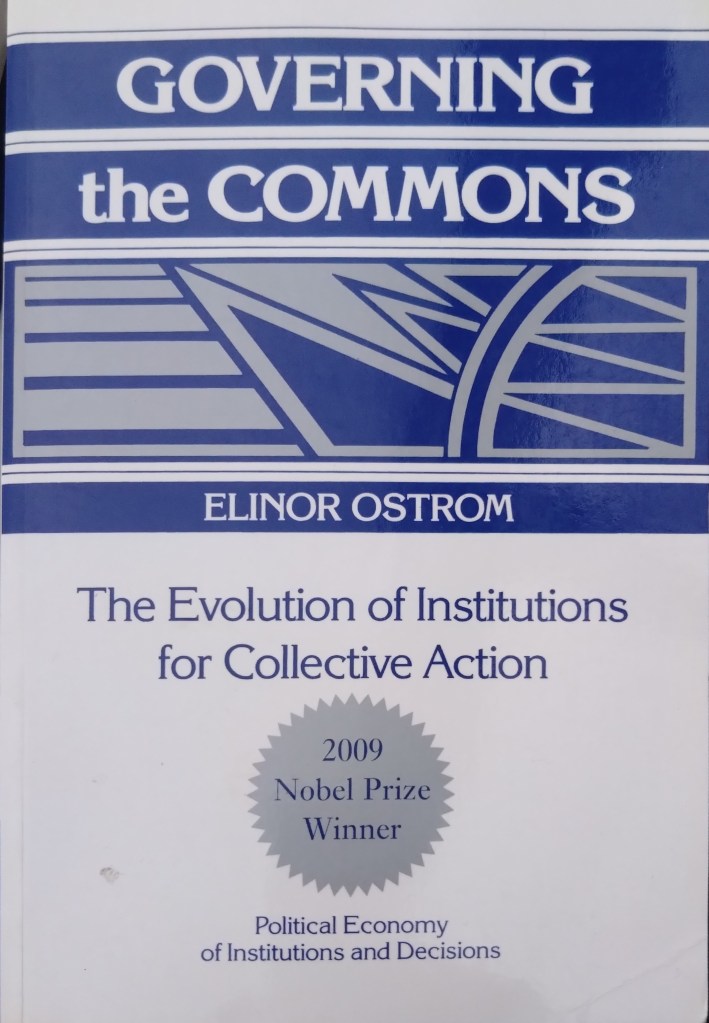
But commons need not be tragic. That was the conclusion of the first female economics Nobel Prize winner, Elinor Ostrom (referenced in my last blog). Ostrom won the award for demonstrating that it is entirely possible for human societies to develop approaches that avoid the tragedy of the commons – without needing to turn the commons over to private ownership or subject them to heavy regulation. Ostrom analyses cases of successful management of shared resources (ranging, among others, from irrigation in Spain and the Philippines to grazing in Switzerland and Japan, to fisheries off Nova Scotia and Indonesia) – what she calls common pool resource (CPR) problems. She shows that there are in fact multiple ways in which people have successfully addressed these problems and so shared the commons effectively over time.
Indeed, the evidence is that commons can be shared in such ways over extraordinary periods of time. The remarkable Dark Emu shows that Australia’s aboriginal peoples farmed the land and exploited other resources so lightly over centuries and perhaps millennia that arriving Europeans allowed themselves to believe that the entire land was tabula rasa and entirely untouched. There was of course a prejudiced and convenient colonial mindset that assisted this thinking, but the Aboriginal footprint on the land, and its exploitation of a range of shared commons, was so slight even after so long as to be deniable.
Ostrom sets out six variables she suggests make it most likely that a common pool resource problem can be addressed through the efforts of those involved in exploiting the shared resource (whom she calls the ‘appropriators’). The six variables are:
- Most appropriators share a common judgment that they will be harmed if they do not adopt an alternative rule.
- Most appropriators will be affected in similar ways by the proposed rule changes.
- Most appropriators highly value the continuation activities from this CPR; in other words, they have low discount rates.
- Appropriators face relatively low information, transformation, and enforcement costs.
- Most appropriators share generalized norms of reciprocity and trust that can be used as initial social capital.
- The group appropriating from the CPR is relatively small and stable.
Ostrom states that these variables are “weakly ordered” from most important to least, and she has significant doubts about whether the last matters at all, though others believe it is extremely important. As an aside, whatever weight is put on the various variables, when considering the list as a whole it isn’t hard to see why the world is so struggling with its current most severe common resource problem: overuse of the shared common of the atmosphere through excess carbon dioxide pollution.
The third of Ostrom’s variables is relevant when considering rising interest rates. In finance, the term discount rate is used synonymously for interest rate: it is the rate at which the future is discounted back to the present, i.e. the extent to which the present is preferred over the future. The synonymity with interest rates largely makes sense, though the extent to which interest rates are driven by narrow supply and demand considerations (in a current UK sense, the unwinding of the heavy investment in gilts by pension funds eager to manage the risk of apparent deficits as those pension schemes increasing sell out to insurers, which tend to invest in long-term assets other than gilts; and the overhang of Covid acquisitions of gilts still held by the Bank of England) rather than longer-term factors should be less relevant for discounting – so there may be a little distortion if we discount using the current interest rate without thinking.
One of the most striking things I found in my researches for my (shortly forthcoming) book was evidence that humans are more likely to place a steep discount on the future if they face conditions of inequality, as, of course, we all do at present. To the extent that this is based on logical reasoning, the future matters less to those who may not survive to reach it, and who may not have sufficient financial resources to enjoy it. However, the researchers suggest that this discounting of the future is much less of a logically reasoned approach and much more deeply embedded in human psychology. Since the same researchers have identified other ways in which the psychology around discount rates can be manipulated – perhaps most strikingly that men tend to discount the future more and rate the present more highly when in the presence of pretty women – I suspect we should accept their view that this impact of inequality on discounting isn’t a wholly logical phenomenon.
Its impact is real though: in conditions of inequality, people discount the future more. In a fairer world, the future matters more to all. As global interest rates rise and in our unequal world, we’ll need to lean still more heavily against the tendency to discount the future – our own and that of future generations. Future generations who need future commons to enjoy rely on us not to exploit them excessively in our present.
I’m happy to confirm as ever that the Sense of Fairness blog is a purely personal endeavour
The Tragedy of the Commons, Garrett Hardin. Science, 162, 1968
Governing the Commons: The Evolution of Institutions for Collective Action, Elinor Ostrom. Cambridge University Press, 1990
Dark Emu: Aboriginal Australia and the Birth of Agriculture, Bruce Pascoe. Scribe, 2018
Carpe Diem: Adaptation and Devaluing the Future, Martin Daly and Margo Wilson. The Quarterly Review of Biology, Vol 80, No. 1, March 2005
Do pretty women inspire men to discount the future? Margo Wilson and Martin Daly. Biology Letters 271(S4):177-179, 2004


One thought on “Fairly sharing the commons, sharing the future”