
As I was researching for my (now very shortly) forthcoming book, I found less evidence for the benefits of fairness in relation to one of the traditional stakeholders of business than the others. This was the environment. In part, this was because of the strength of that evidence almost universally across the other key stakeholders. But perhaps more significant is the fact that the business relationship with the environment is not mediated by people. There is something built into how we interact with other humans, an ongoing push and pull of interests and mutual expectations, that leads to an arrival at a degree of fairness. Where humans are less immediately involved, there’s less of a gravitational pull to fairness, more scope for unfairness.
This left me focusing more in the environmental chapter on the need to strike a fair balance (incidentally, the importance of fair balances spurred the choice of cover image for the book). Inevitably, I also discuss the challenge of externalities and the risks that businesses take when they depend on the persistence of those externalities – they can mask unprofitability when the ability to externalise costs is removed, as it usually is, sooner or later. I also discuss the so-called tragedy of the commons, whereby shared resources can be over-exploited and destroyed, and the remarkable work of Elinor Ostrom in identifying how readily communities can manage such common resources and preserve them into perpetuity. Ostrom’s work provides powerful insights helping support the delivery of intergenerational fairness.
It’s therefore been a pleasure for me to discover more recently that this idea of the need for environmental balance has support from a source I wasn’t aware of. That support comes from Islam. Indeed, for a number of Islamic scholars, the concept of balance is the religion’s key framing of the human interaction with the environment. Take the following, for example:
“Islam looks at the environment from the standpoint of balance. It envisions the environmental balance as a part of the universal ‘grand balance’. The Quran describes the notion of environmental balance in various terms like ‘adl’, ‘qadar’ and ‘mouzoon’.
“The term ‘adl’ literally means acting justly, rightly, or equitably. While explaining the meaning of ‘adl’, one interpreter of the Quran has observed that the universe has been created in balanced form.”
This scholar goes on to argue that this requirement for balance implies constraints on the demands humans can make in terms of both what they extract from the environment and what they discharge into it by way of pollution.
Others have gone further in this analysis, and used the concept of balance to develop a wholesale approach to environmental matters. Al-Mizan apparently also means balance, and is the name for an approach developed alongside more than 300 Islamic institutions and international partners. Making clear that this concept of balance is intimately associated in Islam with equity, fairness and justice, the Al-Mizan Covenant for the Earth was finalised in 2024 and sets out a fair and just approach to environmental matters.
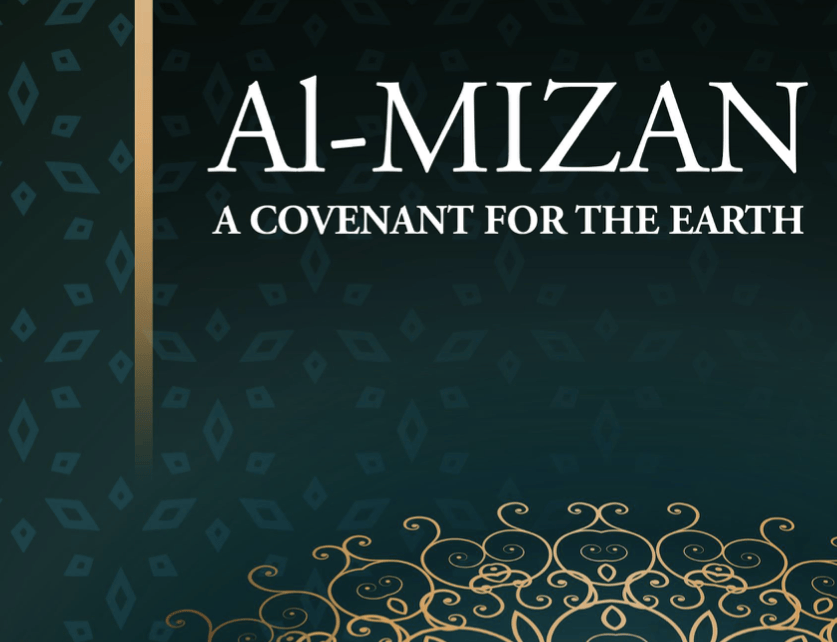
Among other things, the Covenant asserts:
“The economic values of our faith are embodied in frugal moderation while taking joy in the sources of life for humankind and other living beings, respecting their inherent limits by forsaking wasteful excess for just, equitable sharing of their fruits, and forsaking exploitation of the Earth and its inhabitants for charity and cultivation.”
Given that the wealth of a number of Islamic nations arises from their role as fossil fuel producers, it is particularly notable that the Al-Mizan Covenant makes a call not just for a transition away from the burning of fossil fuels but for a wholesale phasing out of fossil fuel production. It does so while noting the need for a just transition for affected workers and communities. The Covenant also seeks sustainable and ethical farming practices, railing at the imbalances brought by monocultural industrial farming practices.
The Covenant’s commitment on the issue of indigenous people’s rights is particularly strong: “To remind leaders and decision makers that it is essential that people of all social and ethnic groups, traditional societies and indigenous people be consulted without discrimination, and that the weakest be held as strongest until their rights are fully secured, and the strongest held as weakest until they comply fully with the law.” The paper’s articulation of what is required by way of truly fair and empowered consultation of those who might otherwise be powerless is particularly striking.
The Covenant also argues strongly for enhanced education on environmental matters and for more community-led approaches to addressing environmental challenges. Again, this appears to be about empowering those whose power might otherwise be limited, and ensuring that there is a readier balance of power and influence in the preservation of biodiversity and natural resources.
While these ideas are clearly grounded in a specific religious perspective and culture, the lessons they teach are more general. Seeking to balance the interests of current generations with those to come, to balance the interests of the wealthy with the disempowered, seeking a balance in the level of exploitation of natural resources, are steps that are in our own interests as well as those less empowered or yet-to-be-born, they are fair. Ostrom, among others, shows clearly that we don’t need a faith-based approach to see that such a balance is fair to ourselves and others. However, we are sadly some distance from striking such a fair balance at present.
See also: Fairly sharing the commons, sharing the future
I am happy to confirm as ever that the Sense of Fairness blog is a purely personal endeavour
Fairness in Business and Investment, Paul Lee. Routledge, 2026
Governing the Commons: The Evolution of Institutions for Collective Action, Elinor Ostrom. Cambridge University Press, 1990
Towards an Islamic Approach for Environmental Balance, Muhammed Ramzan Akhtar. Islamic Economic Studies, Vol 3 No 2, June 1996
Tafheem-ul-Quran [Towards Understanding the Quran], Syed Abu Al Ala Maududi


One thought on “Environment in the balance”