Meritocracy’s unfair

Meritocracy is unfair — at least believing in it too much can trap us in unfairness.

Like many British people I have recently been reading a good deal of history. My main era of choice has been the British revolution, usually known as the civil war, or wars, and mostly I have leaned on the brilliant Christopher Hill, still some years on regarded as the greatest historian of that period. Most recently I have read God’s Englishman, on Oliver Cromwell*.

Most odd to the modern ear is the certainty felt by Cromwell that he was led by divine providence. In this understanding of the world, military and political success, which Cromwell enjoyed in abundance, were merely a reflection of God’s will. There was no room for chance; success was itself a sign that he had been chosen and that his power was rightful. As he said to the 1655 parliament: “What are all our histories and other traditions of nations in former times but God manifesting himself that he hath shaken and tumbled down and trampled upon everything that he hath not planted?” Because Cromwell flourished where he was planted, God’s providence was with him.

Hill’s cynicism about Cromwell’s perspective is subtle, noting the tendency only to engage in battle when the roundheads had an overwhelming numerical advantage, and a somewhat equivalent tendency in his political manoeuvrings to act only when it was clear which way the tides of broad opinion were flowing. Cromwell himself would perhaps have seen both of these as merely waiting until the signs of God’s providence were made plain to him. I’m sure that many Irish might be rather more cynical about Cromwell’s view of divine providence, given the horrors in that land that his understanding of his religion led him to believe were wholly appropriate. Nevertheless, Cromwell felt assured by his perceived successes that providence was with him.

This argument that personal success is the result of being chosen, and that it is rightful because of that fact, seems odd to the modern ear. It seems odd, but the modern brain tends to fall into a remarkably similar fallacy. That is where meritocracy comes in: we tell ourselves that we live in meritocratic societies and therefore that we deserve all that comes to us. And through that same route, unfairness comes in: both because our meritocracies are flawed, and because there’s plenty of dumb luck that drives success, not just the skill and hard work that we like to imagine, particularly when the success is our own.

And by falling into undue faith in meritocracy, we become more unfair in our actions and outlook. 

In part, this is down to how humans understand fairness. Various studies have shown that people will tolerate more inequality when it seems justified by merit. Perhaps most striking is the 2019 paper Cutthroat capitalism versus cuddly socialism: Are Americans more meritocratic and efficiency-seeking than Scandinavians? from a team at Norway’s Centre for Experimental Research on Fairness, Inequality and Rationality. 

In this large study, so-called ‘spectators’ were given the chance to reallocate rewards between two ‘workers’ to whom pay had initially been allocated wholly unequally (one of the two receiving nothing at all). Playing to national stereotypes, the most popular choice among the US participants was to leave the distribution as initially awarded, whilst a majority of the Norwegians equalised the reward. The core of the study though was to assess how responses differed between situations first where the spectators were told the initial allocation of the reward was based wholly on luck and second where the basis of the reward was said to be differentials in productivity (which was undefined and unquantified) between the workers.

Perhaps unsurprisingly where the source of the inequality was merit (in this sense of greater productivity), spectators from both countries were willing to tolerate more inequality in reward, than if the basis was simply luck. Though many Norwegians still favoured equalising the rewards of the workers, the merit basis led to more being willing to tolerate inequality; more starkly, 80% of the participants from the US allowed unequal distribution of rewards where there was merit involved (though many did not leave the allocation quite as unequal as the starting position), while more than half of them equalised rewards where luck was the driver. As the paper concludes:

“We show that the source of inequality is essential for understanding inequality acceptance in both the United States and Norway; in all subgroups of our samples, we find that the introduction of a difference in productivity as the source of inequality significantly increases inequality acceptance.”

Similar findings come in Merit and Justice: An Experimental Analysis of Attitude to Inequality. Again here there was a comparison between attitudes to earnings based on skill and on luck. A group of individuals played a series of rounds of one sort of game (either skilled or lucky) and then had the chance to fine earnings from the other players. The group then played the other sort of game and had a second opportunity to remove earnings from others. There was a greater tendency to try to ‘rectify’ earnings where the game was one of pure chance, and some greater willingness to tolerate inequality arising from skill.

The paper discusses its findings in the context of a broader philosophical understanding of justice and fairness, and concludes that “Individuals attach merit to an outcome when it is due to skill, and do not when it is due to luck. Thus, the concepts of moral desert and justice are deeply connected, and one needs the other for a proper definition.” 

A further paper concludes something similar: “the perception of fairness is sensitive to the sense of entitlement, an important contextual cue that constitutes distributive justice”. This conclusion arises from The Flexible Fairness: Equality, Earned Entitlement, and Self-Interest. The study framed dictator and ultimatum game decision-making in the context of performance in another game, supposedly one of skill. Framing the ultimatum game with entitlement from merit (or the absence of such entitlement) led to different offers and different acceptances. In essence, those who felt entitled by apparent merit were less generous in their offers, and most starkly those who felt lower entitlement because of lesser perceived contributions were much more willing to accept even very uneven ultimatum game offers. 

This appears to be a universal trait — apparent merit colours how we perceive fairness. And, sadly, we do not seem to test too closely how significant is the merit factor in the overall result, and do not try hard to test whether merit is really there at all. The global nature of this attitude is shown by further work by the same team as delivered Cutthroat Capitalism, under the banner Fairness Across the World: the Nature and Consequences of Inequality. This is ongoing work based on redistribution experiments like those for the earlier paper, involving 65,000 people in 60 countries. It is not yet published, though headline results were released in a talk last November. I have scraped the following images from a twitter thread by @RobertoIacono83, Roberto Iacono of the Norwegian University of Science and Technology, Managing Editor of the Journal of Income Distribution.

Redistribution across countries is less equal in cases of merit than of luck:

Merit treatment slide

Luck treatment slide

Clearly, our understanding of what is fair is framed by an understanding of merit — even where the extent of merit and what has driven differential performance is unclear. Particularly striking is the variation between countries, the willingness in many countries to tolerate high levels of inequality even when it arises purely from luck. But overall, it is clear that people worldwide generally tolerate much less inequality where it arises from luck than where it arises from merit — the luck chart is set at a much lower level than the merit chart — though people from a few countries (most notably India and China) make little distinction between the two, tolerating remarkably similar levels of inequality whether it arises from luck or merit.

Fairness is not inequality. Our understanding of what is fair is shaped by our understanding of merit — or just an indication that one party merits more than the other. The problem arises because that meritocratic urge is not well calibrated and we seem willing to accept undue inequality on even the weakest evidence of differential merit. We want to believe in meritocracy and so are willing to do so even when it isn’t really there — we are tricked by our faith in fairness into believing that we are more surrounded by meritocracy than we really are. And that leads us towards unfairness.

Studies show that where managers are asked to frame their promotions and bonuses in terms of merit, they are more likely to display bias in favour of men rather than women. Where merit is not so heavily pushed in organisations, ironically managers are more likely to operate fairly between the sexes. Even in hypothetical situations, our bargaining position and more significantly our assumption about what we see as fair is coloured by what role we are asked to perform, meaning that our understanding of merit displays bias. In the Flexible Fairness experiments participants’ vision of merit and what proportion of the overall reward that entitled them to was blurred by their own position, as either the better performer or the worse performer: “earned entitlement is evaluated in a self-serving way”. We recognise merit when it flatters us, but are less swayed by the same measures when they do not portray us in as positive a light.

We like meritocracy and respond more favourably to inequalities that arise from merit. And yet we all know that our supposed meritocracies are not perfect. We know that luck is often a big driver of success — though like Cromwell we want to think that success (particularly our own success) is always righteous rather than just the product of chance. We want to believe in meritocracy, and particularly those of us who enjoy some success want to believe in meritocracy. And that leads us to act less fairly than we might, because we are tempted to see success as evidence of merit, not simply of a combination of factors including luck. We might be better off, and happier, if we were grateful for the chances that have helped us to be successful, than if we believe it is simply on the basis of merit.

As the Cutthroat Capitalism paper states: “The lower acceptance among Scandinavians than among Americans of inequalities reflecting luck may contribute to explain why there is greater support in Scandinavia than in the United States for policies aimed at reducing the accident of birth as a source of inequality.” Remember that fairness is a choice and that the evidence shows that the heritage of Scandinavia was no more equal than any other part of the world. There appears to be nothing inevitable that made Scandinavia different, other than political choices in the second half of the twentieth century. The article I reference in that blog was discussing Sweden but note that the chart shows Norway followed the same trajectory as its neighbour, with inequalities as extreme as anywhere in the years around 1900, and notably low inequality now.

A belief in meritocracy seems to play a significant role in the US view that there is less need to intervene to prevent accidents of birth having broader impacts. This slide from a recent presentation by Harvard University’s Stefanie Stantcheva on Perceptions of Inequality (given at the San Diego meeting of the Allied Social Sciences Association and the Econometric Society earlier this month, as part of a special session dedicated to the IFS Deaton Review into inequalities in the twenty-first century) is very striking in this context. It compares the real likelihood of someone born in the poorest fifth of the population making it to the richest fifth in their lifetime with the perceived probability. In the study, only the US participants thought this was more likely to happen than is in reality the case (and they put the greatest likelihood on that event of all participants even though it is least likely to happen in their country).

US optimism

People in the US are lulled by the myth of the American dream into believing their nation is more meritocratic than it is in reality — leading them to tolerate more inequality and to accept undue unfairness. It is surely this excess faith in meritocracy that leads to the US stereotypes displayed in a number of the studies discussed here.

We are all lulled by our wish to live in meritocratic societies into a belief that merit is a greater driver of success than it in fact is. Meritocracy may be fairer than the alternatives, but we risk becoming decidedly unfair when we have too much faith that we actually live in wholly effective meritocracies.

*I post this blog on the anniversary of Oliver Cromwell’s hanging and beheading.
That was in 1661, more than 2 years after his death and burial.

See also: Squid Game ‘fairness’

Cutthroat capitalism versus cuddly socialism: Are Americans more meritocratic and efficiency-seeking than Scandinavians?
Ingvild Almas, Alexander Cappelen, Bertil Tungodden, NHH Dept. of Economics Discussion Paper No. 4/2019

Merit and Justice: An Experimental Analysis of Attitude to Inequality
Aldo Rustichini, Alexander Vostroknutov, PLoS One 2014, 9(12)

The Flexible Fairness: Equality, Earned Entitlement, and Self-Interest
Chunliang Feng et al, PLoS One 2013, 8(9)

The Paradox of Meritocracy in Organizations
Emilio Castilla, Stephen Benard, Administrative Science Quarterly, 2010

Biased Judgments of Fairness in Bargaining
Linda Babcock, George Loewenstein, Samuel Issacharoff, Colin Camerer, American Economic Association, 2011

A belief in meritocracy is not only false: it’s bad for you
Clifton Mark, 2019, Aeon

The fast track to a life well lived is feeling grateful
David DeSteno, 2019, Aeon
Better ways of showing how people matter

In brief follow-up to my last blog, it is worthwhile to reflect on the latest report from the FRC’s Financial Reporting Lab which on January 16th published a report on the ways in which leading companies currently report on their workforce. The report provides suggestions on how others can consider adopting better practice.

“In trying to understand which companies are able to build and maintain a productive workforce over time, investors are interested in how a company intends to support the development of its workforce in a sustainable, long-term fashion,” the report states, making clear the challenge by going on to say: “there is no single approach that captures how human capital considerations have an impact on company performance”. 

The proposed model of placing human capital investments on the corporate balance sheet, as critiqued in People matter, but not like that, is certainly not the favoured single approach for any of the companies identified as producing leading practice. That’s welcome.

The fact that there is no single approach to appropriately capturing human capital considerations is in a sense the opportunity for companies, who can highlight the value of their people in the way that most suits their business model. As the Lab rightly highlights, the other thing that investors are keen to understand is the effectiveness of board oversight of employee issues, without which the link to strategy and business model cannot mean anything of substance. 

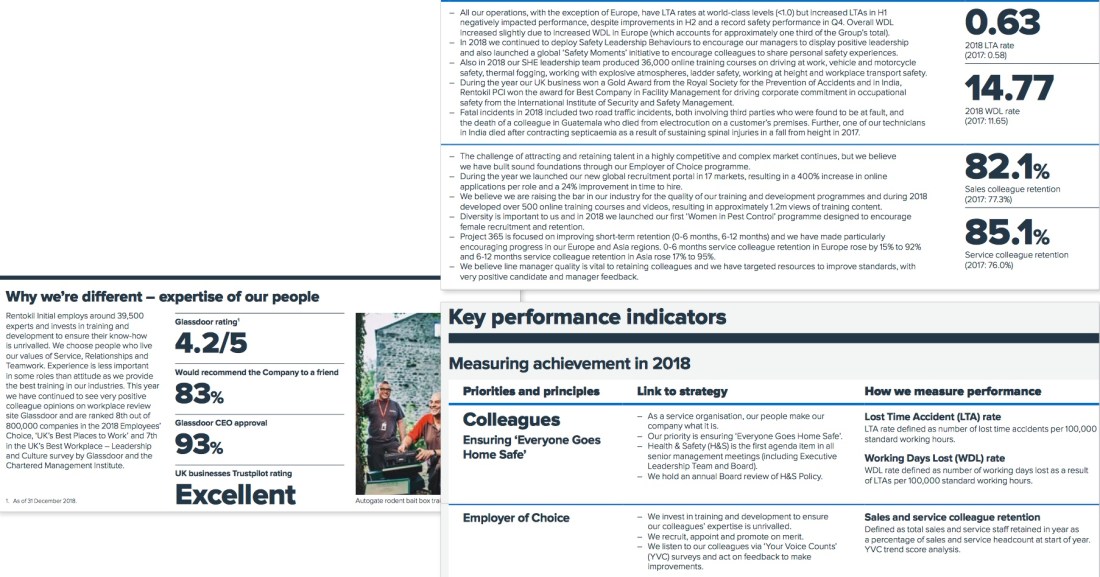
My favoured among the sample of good practice that the Lab identifies is Rentokil Initial:

Rentokil clip

From this small sample of their reporting in the Lab report, it is clear that the company is willing to talk openly about challenges as well as the positive stories, and it publishes clear metrics about performance, including year-on-year performance. Rentokil takes seriously the skill levels of its workforce and has an idea of the culture it has and is seeking.

The example from the report that perhaps best covers issues of fairness is that from SSE:

SSE ROI

While I’m rather dubious about the very precise numbers put on this (for every £1 invested in 2017, apparently SSE generated £4.52 in return on inclusion, ROI; it predicts £7.56 ROI on each £1 of investment in 2020 just from business as usual, £11.33 ROI from a tweaked strategy or £15 ROI from a fully upgraded strategy), the company’s approach is admirable and does attempt to address some of the current unfairnesses and inequalities in our country — as well as allowing the company to identify and build a workforce that should prove effective and loyal. The hoped for £15 return happens to be the organisation’s target for delivery by March 2021, with the main driver for achieving it appearing to be a still more inclusive approach that seeks to advance many individuals now most neglected by employers. That can only be a good thing, something that must advance fairness.

As discussed in People matter, but not like that, at the end of the day the real driver for that fairness will be when these metrics on people actually matter for executive reward. It’s therefore welcome that Rentokil Initial recently switched to make employee retention a measure in its performance share plan (albeit only 5% of the total) as well as (rather opaquely) part of its bonus scheme. SSE determines fully 20% of executive bonuses (though none of its performance share plan) based on a range of workforce measures. In this, as with their reporting on workforce issues, the two companies are unusual and exemplars. Sadly they remain uncommon still as insufficient companies genuinely seek to take the steps necessary to deliver workforce fairness.

People matter, but not like that

Taking the workforce seriously and treating people fairly and well is not served by mechanical approaches that hide as much reality as they purportedly reveal. Yet too often those proposing radical reform see the need to squeeze things that are by their nature hard to measure uncomfortably into a single box of a spreadsheet. That risks failing to do justice to the issues involved.

Their aim is an admirable desire to ensure a focus on fairness to stakeholders — in this case workers — and to drive long-term business success. Yet the approach is surely wrong-headed. Things absolutely need to change, but it would be best to focus on the areas where change can best be delivered and where it will have the greatest effect.

Two recent reports suggest specifically that investments in people be added to corporate balance sheets. One is in the US, Leo Strine’s Toward Fair and Sustainable Capitalism (see The Limited Responsibility Company), and the second in the UK, part of the British Academy’s Future of the Corporation work. This blog seeks to unpack these proposals, to the extent that they are clear, and test whether there is a better route to achieve their aims.

Strine is most explicit. One of his headline calls is: “Change accounting rules to treat investments in human capital like other long-term investments and require companies to disclose more information in narrative form about their human capital investments.” The second portion of this is unarguable, particularly in a US context where companies report little — mostly because they claim to feel constrained by litigation risks to disclose only what they are required by regulation to disclose. But the first portion is rather more debatable. In case there is any doubt about the proposal, the unnatural revolutionary later makes his meaning explicitly clear: 

“instruct the Financial Accounting Standards Board to revise generally accepted accounting principles to treat investments in human capital as capital expenditures like investments in plants, property, and equipment”

His intent is that investments in human capital should be capitalised on corporate balance sheets.

The Future of the Corporation’s proposal is less explicit — indeed a cynic might say that the bulk of its Principles for Purposeful Business is opaque and too high level to be meaningful — but appears to head in the same direction. It states that: “Measurement should recognise investment by companies in their workers, societies and natural assets both within and outside the firm.” The confusion of what is actually being proposed is shown by its call both for a “greater consensus … and standardisation of available information” and that “the board of a company should determine the firm-specific metrics against which fulfilment of purposes … can be evaluated”. How measures can be standardised and at the same time bespoke and company-specific is a mystery to me at least.

The intent of the Principles for Purposeful Business is made less opaque in one of its underlying papers, How to Measure Performance in a Purposeful Company? This states: 

“from a purpose driven, non-financial management perspective, investments into training of employees is viewed as an investment into building social and human capital for the company and its employees. This investment would be expected to yield positive operational results and should therefore be capitalized.”

Again, the intent seems to be that investments in human capital should be capitalised on corporate balance sheets.

There are practical challenges around this — not least the question of whether such capitalised employee assets should be amortised or subject to periodic impairment assessments. Those who follow accounting debates will know that this is a highly controversial area where there is much doubt about the effectiveness of the impairment process — but also a recognition that amortisation does not really reflect the economic reality of many capitalised assets, which often endure rather than deteriorating in value on a straight line basis over an arbitrary period. If we did capitalise it as an asset, would the value of training simply be amortised, or would it be written off when significant numbers of the trained individuals departed the business or a business process changed? 

There’s the old adage about half of the spend on advertising being wasted but that it is impossible to know which half. Investing in a business’s people surely suffers from a similar challenge, with the added complication that it is impossible to know how much of the half of spending that hits home will in practice remain in the company to its own business benefit. This makes both impairment and amortisation models hugely challenging. But none of the proposals I have seen suggesting that these be balance sheet assets have started to consider the most basic practical challenges around their proposal.

There is also a philosophical challenge — to whom does the value of training belong? It is surely hard to state that the value of everything in staff members’ heads belongs to their employers. The old saw of the majority of some companies’ value going down in the lift at the end of the day is a truism, so saying that training is a capital asset for the corporation is surely philosophically difficult. Regular readers will not be surprised to find that I do not wholly agree with Milton Friedman’s take on human capital, as set out in What is human capital? on the ever-excellent Aeon. This argues that the concept was invented as an argument in the Cold War, turning each individual into a mini-capitalist hawking their personal assets around businesses. The long-term consequence of this approach appears to have been divesting in people rather than the opposite — but the philosophical point that a person’s brain cannot belong to a corporation surely has some weight. 

Friedman’s argument that it is for individuals to invest in themselves and that corporate spending on staff training is worthless is clearly wrong. But seeing training and employee relations as generating an asset purely for the corporation must also be wrong — it must be about generating productivity within the business and about employee retention. It is certainly hard to keep good staff if the message to them is that they do not matter to the organisation. 

The academic literature on intangibles, which for many include aspects of employee skills and experience, focuses most often on the challenges with inclusion in accounts that arise from difficulties of measurement and objectivity. But as IAS 38 on intangibles clearly recognises, separability from the operating business is key — how can intangibles be calculated as separate assets when they only exist within the business processes? This is why many investors (and preparers of accounts) are frustrated by the current rules requiring the breakdown of goodwill into some separately calculated intangible assets — which exist only for accounting purposes because they cannot in practice be severed from the business as an operating business. That intimacy with ongoing value creation is precisely why these contributors to corporate value matter so, but that does not mean they need to be turned into balance sheet assets. Putting a false single value on something core to the ongoing business is more likely to mislead rather than inform (see What gets measured gets managed, unfortunately).

At their hearts, these proposals to capitalise employee expenditure are attempts to deliver greater fairness between spending on staff and spending on capital assets, and attempts to avoid disincentivising investment in people, which has led in part to less productivity in business. What might be a better approach to deliver on this intent?

Many will find it hard to disagree with the conclusions of the Brookings Task Force on Intangibles, as quoted in a 2019 FRC discussion paper on the issue:

“After some internal debate and extensive interviews with individuals preparing financial statements, users, auditors, standard setters, and regulators, the task force has concluded that the debate about capitalization versus expensing of R&D focuses on the wrong problem. What investors want, and need, is information about the value of internally developed intangibles and the other factors that drive the value creation process in firms.’’ 

This is also the conclusion of the IIRC (International Integrated Reporting Council). While its model talks about six capitals, one of which is human capital, it doesn’t argue that these need to be capitalised assets on balance sheets. Rather, first it notes that each of its six capitals are simply reminders for companies to ensure that their understanding of value creation fairly respects all relevant stakeholders, and that companies are not expected always simply to report on each of the capitals separately but should consider how they are best reflected in the company’s business model. As an aside, it would be great if more (some!) integrated reporting companies respected this call to think independently. But more relevantly, the IIRC model is that the capitals should be disclosed in the narrative reporting, using KPIs and hard metrics of performance and what has been delivered over the reporting period, but not altering the financial reports themselves.

This is the general model of the IIRC — that the reporting on key issues should be in the narrative section of reporting and not influence the financials. This seems wrong in some areas, such as climate change, where the financial implications of carbon constraints will need to be fully integrated into the balance sheet and income reporting by companies — as Nick Anderson of the IASB has recently acknowledged. But the approach does seem right for human capital issues. 

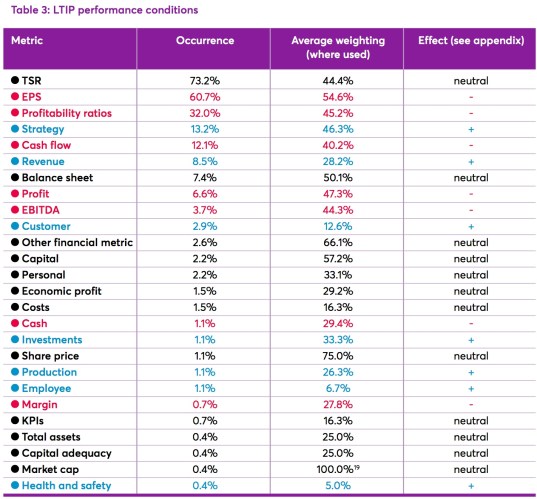
At its heart, what matters is not what is on the balance sheet, but that management should not be disincentivised from appropriately and fairly investing in the long-term of their business, including in the skills of their people. That’s why a recent study by Nesta is for me so depressing. The Invisible Drag on UK R&D demonstrates just how short-termist are the measures applied by the bulk of UK corporations (and there is no reason to assume that the UK is any worse than other markets, so this criticism is likely to apply to most public companies):

NESTA LTIP incentives

In particular, the chart shows just how low a rating most companies place on employee issues. It appears that just one company across all the UK listed businesses studied uses a health and safety measure, and only three use other employee measures in assessing executive performance. Even when they are used, their proportion within the overall incentive structure is so low as to be largely irrelevant. And unfortunately the three-year time horizon typical of LTIPs and their total shareholder return (TSR) measures is not sufficient to compensate for this as any underinvestment in staff skills is unlikely to become reflected in share prices over such a time period, whereas the cashflow benefit from the underinvestment will be felt immediately. The statistics for bonuses are no better: employee measures represent only 4.1% of the non-financial performance metrics, with a further 12% using health and safety measures; again, even where these metrics are used the portion of the overall incentive that they represent is paltry. 

It is perhaps no wonder that the UK has a productivity problem if no senior management has any incentive to invest actively in their people — indeed they appear to have active disincentives from doing so. Let’s address that problem fairly and squarely rather than reshaping corporate balance sheets as an indirect — and highly dubious — route towards the same direction.


I explored some of the ideas in this post further in: Better ways of showing how people matter


Toward Fair and Sustainable Capitalism, Leo Strine, Harvard John M. Olin Center for Law, Economics, and Business Discussion Paper No. 1018, September 2019

Principles for Purposeful Business, British Academy Future of the Corporation project, 2019

How to Measure Performance in a Purposeful Company? Analysing the Status Quo, British Academy Future of the Corporation Working Paper 3, JC Strehle, K Soonawalla, M Metzner (2019)

What is human capital? Aeon, 2017

Unseen Wealth, Report of the Brookings Task Force on Intangibles, Ed Margaret Blair and Steven Wallman, October 2000

Business Reporting of Intangibles: Realistic proposals, FRC discussion paper, February 2019

IFRS Standards and climate-related disclosures, Nick Anderson, IASB, November 2019

The Invisible Drag on UK R&D: How corporate incentives within the FTSE 350 inhibit innovation, NESTA, 2019