An archaeology of equality

Reading an old book can sometimes feel like an archaeological dig – you find fragmented artefacts of how people used to think and have to try to piece together an understanding of their world, and their world view. Very often it serves to illuminate our own.

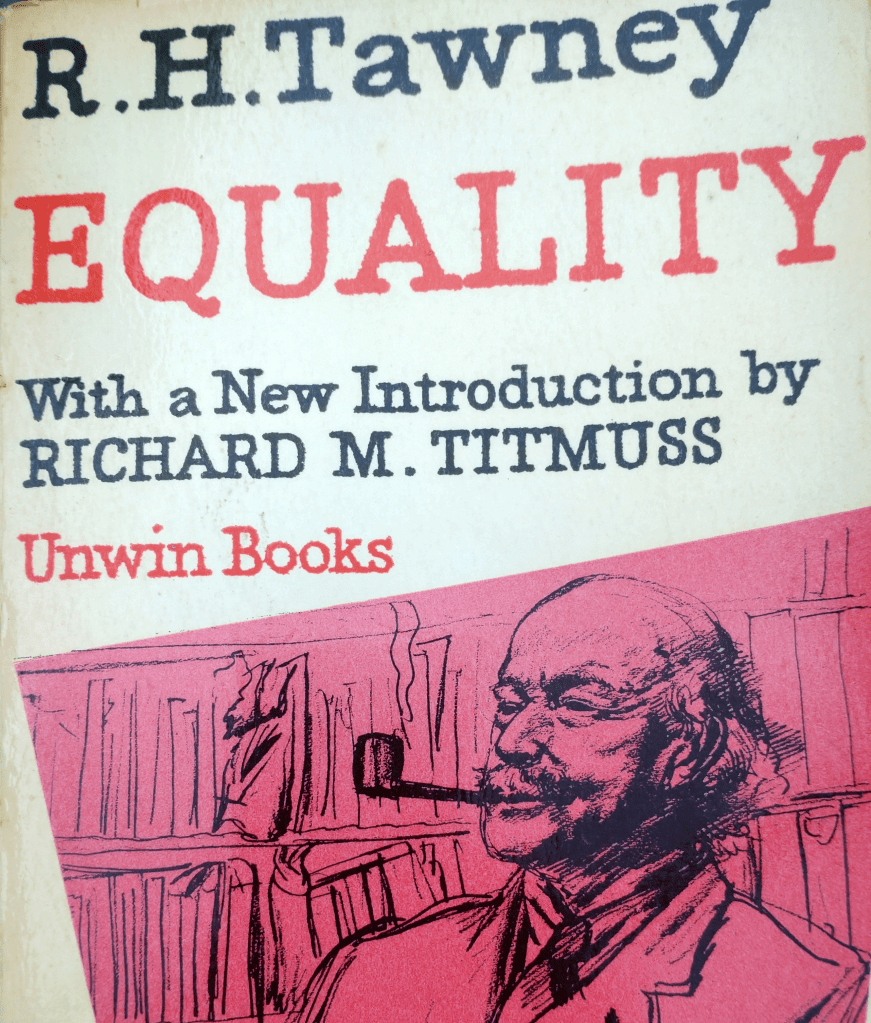
That’s definitely my sense while reading a book called Equality by an old socialist and economic historian, RH (Richard Henry) Tawney. My edition dates from 1964 but the original book was published in 1931, based on lectures given in 1929. This version enjoys a 1964 introduction by founding father of social policy Richard Titmuss, and no fewer than two prefaces by Tawney himself, one from the 1951 revised edition and one from the ‘substantially revised’ 1938 edition. Reading through these in this order is like uncovering historic layers of English inequality, and repeated aspirations for greater equality. What’s more, the first chapter of the book, The Religion of Inequality, starts by referring to a lecture by Matthew Arnold from I think 1878, to which it attributes the coining of that phrase.

I find it impossible to read these archaeological artefacts and not reflect on our own age. This blogpost aims simply to capture a few sentiments from each of these layers of history. Readers will no doubt be conscious of the great ruptures and attempts towards greater equality that provided the context for the writing of each of these layers of commentary, from the heights of the Cold War, the challenges of the Second World War and the creation of the welfare state that followed it, the Great Depression and the rise of fascism – and even, back around the 1870s, the first steps to broad enfranchisement (and while the right to vote did not then extend to women, that decade did see them permitted for the first time to retain their own property rather than simply surrender it on marriage).
Titmuss in his 1964 introduction:

“We…delude ourselves if we think we can equalize the social distribution of life chances by expanding educational opportunities while millions of children live in slums without baths, decent lavatories, leisure facilities, room to explore and the space to dream. Nor do we achieve with any permanency a fairer distribution of rewards and a society less sharply divided by class and status by simply narrowing the differences in cash earnings among men during certain limited periods of their lives.”

“Long years of economic depression, a civilians’ war, rationing and ‘fair shares for all’, so-called ‘penal rates’ of taxation and estate duty, and ‘The Welfare State’ have made little impression on the holdings of great fortunes…Wealth still bestows power, more power than income, though it is probably exercised differently and with more respect for public opinion than in the nineteenth century.”

“These consequences of technology in an age of abundance are more likely to increase than to decrease differentials in income and wealth if no major corrective policies are set to work…Without a major shift in values, an impoverishment in social living for some groups can only result from this new wave of industrialism.”

Tawney in his 1951 preface:

“Like earlier wars of religion, the credal conflicts of our day will find varying issues in different regions; but, if Europe survives, societies convinced that liberty and justice are equally indispensable to civilization will survive as part of her. The experience of a people which regards these great abstractions, not as antagonists, but as allies, and which has endeavoured, during six not too easy years, to serve the cause of both, is not barren of lessons which may profitably be pondered.”

And he quotes The Times from 1 July 1940:

“If we speak of democracy, we do not mean the democracy which maintains the right to vote, but forgets the right to live and work. If we speak of freedom, we do not mean a rugged individualism which excludes social organization and economic planning. If we speak of equality, we do not mean a political equality nullified by social and economic privilege. If we speak of economic reconstruction, we think less of maximum production…than of equitable distribution.”

Tawney in his 1938 preface:

“It is still sometimes suggested that what Professor Pigou, in his latest work, calls ‘the glaring inequalities of fortune and opportunity which deface our present civilization’ are beneficial, irremediable, or both together. Innocent laymen are disposed to believe that these monstrosities, though morally repulsive, are economically advantageous, and that, even were they not, the practical difficulties of abolishing them are too great to be overcome. Both opinions, it may be said with some confidence, are mere superstitions.”

“Institutions which enable a tiny class, amounting to less than two per cent of the population of Great Britain, to take year by year nearly one quarter of the nation’s annual output of wealth…are an economic liability of alarming dimensions. They involve…a perpetual misdirection of limited resources to the production or upkeep of costly futilities, when what the nation requires for its welfare is more and better food, more and better houses, more and better schools.”

“Today, when three-quarters or more of the nation leave less than £100 at death, and nearly two-thirds of the aggregate wealth is owned by about one per cent of it, inheritance is on the way to become little more than a device by which a small minority of rich men bequeath to their heirs a right to free quarters at the expense of their fellow-countrymen. The limitations imposed on that right during the past half-century were greeted, when first introduced, with the usual cries of alarm; and the alarm, as is not less usual, has been proved by experience to be mere hysteria. It is perfectly practicable, by extending those limitations and accelerating their application, to reduce the influence of inheritance – at present a strong poison – to negligible dimensions.”

“To make [democracy] a type of society requires an advance along two lines. It involves, in the first place, the resolute elimination of all forms of special privilege, which favour some groups and depress others, whether their source be differences of environment, of education, or of pecuniary income. It involves, in the second place, the conversion of economic power, now often an irresponsible tyrant, into the servant of society, working within clearly defined limits, and accountable for its action to a public authority.”

Tawney reports that Matthew Arnold said, in c1878:

“Arnold observed that in England inequality is almost a religion. He remarked on the incompatibility of that attitude with the spirit of humanity, and sense of the dignity of man as man, which are the marks of a truly civilized society. ‘On the one side, in fact, inequality harms by pampering; on the other by vulgarizing and depressing. A system founded on it is against nature, and, in the long run, breaks down.’”

As LP Hartley says in another old book, one that deliberately plays with memory and history, “The past is a foreign country; they do things differently there.” But often ‘they’ worried about the same challenges we do, and sought similar solutions.

I am happy to confirm as ever that the Sense of Fairness blog is a purely personal endeavour.

See also: Plague and planning: a long history of English unfairness
Unveiled: fleeced by power and business as usual

RH Tawney, Equality, 1964, Unwin

Arthur Pigou, Socialism versus Capitalism, 1937

LP Hartley, The Go-Between, 1953

Data and inequality

Long-term readers will know that I have my doubts about the value of the precise measurement of inequality known as the Gini coefficient. It’s one of the specific examples of my general cynicism about overly specific measurements. Things are usually a good deal more complicated.

Nonetheless it is fascinating to read John Burn-Murdoch’s piece for the Financial Times this weekend, Inequality hasn’t risen. Here’s why it feels like it has, which is grounded wholly in the Gini coefficient. Burn-Murdoch is the FT’s Mr Statistics, and he is always readable and interesting, so I’ll forgive the obsession with the use of single datapoints that will always be flawed if viewed in isolation (and I’ll acknowledge also that he recognises the limits of Gini: “Aggregate inequality statistics certainly have their place, but they can mask important nuances,” he writes).

The core of Burn-Murdoch’s article is the data shown in these charts:

He notes the increased attention to inequality over the past decade, even though the Gini numbers suggest it is in fact falling in both the UK and US, and he attributes this to a squeezing of the middle class between improved treatment of the poorest paid (which appears to be the driver of more than the total drop in the Gini measurement) and an increased stretching of the advantages of those best off in our society (which has increased inequality, but less than the reduction driven by the improvements for those least well off). While it’s known that the minimum wage in the UK and its bolstering over time has helped those least well off here, it is more surprising to find that some similar improvements have also been experienced by the poorest in the US also, despite the notorious stagnation of the national minimum wage there. This squeezing effect is reflected in the title given to the article in the paper copy of the newspaper: Why the middle class is right to feel squeezed.

This blog would naturally suggest that one reason why there is increased noise about inequality now, despite the falls in the Gini coefficient, is that the problem as humans see it is unfairness, not inequality, and the bluntness of Gini fails to capture the richness of human experience. In particular, it’s hard to believe that the improvement in the incomes of the poorest is genuinely felt to be an improvement in their life experience – perhaps especially as they have experienced greater inflation than wider society over recent times. The moves in Gini may be masking insight as much as they are revealing.

Burn-Murdoch is clearly right when he highlights the reductions in sense of opportunity available to many in society – opportunity both for themselves and for their children. But, for this blog at least, these are questions of fairness, not of inequality (measured by Gini or in some other way).

See also: Fairness – the human lens for addressing our current challenges
What gets measured gets managed – unfortunately
The centre cannot hold
Inflation’s two separate world’s (at least)

I am happy to confirm as ever that the Sense of Fairness blog is a purely personal endeavour.

Inequality hasn’t risen. Here’s why it feels like it has, John Burn-Murdoch, Financial Times, 4 January 2025

Plague and planning: a long history of English unfairness

A historical meander through the countryside for the holidays

The quintessential vision of England is of a village set in rolling countryside. Depending on the topography, this may be hills cropped by sheep, or less frequently other farm animals, or flatter lands growing cereal. But whatever the countryside, the village is consistently there (whether or not, like former prime minister John Major, we include in our image cricket and warm beer and spinsters cycling across the village green). We imagine these villages as images of fairness and justice, representing the ordinary people of England, strong, independent and free.

But those villages have not always been there. And they do not always represent fairness, independence or freedom (even if we can set aside modern concerns about incomers pricing out locals). Any settlement and community is the creation of a set of decisions. Some of those decisions were by ordinary folk choosing to come together for their own reasons. But many times what are now viewed as symbols of peace and tranquillity were created by force at the whim of the local landlord, a feudal founding created to control the population and ensure that it was productive – to the benefit of the seigneur.

The bucolic beauty that we tend to take for granted was often an emblem of power and an assertion of unfairness. The same villages have also over centuries witnessed further episodes of the ebb and flow of power, and of fairness. We tend to imagine these places unchanged forever. They are not.

It used to be thought that there was a ‘village moment’ in England, when villages suddenly appeared in the landscape. My use of the term ‘seigneur’ was deliberate, for this ‘moment’ was for decades ascribed to the Norman invasion of 1066 and the following years, when newly created feudal lords established villages as power bases to control the population and its work effort. It is not just that the Domesday Book (which dates to 1086) provides us with the first consistent written record of the existence of English villages (though often it refers to individual farmsteads or small hamlets that later developed, or were developed, into villages).

This belief in a particular moment of village creation was reinforced by the archaeological digs of abandoned (or shrunken) mediaeval settlements, which “showed very little evidence for occupation earlier than the eleventh or twelfth century” as Carenza Lewis and colleagues explain in their key work Village, Hamlet and Field. But the belief eroded as further investigations, not least of settlements that continue to exist, tended to extend the moment to a rather broader period: they “seemed to push forward the origin of the large nucleated village to the period between about 850 and 1200”. It’s tempting to suggest that the disproportionate representation of the Norman-created villages among those that were subsequently abandoned is a sign that their artificial creation meant they were less sustainable than those created organically by a population choosing to move closer together, but I suspect that’s a little pat.

While landscape historians have pushed back the creation of many villages, it is undoubtedly true that many others were created soon after the Norman invasion, by those new feudal landlords: “lordly authority was clearly a key motor in the planning of settlements,” explains Oliver Creighton in his Designs Upon the Land. He further says: “The well attested phenomenon of seigneurial village planning, which in many cases extended to embrace field systems, can be taken as further evidence for the expression of lordly authority.”

These Saxon and mediaeval creations were of course not the first villages, though they were the first of a scale that we would recognise, and the first to include a village church (typically seen as the signifier of the distinction between village and hamlet). There were Neolithic villages – examples of these can still be seen at Scara Brae in Orkney, Carn Euny in Cornwall and Ty Mawr on Anglesey (preservation is better in remote places). But life generally remained scattered until towards the end of the Anglo-Saxon period.

These were not the first villages, but these were the first that we might recognise today. And, whatever the timing of their creation, all were under tight command and control arrangement, “a tightly managed landscape” says Trevor Rowley in the classic Villages in the Landscape. “The manorial court was responsible for the regulation of internal field boundaries, the precise amount of grazing and rights of gathering on the common waste, and it also had responsibility for the trackways and streams. The manor courts collectively administered rules of husbandry, watched over local customs of tenure and inheritance and enforced local peace and order. By 1300 we would have looked on a landscape which was intensively used at a subsistence level.” This was not a fair landscape: most lived the hardest of subsistence existences while a small handful prospered.

As Rowley summarises: “the permanent nucleated village so familiar to us today was a factor not of ethnic or cultural change, but of economic and social forces. It was brought about by a complex combination of increasing population and increasing authoritarian control through the manorial system”.

And it wasn’t only the villages, but the landscape more broadly. Creighton takes a particular interest in parkland, land taken into private ownership as a venue for hunting. He points out that taking land out of agricultural production and creating parks was not an economic decision, but a social one driven by concerns of status. “The right to empark was a jealously guarded privilege and badge of lordly authority,” he writes. “The huge outlay involved in the creation of parks and the challenges of maintaining them, combined with the minimal financial returns that accrued, shows that they were not geared to maximise profit by cold, hard businesslike patrons.”

Ridge and furrow – a relic of mediaeval communal shared fields – within the private walled grounds of the National Trust’s Canons Ashby, Northamptonshire. An example of the historic privatisation of shared land

This contrasts of course with the much later enclosure movement when the wealthy took land out of common usage by the general population and asserted their direct ownership of it (often with the formal endorsement of acts of parliament – the law being used to enforce the demands of the powerful). Enclosure coincided with the agricultural revolution, making the productivity of the seized lands more than recompense the cost of the creation of the hedges, walls and fencing – and of the policing of the protests from the dispossessed population. Susanna Wade Martins in Farmers, Landlords and Landscapes reports that after enclosure, “Productivity could sometimes be doubled and rents went up by an equivalent amount.” That wasn’t the case with mediaeval seizures.

Parks in the mediaeval era were just as contested as the enclosed lands, though. As Creighton points out, “Many parks were recorded for the first time not when they were licenced or created, but when they were first broken into.” He suggests that poaching may have been just an assertion of continuing rights to seek food in emparked land.

Alongside this privatisation of land, from 1250, the elite turned more aloof, power and wealth enabling them to distance themselves from ordinary folk. Increasingly, the wealthy kept themselves apart, both in the siting of their own property and in the design of their buildings also. Creighton says: “an increasingly aloof aristocracy … was progressively increasing the social distance between the household and the world beyond the walls… This is part of a pan-European phenomenon evident at key lordship sites in France, Germany and Scandinavia and, in turn, part and parcel of a broader phenomenon of the increased privatisation of space, as manifested particularly clearly in the changing function of the hall and modes of domestic planning that enabled individuals to spend more time in individual rooms.” This period seems to coincide with a trend towards moated sites for elite dwellings – typically a symbolic separation rather than offering any degree of protection. This trend towards status symbols and separation was reflected in food also, for example it is at this period when the eating of more exotic birds becomes an activity for the elite, and the poor were excluded from certain foods.

This move is not to be taken lightly. In his The Archaeology of Power, John Steane discusses the ceremonial role of the lordship’s property, in particular the community role fulfilled by his hall, “the architectural expression of the household”. He quotes from William Langland, the 14th century supposed author of Piers Plowman, who criticises those lords whose halls have become a “sorry, deserted place” because “the rich nowadays have a habit of eating by themselves in private parlors”. The implications of the harm caused to community and society as a whole by this withdrawal are significant.

This was an age of remarkable unfairness. The majority toiled, a few did well – and increasingly turned their backs on the toilers, living very separate lives. It took a devastating event, or series of events, to reawaken fairness in our country. Those events were the repeated scourges of the Black Death (which first swept across Europe in the years either side of 1350), devastating the population and bringing enormous changes in its diseased wake.

I wrote in my last post about the impact of the Second World War in sweeping away some of our nation’s then ossified unfairness and injustice. And I noted that we must hope that it doesn’t take such an event to sweep aside the unfairness that has built up again in our society. The Black Death was a still more lethal and traumatic event that led to an even more remarkable reversal of inequalities. According to James Belich’s analysis in his remarkable and epic history of the consequences of the plague era, The World the Plague Made, around half of Europe’s population died from the initial outbreak of the plague (he spends a whole chapter justifying this conclusion, which is greater than the usually quoted one-third, a death toll that would have been remarkable enough).

As Belich explains, this halving of the population dramatically increased the value put on labour – meaning that the poorest suddenly began to be paid more. The poorest may have doubled their available spending capacity (even the smallest increment in pay for someone operating at subsistence levels will enable this), as well as giving them more leisure time; others fared better in absolute terms. The decrease in the availability of labour, and the increase in its cost, led to a productivity revolution – and with the same capital goods now shared between a halved population there was significant scope for such a productivity shift. This, together with increases in money available across the economy, led to a boom in demand for what had previously been luxuries available only to the few. Trade boomed, deploying the same shipping capacity for the benefit of the halved population. Many were freed from subsistence farming and agricultural patterns shifted to favour more specialisation.

Belich argues that it was the plague that led to Europe’s imperial dominance of the globe over subsequent centuries. One vehicle for this, he suggests, is that the fairness of the post-plague era lingered long enough in folk memories that it made ordinary people willing to risk everything to travel to far off lands in search of a better life, a life more like the less unequal era post-plague.

Those with Scottish and Irish heritage will no doubt baulk at this, pointing to the enforced movements caused by those great historic injustices the Clearances and the Great Hunger (the capital letters just a nod to their cultural significance) – and others will point to other causes in other lands. There’s truth that many travelled the world (and do so now as well as then) because their homeland no longer offered them a home, but both events came later than Belich intends. He is thinking about the start of the European imperial era, in the fifteenth and sixteenth centuries, when the journey itself was extremely hazardous, with around 30% dying even before they reached their destination – let alone the challenges of the precarious imperial outposts that were created. Those of course are the odds of those who travelled freely as free people, not of those who were enslaved, nor those of the indigenous peoples whose lands were taken from them.

European people travelled in spite of these odds, Belich believes, because they remembered the freedom and fairness that followed the horrors of the Black Death. A small hope for fairness will inspire many to action.

As we walk the countryside, we should recognise how it offers insights into past unfairness, and not the simple bucolic beauty that is all we sometimes see.

I am happy to confirm as ever that the Sense of Fairness blog is a purely personal endeavour.

Village, Hamlet and Field: Changing Mediaeval Settlements in Central England, Carenza Lewis, Patrick Mitchell-Fox, Christopher Dyer, Windgather Press, 2001

Designs Upon the Land: Elite Landscapes of the Middle Ages, Oliver Creighton, Boydell Press, 2009

Villages in the Landscape, Trevor Rowley, Dent, 1978

Farmers, Landlords and Landscapes: Rural Britain 1720-1870, Susanna Wade Martins, Windgather Press, 2001

The Archaeology of Power, John Steane, Tempus Publishing, 2004

The World the Plague Made: The Black Death and the Rise of Europe, James Belich, Princeton University Press, 2022

Debilitating poverty

Being poor brings many disadvantages. A lack of money squeezes options and reduces opportunity. It hampers health and makes ambition harder. But the effects aren’t just direct and physical. They are psychological too. Researchers are beginning to uncover just how debilitating being poor is for effective thinking.

The answer to the question posed in the title Do Financial Concerns Make Workers Less Productive? was a resounding yes. Not only did poor workers whose money troubles were temporarily alleviated produce more, they also made fewer mistakes in production, despite operating more quickly. There is a clear business productivity benefit from this poverty alleviation; and in work that pays piece rates – where workers are paid for their useful output in numbers of products – this alleviation of worry also enabled them to earn more.

In a world of unfairness in which many are kept poor, these are significant findings. In a world seeking greater growth, where growth has been held back by stagnant productivity, they are still more important.

The increase in productivity shown was much greater than that brought about by an increase in the piece rate paid (which in a control experiment was done alongside a cut in base pay so that overall earnings were steady). There was a small increase in output following the piece rate increase, but it was less than a tenth of the change brought about by removing money worries – and there was no discernable increase in the quality of production, meaning this piece rate change delivered much less than a twentieth of the improvement in productivity that alleviating poverty did.

It’s worth noting that the researchers were able to discard alternative explanations of why these workers become more productive. In particular, they specifically discounted the possibility that improved nutrition of the poverty-relieved workers was the cause, because of the speed of the effect of the early payments and the lack of difference in nutritional intake in that short period. The effect is a psychological one: workers who don’t need to worry constantly about money are more productive.

This means that our economies are being held back by workers who are less productive than they could be, simply because they do worry about money on an ongoing basis. GDP growth is being artificially depressed and poverty alleviation could help it recover. This represents a business, investment and economic opportunity.

These findings are depressing. But it’s worse to find that growing up in poverty also has debilitating effects on children.

A recent study finds that poor students underperform their usual standard on maths tests that use real-world scenarios involving money, food or social interactions. It’s not a small effect, either: their performance is on average 18% lower than it is on questions overall – and, the researchers note, it would look even worse if they compared performance against just those questions that are more neutral.

These results were surprising to the researchers, who were expecting to see outperformance in these more practical questions, revealing hidden talent among poor students (they use the jargon low SES, socioeconomic status) that may be untapped by traditional education. That’s the reason why such questions have increasingly been used in modern testing: they are thought to be more accessible to all students. But the result of this study indicates that accessibility comes at the price of triggering distracting thoughts for poorer young people. As the chart shows, performance is worst with regard to questions that refer to money specifically.

Another recent study also found evidence of underperformance on money-linked questions by poor students. It puts this down to ‘attention capture’ as the researcher identified an effect not only on the specifically money-linked questions but also underperformance on more neutral questions asked subsequent to them. It seems as though the question reminds the students to worry about money, and they then can’t shake off the concerns.

These results amount to another example of apparent meritocracy in fact acting to limit the opportunity of those who start with less. As the Fictional Money, Real Costs paper states:

“Examinations are an efficient mechanism to benchmark and rank a population based on a specific set of skills. The notion that they are fair, however, has increasingly been questioned. A significant concern is that performance differences reflect inequities in the testing process itself, rather than differences in underlying skills, and thus may contribute to the intergenerational transmission of existing inequality.”

See also: Meritocracy’s unfair
Business and investment’s fairness challenge – and opportunity

I am happy to confirm as ever that the Sense of Fairness blog is a purely personal endeavour

Do Financial Concerns Make Workers Less Productive?, Supreet Kaur, Sendhil Mullainathan, Suanna Oh, Frank Schilbach, National Bureau Of Economic Research Working Paper 28338, January 2021

Math items about real-world content lower test-scores of students from families with low socioeconomic status, Marjolein Muskens, Willem Frankenhuis, Lex Borghans, npj Science of Learning, vol 9, art 19 (2024)

Fictional Money, Real Costs: Impacts of Financial Salience on Disadvantaged Students, Claire Duquennois, American Economic Review 2022, 112(3): 798–826

Business and investment’s fairness challenge – and opportunity

“We need a major repair that is not going to be found in the traditional economic models that consider the social impact of our decisions as something to be fixed ex post through social policies and redistribution. It needs a major change in the economic narrative, that brings equality and sustainability objectives on an equal footing with productivity and growth when measuring success. And it needs to bring in the private and the financial sector to change the way they define and measure their objectives and actions ex ante.”

So said Gabriela Ramos, Assistant Director-General for Social and Human Sciences of UNESCO, at the launch of the mouthful that is the Taskforce on Inequality and Social-related Financial Disclosures, or TISFD – an organisation she will co-chair – at the end of September.

Ramos went on to express the hope that the TISFD disclosure framework “will encourage organisations to consider the broader impact of their operations in an ex ante manner and make the social implications of business models transparent … We need to integrate the private sector and the financial sector in the solution because with that we can drive meaningful change that aligns economic progress with positive social impact.”

One of her fellow co-chairs, Arunma Oteh, former World Bank Vice President and Treasurer, and former Director General of Nigeria’s Securities and Exchange Commission, took the opportunity of the launch webinar to invite the investment and business communities to take part in the development of the TISFD standards: “By participating in this process businesses and financial institutions in my view will gain a deeper understanding of how social and inequality issues contribute to systemic risks that can affect financial markets and the global economy.”

Her aspiration is clear: “By standardising how organisations report on social-related issues we can also empower all stakeholders to hold businesses and financial institutions accountable for their social impact.”

These are not small ambitions. It’s clear that the new Taskforce will throw down a gauntlet for both business and the investment community, to think more deeply about the negative implications of business models and investment for society, and particularly the danger that the current approaches further foster inequality. In the language of this blog, the ambition is to instil a greater sense of fairness in business and investment.

Fortunately, there are a few voices from the world of business talking about these issues. Professor Scott Galloway, a successful tech entrepreneur – with an unusual humility for someone with that background – turned educator, is typically excoriating in a recent blog on the US minimum wage: “We have epidemics in the US — depression, anxiety, high blood pressure, homelessness, obesity, and poverty — among young people, particularly men. (Though it’s worth noting here that the majority of people making the minimum wage in the US are women.) The most powerful means of addressing these ills, and the ‘deaths of despair’ that follow, is a good job at a fair wage that acknowledges the nobility of work. In addition, a good job creates incentives and illuminates a path to wealth creation and economic security.” He is clearly referencing the work of economist Angus Deaton, and in doing so highlights the opportunity for investors: economies with fairer pay will prosper more. But Galloway is an unusual figure, in multiple different ways.

Peter Bakker, CEO of World Business Council for Sustainable Development (WBCSD), and former CEO of Dutch logistics firm TNT, talked about the creation of the TISFD arising out of earlier work of the Business Commission to Tackle Inequality: “One of the key conclusions out of that work is that the way that business makes decisions today, the way that businesses are managed, the way that capital markets look and value businesses, does not incorporate the social- and inequality-related risks, the dependencies and the impacts that business actually has on society and on people in it.”

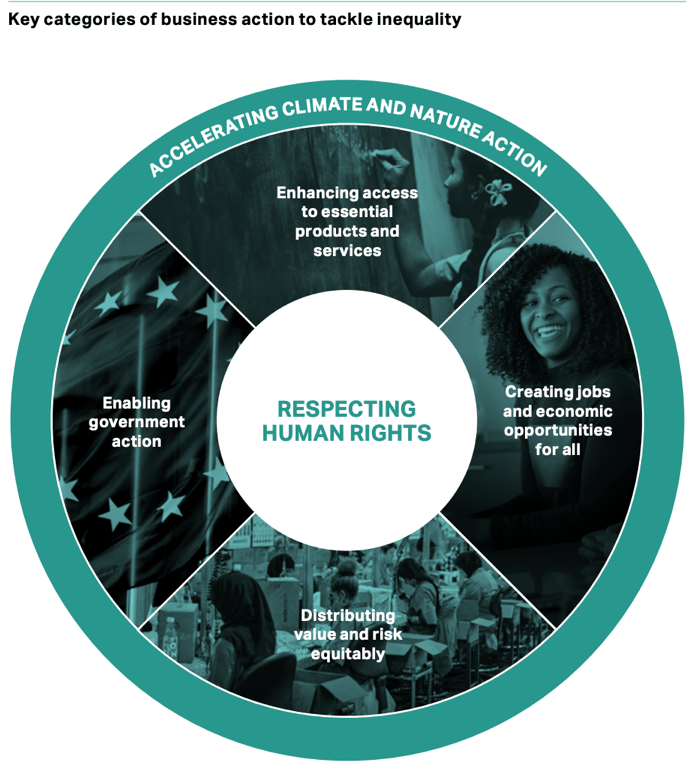
This image from the Business Commission to Tackle Inequality’s flagship publication shows the breadth of what that group sought to encompass. If anything, the breadth of the challenges that TISFD is intending to cover is still greater. The inclusive – even eclectic – nature of the issues covered by the new group readily demonstrated by the failure (at least so far) to find a streamlined name for the Taskforce. It represents the combination of separate groups, one considering inequalities and the other social issues. Of course there are multiple cross-overs between these areas but clearly neither group felt able to compromise over the name.

As well as the spread of its ambitions, the inclusive nature of the TISFD is also shown by the breadth of the backgrounds of the co-chairs. The fourth co-chair is Sharan Burrow, the redoubtable former General Secretary of the International Trade Union Confederation. She noted that TISFD’s aim goes far beyond disclosure: “If we think about it as an end process which is just disclosure then we’re not actually considering what the recommendations must do, which is actually to put up front the sorts of issues that ought to be taken into the business model, the externalities, the risks that must be accounted for in planning.”

Bakker agreed: “Do not make the mistake that TISFD is about disclosures or reporting, because that’s the mistake that everybody always makes in the sustainability world. The reporting bit is the end of a process in which better decisions are made and that’s how you influence the social impacts towards a more positive outcome.”

Bakker went on, and laid down the crucial challenge particularly for the investment world:

“It is partly corporate decision making, partly corporate disclosures, but it’s also about how financial markets will then pick up this decision-useful information and provide incentives for a much fairer and more equal and inclusive world.”

We will see if investors are ready to rise to this challenge.

See also: Deaton’s economics: fair criticism?

I am happy to confirm as ever that the Sense of Fairness blog is a purely personal endeavour

Taskforce on Inequality and Social-related Financial Disclosures

TISFD Launch Webinar, September 27 2024

Doing the Minimum, No Mercy/No Malice blog, Professor Scott Galloway, September 13 2024

Business Commission to Tackle Inequality

Tackling inequality: An agenda for business action, Business Commission to Tackle Inequality, May 2023

Is enough enough? Addressing the problem of the super-rich

“To make the poor richer, you have to make the rich poorer.”

It’s one of the bolder early assertions made in a new book, Enough: Why it’s time to Abolish the Super-Rich, from my friend Luke Hildyard, who leads the High Pay Centre, the think tank dedicated to considerations of pay and employment rights. Given the hours he put into it, he’ll hate that I note it’s a short book, but that means it is a quick read – which its brisk and energetic style greatly assists. It includes extensive references to the evidence of academic and other studies, but Hildyard doesn’t let them weigh down his central messages and arguments.

Much of the book is dedicated to demonstrating the truth of this early assertion. Beyond that, Enough also aims to show that there would be benefits from a more equal income and wealth distribution and that much current income and wealth is unearned and undeserved. It argues that it is possible to address the issue of the super-rich, both politically and practically – but that at present the political will isn’t there and the social pressure for change isn’t yet great enough. “The super-rich are tragically unloathed,” says Hildyard in one of his typically crisp and blunt phrases.

As is perhaps obvious, this is a polemic, using vigorous and direct language to make its points – and it is none the worse for it. It’s also funny. I didn’t expect to laugh out loud at the book, but its dogged pursuit of a thought experiment of carpeting the nation in £5 notes is only one among its amusing moments.

Hildyard also charts a path for addressing the issue of the super-rich, one part of which would be wealth taxes. That particular path became potentially much easier just yesterday when a UN committee of tax experts agreed to develop a clear map for it: the Committee of Experts on International Cooperation in Tax Matters approved guidance for the creation of wealth taxes. This will not be called a ‘model law’ but rather an ‘example law’, but the intent is clear, and the idea of international cooperation in this area is aimed to reduce incentives for individuals to move to avoid such tax burdens. We’ll see how far these proposals progress in practice.

There is clearly some political will, and indeed some general willingness to engage in these issues. If the interest shown by those seeing me reading Enough on public transport are anything to go by, this is a book whose time has come. I would certainly heartily commend it. It was formally published this last week.

In many ways, vigorous and blunt as it is, Hildyard’s language is less hardline than others’. For example, the authors of the wonderful Spirit Level, Kate Pickett and Richard Wilkinson, both professors of epidemiology at York University, recently wrote a comment piece published in venerable journal Nature entitled Why the world cannot afford the rich.

As well as noting the disproportionate greenhouse gas emission impacts of the lifestyles of the wealthy (as previously noted in this blog), Wilkinson and Pickett state: “large differences in income are a powerful social stressor that is increasingly rendering societies dysfunctional”.

They continue:

“bigger gaps between rich and poor are accompanied by higher rates of homicide and imprisonment. They also correspond to more infant mortality, obesity, drug abuse and COVID-19 deaths, as well as higher rates of teenage pregnancy and lower levels of child well-being, social mobility and public trust.”

Most strikingly, the epidemiologists argue that “Even affluent people would enjoy a better quality of life if they lived in a country with a more equal distribution of wealth”. They complain about the wastefulness of unfair distributions: “Inequality also increases consumerism…Studies show that people who live in more-unequal societies spend more on status goods.” It’s certainly clear that this is happening. For example, ultra-luxury carmaker Bentley recently revealed its financial results, making revenues of €2.9 billion on sales of just 13,560 cars (or over €200,000 per vehicle), with margins improved by a record of nearly 10,000 of those vehicles including personalised features costing upwards of €40,000. For these buyers, it appears, it’s not enough to be able to buy a car that costs more than many houses. They also want the additional status of a still more expensive and truly unique vehicle.

The wealthy also buy other trappings of status – like the arts building branding that was part of the focus of the Sackler family in deploying their immoral earnings from Purdue Pharma’s role in the opioid crisis, or political donations. Evidence shows that rarely are such gifts really generosity – something is expected in return (as the reliably brilliant Tom Burgis amply shows in his excoriating new book Cuckooland). Sadly, rarely do the super-rich now feel the need to be genuinely generous in sharing their wealth in the ways their predecessors in earlier generations did. Alms houses are among our most beautiful old buildings, mostly built by our wealthy Tudor or Victorian forbears, but there seems to be no modern equivalent being created now.

This urge towards status skews our whole business sector. When you now look at the market capitalisations of major businesses, it is notable how much more valuable are the luxury goods companies that cater to the demands of a tiny minority than those that provide much larger markets with less luxurious versions of the same products. Germany’s Porsche is valued at more than $90 billion and Italy’s Ferrari (actually listed in the Netherlands to benefit from rules allowing unequal voting rights) is touching a valuation of nearly $80 billion; Ford and General Motors hover around the $50 billion mark, while producing orders of magnitude more vehicles. In a similar way, the valuation of Hermes (around $270 billion) is nearly double that of Inditex, whose major brand is Zara (valued at some $150 billion). The mass market isn’t where the money is made any more: even collectively, the centre doesn’t hold as much spending power.

Pickett and Wilkinson capture their findings in a striking chart that sets the Gini coefficient measure of inequality against an index the authors created of environmental, health and social issues (including measures such as air pollution and recycling; infant mortality, life expectancy, and obesity; and educational attainment, teenage births, social mobility and trust). As they say, “There’s a clear trend, with more-unequal societies having worse scores”:

As an earlier editorial in Nature raged, Reducing inequality benefits everyone — so why isn’t it happening? Essentially, that’s the challenge that Hildyard is attempting to rise to, and he provides some useful answers, and relevant solutions, as well as amusing challenge to the status quo. Do we need to make the rich poorer in order to make the poor richer? Probably, yes. The greatest political challenge on this issue though is likely to be defining what amounts to ‘rich’ or ‘super-rich’ for these purposes. One hindrance to action may be that definitions of what is too much are hard to draw. It’s hard to build a coalition of the willing among those who fear they may be next to face reductions (even if intellectually they might accept the idea that they would benefit from less inequality), and that – for the present at least – seems to limit the political pressure for change.

Hildyard himself blurs these lines, at times railing only and specifically at the truly (absurdly) super-rich, the billionaires, and at other times focusing on broader wealthy groups, including all public company bosses, top lawyers and bankers, and anyone earning in the top 1%, or having wealth among the top 1%. He quotes income of £183,000 and wealth of £3.7 million for the UK, and $400,000 and $11 million respectively for the US, as placing people into the respective 1% groups. These are huge numbers, clearly, but not close to being in the same league as the billionaires. A focus on a loosely defined super-rich elides this challenge – and while Hildyard demonstrates just how much might be available from the individuals at the very top of the income and wealth distributions, were they taxed more effectively (a simple function of their extreme wealth), he leaves open the question of seeing changes lower down the income levels too. This doesn’t undermine his arguments, but clarity is likely to be helpful in garnering political support and leveraging real change.

Hildyard ends the book saying:

“Indeed, it will be impossible to achieve our full potential to build a fairer, happier, more prosperous society without a major rebalancing of incomes and wealth. This ought not to be a question of partisan ideology – the logic, feasibility and urgent importance of the issue are clear. It is time to abolish the super-rich.”

I’d argue that all of this but the final sentence is unarguably true – that last sentence probably remains open to some debate, not least as to where the threshold for super-richness lies.

As the phrase goes, the poor are always with us. It is less clear that the super-rich need to be.

See also: Unfairness in carbon emissions

The centre cannot hold

As ever, I am pleased to confirm that the Sense of Fairness blog is a purely personal endeavour.

Enough: Why it’s time to Abolish the Super-Rich, Luke Hildyard, Pluto Press, 2024

Subcommittee on Wealth and Solidarity Taxes Guidance as of 1 March 2024, UN Committee of Experts on International Cooperation in Tax Matters

Why the world cannot afford the rich, Richard Wilkinson, Kate Pickett, Nature 627, 268-270, 12 March 2024

The Spirit Level: Why Equality is Better for Everyone, Kate Pickett, Richard Wilkinson, Penguin, 2010

Highest Levels of Personalisation Drive Second Best Financial Performance on Record for Bentley Motors, Bentley, 19 March 2024

Cuckooland: Where the Rich own the Truth, Tom Burgis, HarperCollins, 2024

Reducing inequality benefits everyone — so why isn’t it happening?, Nature 620, 468, 16 August 2023