
I fight shy of defining fairness. There’s a broad range of options that fulfil fairness for human beings – and different individuals will reach different judgements as to whether a particular circumstance falls within that range. There’s somewhat more clarity about unfairness. That concept animates us all so viscerally that we can more readily agree that something is unfair, even though there is much human judgement in that too.
This human and emotional side of fairness and unfairness is exactly why it is more rewarding to explore than the definable and measurable concepts of equality and inequality.
Such is the strength of my sense that I shouldn’t seek to define fairness that throughout my forthcoming book I provide no easy answers. Instead, I talk about ways in which businesspeople and investors can develop their own approach to finding a fair landing ground. I believe that the push and pull between people is so key to finding what is fair in any particular circumstance that making assertions in the absence of its particular details is all but impossible. It’s not by chance that the legal approach of equity is entirely based on reaching a fair outcome, setting aside any detailed legal rules: equity – fairness – can’t be defined in advance, successive courts have found, but only decided by judges considering the facts of the individual case. The same is true of fairness outside the court context: it must be subject to judgement based on the particular circumstances.
So I found myself baulking a little at those sections of Will Snell’s highly accessible new book The Fair Necessities that assert “Fairness is definable”. Indeed, for Snell, the CEO of the wonderful Fairness Foundation, the definition of fairness is based on his eponymous ‘fair necessities’ (which he and the Fairness Foundation first launched on the world in 2021). They are, exactly as he sets them out in the book:
- Fair essentials: Everyone should have their basic needs met, but we need to go further to enable people to play a constructive role in society.
- Fair opportunities: Everyone should be able to thrive, without having to overcome unreasonable barriers to opportunity or earn a huge salary.
- Fair rewards: Everyone’s hard work should be rewarded, in line with their contribution to our society as well as to our economy.
- Fair exchange: Everyone should contribute to society by paying their fair share in tax, and in return should be supported by society when they need it.
- Fair treatment: Everyone should be treated with equal respect and should be able to exercise equal influence on decisions made in their name.
These seem to me a good articulation of key pillars of fairness, and key elements of what fairness might look like if delivered in practice. But a definition? Maybe not so much.
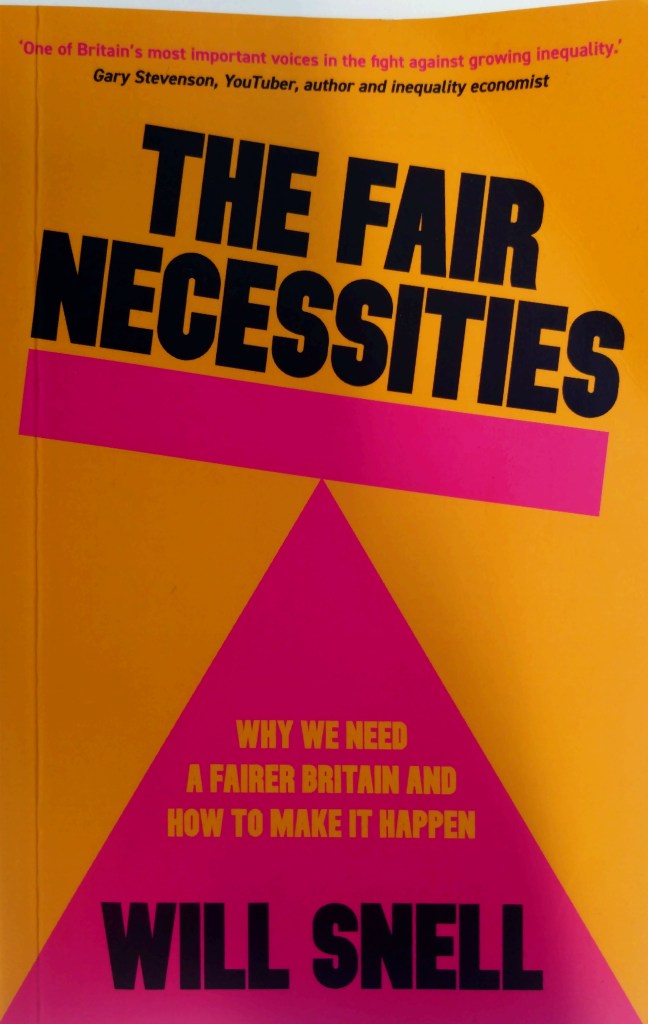
So I personally welcome the book’s later comments that fairness inevitably means different things to different people, and particularly comments acknowledging that really the fair necessities offer a framework for understanding fairness, and operationalising it in society – rather than a definition as such. Certainly, it was as such a framework that Snell spoke about the fair necessities at the book launch I had the pleasure of attending last month.
And it is really in that operationalisation of fairness that Snell’s book comes into its own, in a powerful and valuable way. Even as someone who has chatted with Snell over a number of years and closely followed the Fairness Foundation’s thoughtful work, I found much that was new in the book’s later chapters, especially the last substantive one, ‘Dismantling the barriers to fairness’. In particular, Snell discusses how to win the social and political argument about the need for greater fairness, and particularly highlights the need for an engaging and emotional discussion of fairness, not a purely technocratic one. Only occasionally does he fall into the trap of implying that the fairness agenda is favoured by people of one specific political persuasion; elsewhere he rightly notes that the concept works across the political spectrum.
Only deploying such an engaging and emotional discussion of fairness will, in Snell’s words, change the political wind, and help society acknowledge the scale of the risk that our current unfairnesses represent. I suspect his quote from economist Angus Deaton (from his 2024 Rethinking my Economics comments) will stay with me for some time: “Efficiency is important, but we valorise it over other ends … When efficiency comes with upward redistribution – frequently though not inevitably – our recommendations have become little more than a license for plunder.”
I’ve niggled about a small aspect of the book (though the posited definition is the frame within which its title is first explained) but really I would, very simply, highly commend The Fair Necessities to all. It’s accessible and challenging, and like this blog it is based on the clear understanding that our world needs, and deserves, more fairness. Do read it, do enjoy, and do think about how we collectively can more effectively operationalise fairness.
See also: Mother Nature’s recipes
Fairness: the human lens for addressing our current challenges
Deaton’s economics: fair criticism?
I’m happy to confirm as ever that the Sense of Fairness blog is a purely personal endeavour.
The Fair Necessities, Will Snell. Policy Press, 2026
The Fair Necessities: Why we need a fairer Britain and how to make it happen, event at Policy Institute at King’s College London, 8 September 2026
Rethinking my economics, Angus Deaton, International Monetary Fund blog, March 2024

