
Baring the necessities

I fight shy of defining fairness. There’s a broad range of options that fulfil fairness for human beings – and different individuals will reach different judgements as to whether a particular circumstance falls within that range. There’s somewhat more clarity about unfairness. That concept animates us all so viscerally that we can more readily agree that something is unfair, even though there is much human judgement in that too.

This human and emotional side of fairness and unfairness is exactly why it is more rewarding to explore than the definable and measurable concepts of equality and inequality.

Such is the strength of my sense that I shouldn’t seek to define fairness that throughout my forthcoming book I provide no easy answers. Instead, I talk about ways in which businesspeople and investors can develop their own approach to finding a fair landing ground. I believe that the push and pull between people is so key to finding what is fair in any particular circumstance that making assertions in the absence of its particular details is all but impossible. It’s not by chance that the legal approach of equity is entirely based on reaching a fair outcome, setting aside any detailed legal rules: equity – fairness – can’t be defined in advance, successive courts have found, but only decided by judges considering the facts of the individual case. The same is true of fairness outside the court context: it must be subject to judgement based on the particular circumstances.

So I found myself baulking a little at those sections of Will Snell’s highly accessible new book The Fair Necessities that assert “Fairness is definable”. Indeed, for Snell, the CEO of the wonderful Fairness Foundation, the definition of fairness is based on his eponymous ‘fair necessities’ (which he and the Fairness Foundation first launched on the world in 2021). They are, exactly as he sets them out in the book:

  • Fair essentials: Everyone should have their basic needs met, but we need to go further to enable people to play a constructive role in society.
  • Fair opportunities: Everyone should be able to thrive, without having to overcome unreasonable barriers to opportunity or earn a huge salary.
  • Fair rewards: Everyone’s hard work should be rewarded, in line with their contribution to our society as well as to our economy.
  • Fair exchange: Everyone should contribute to society by paying their fair share in tax, and in return should be supported by society when they need it.
  • Fair treatment: Everyone should be treated with equal respect and should be able to exercise equal influence on decisions made in their name.

These seem to me a good articulation of key pillars of fairness, and key elements of what fairness might look like if delivered in practice. But a definition? Maybe not so much.
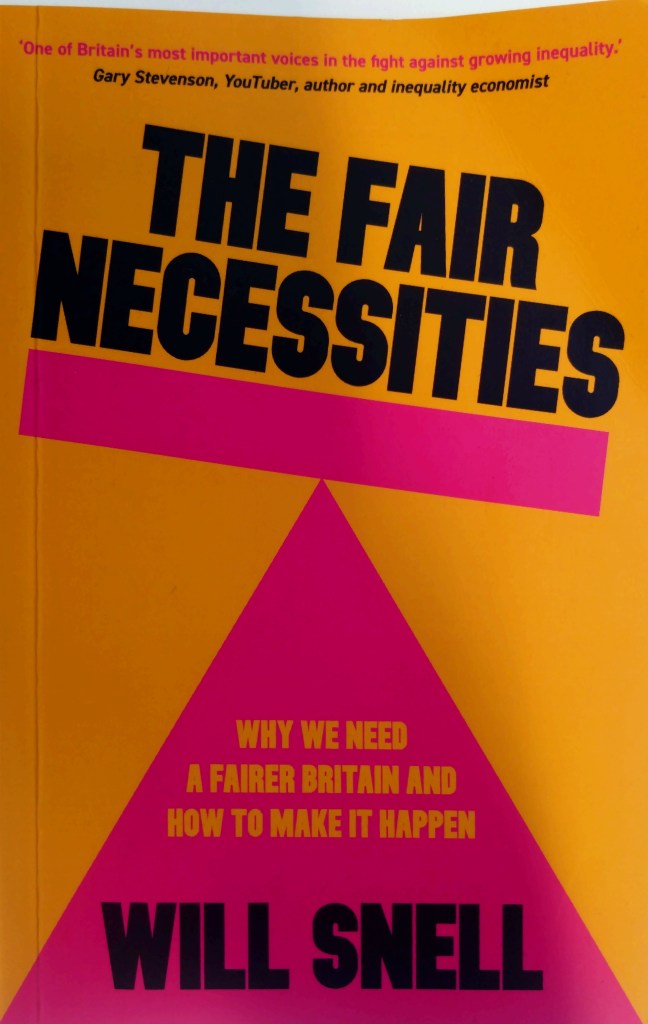
So I personally welcome the book’s later comments that fairness inevitably means different things to different people, and particularly comments acknowledging that really the fair necessities offer a framework for understanding fairness, and operationalising it in society – rather than a definition as such. Certainly, it was as such a framework that Snell spoke about the fair necessities at the book launch I had the pleasure of attending last month.

And it is really in that operationalisation of fairness that Snell’s book comes into its own, in a powerful and valuable way. Even as someone who has chatted with Snell over a number of years and closely followed the Fairness Foundation’s thoughtful work, I found much that was new in the book’s later chapters, especially the last substantive one, ‘Dismantling the barriers to fairness’. In particular, Snell discusses how to win the social and political argument about the need for greater fairness, and particularly highlights the need for an engaging and emotional discussion of fairness, not a purely technocratic one. Only occasionally does he fall into the trap of implying that the fairness agenda is favoured by people of one specific political persuasion; elsewhere he rightly notes that the concept works across the political spectrum.

Only deploying such an engaging and emotional discussion of fairness will, in Snell’s words, change the political wind, and help society acknowledge the scale of the risk that our current unfairnesses represent. I suspect his quote from economist Angus Deaton (from his 2024 Rethinking my Economics comments) will stay with me for some time: “Efficiency is important, but we valorise it over other ends … When efficiency comes with upward redistribution – frequently though not inevitably – our recommendations have become little more than a license for plunder.”

I’ve niggled about a small aspect of the book (though the posited definition is the frame within which its title is first explained) but really I would, very simply, highly commend The Fair Necessities to all. It’s accessible and challenging, and like this blog it is based on the clear understanding that our world needs, and deserves, more fairness. Do read it, do enjoy, and do think about how we collectively can more effectively operationalise fairness.

See also: Mother Nature’s recipes

Fairness: the human lens for addressing our current challenges

Deaton’s economics: fair criticism?

I’m happy to confirm as ever that the Sense of Fairness blog is a purely personal endeavour.

The Fair Necessities, Will Snell. Policy Press, 2026

The Fair Necessities: Why we need a fairer Britain and how to make it happen, event at Policy Institute at King’s College London, 8 September 2026

Rethinking my economics, Angus Deaton, International Monetary Fund blog, March 2024
An archaeology of equality

Reading an old book can sometimes feel like an archaeological dig – you find fragmented artefacts of how people used to think and have to try to piece together an understanding of their world, and their world view. Very often it serves to illuminate our own.

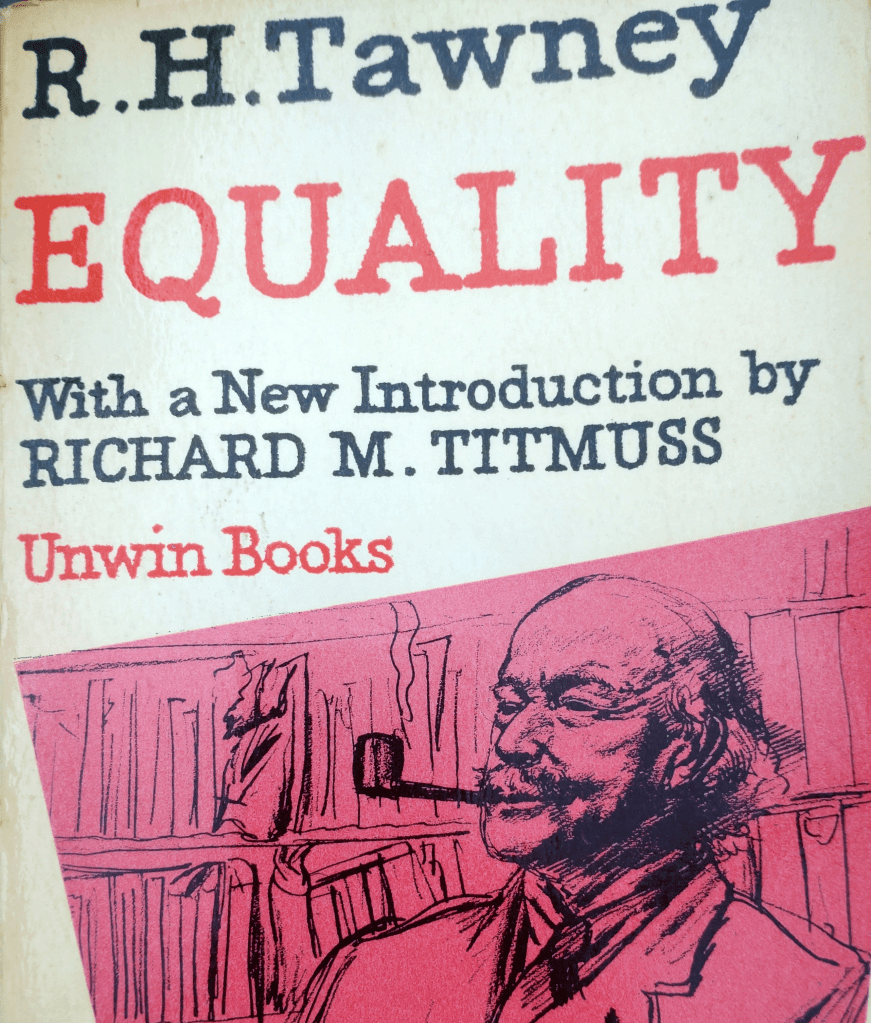
That’s definitely my sense while reading a book called Equality by an old socialist and economic historian, RH (Richard Henry) Tawney. My edition dates from 1964 but the original book was published in 1931, based on lectures given in 1929. This version enjoys a 1964 introduction by founding father of social policy Richard Titmuss, and no fewer than two prefaces by Tawney himself, one from the 1951 revised edition and one from the ‘substantially revised’ 1938 edition. Reading through these in this order is like uncovering historic layers of English inequality, and repeated aspirations for greater equality. What’s more, the first chapter of the book, The Religion of Inequality, starts by referring to a lecture by Matthew Arnold from I think 1878, to which it attributes the coining of that phrase.

I find it impossible to read these archaeological artefacts and not reflect on our own age. This blogpost aims simply to capture a few sentiments from each of these layers of history. Readers will no doubt be conscious of the great ruptures and attempts towards greater equality that provided the context for the writing of each of these layers of commentary, from the heights of the Cold War, the challenges of the Second World War and the creation of the welfare state that followed it, the Great Depression and the rise of fascism – and even, back around the 1870s, the first steps to broad enfranchisement (and while the right to vote did not then extend to women, that decade did see them permitted for the first time to retain their own property rather than simply surrender it on marriage).

Titmuss in his 1964 introduction:

“We…delude ourselves if we think we can equalize the social distribution of life chances by expanding educational opportunities while millions of children live in slums without baths, decent lavatories, leisure facilities, room to explore and the space to dream. Nor do we achieve with any permanency a fairer distribution of rewards and a society less sharply divided by class and status by simply narrowing the differences in cash earnings among men during certain limited periods of their lives.”

“Long years of economic depression, a civilians’ war, rationing and ‘fair shares for all’, so-called ‘penal rates’ of taxation and estate duty, and ‘The Welfare State’ have made little impression on the holdings of great fortunes…Wealth still bestows power, more power than income, though it is probably exercised differently and with more respect for public opinion than in the nineteenth century.”

“These consequences of technology in an age of abundance are more likely to increase than to decrease differentials in income and wealth if no major corrective policies are set to work…Without a major shift in values, an impoverishment in social living for some groups can only result from this new wave of industrialism.”

Tawney in his 1951 preface:

“Like earlier wars of religion, the credal conflicts of our day will find varying issues in different regions; but, if Europe survives, societies convinced that liberty and justice are equally indispensable to civilization will survive as part of her. The experience of a people which regards these great abstractions, not as antagonists, but as allies, and which has endeavoured, during six not too easy years, to serve the cause of both, is not barren of lessons which may profitably be pondered.”

And he quotes The Times from 1 July 1940:

“If we speak of democracy, we do not mean the democracy which maintains the right to vote, but forgets the right to live and work. If we speak of freedom, we do not mean a rugged individualism which excludes social organization and economic planning. If we speak of equality, we do not mean a political equality nullified by social and economic privilege. If we speak of economic reconstruction, we think less of maximum production…than of equitable distribution.”

Tawney in his 1938 preface:

“It is still sometimes suggested that what Professor Pigou, in his latest work, calls ‘the glaring inequalities of fortune and opportunity which deface our present civilization’ are beneficial, irremediable, or both together. Innocent laymen are disposed to believe that these monstrosities, though morally repulsive, are economically advantageous, and that, even were they not, the practical difficulties of abolishing them are too great to be overcome. Both opinions, it may be said with some confidence, are mere superstitions.”

“Institutions which enable a tiny class, amounting to less than two per cent of the population of Great Britain, to take year by year nearly one quarter of the nation’s annual output of wealth…are an economic liability of alarming dimensions. They involve…a perpetual misdirection of limited resources to the production or upkeep of costly futilities, when what the nation requires for its welfare is more and better food, more and better houses, more and better schools.”

“Today, when three-quarters or more of the nation leave less than £100 at death, and nearly two-thirds of the aggregate wealth is owned by about one per cent of it, inheritance is on the way to become little more than a device by which a small minority of rich men bequeath to their heirs a right to free quarters at the expense of their fellow-countrymen. The limitations imposed on that right during the past half-century were greeted, when first introduced, with the usual cries of alarm; and the alarm, as is not less usual, has been proved by experience to be mere hysteria. It is perfectly practicable, by extending those limitations and accelerating their application, to reduce the influence of inheritance – at present a strong poison – to negligible dimensions.”

“To make [democracy] a type of society requires an advance along two lines. It involves, in the first place, the resolute elimination of all forms of special privilege, which favour some groups and depress others, whether their source be differences of environment, of education, or of pecuniary income. It involves, in the second place, the conversion of economic power, now often an irresponsible tyrant, into the servant of society, working within clearly defined limits, and accountable for its action to a public authority.”

Tawney reports that Matthew Arnold said, in c1878:

“Arnold observed that in England inequality is almost a religion. He remarked on the incompatibility of that attitude with the spirit of humanity, and sense of the dignity of man as man, which are the marks of a truly civilized society. ‘On the one side, in fact, inequality harms by pampering; on the other by vulgarizing and depressing. A system founded on it is against nature, and, in the long run, breaks down.’”

As LP Hartley says in another old book, one that deliberately plays with memory and history, “The past is a foreign country; they do things differently there.” But often ‘they’ worried about the same challenges we do, and sought similar solutions.

I am happy to confirm as ever that the Sense of Fairness blog is a purely personal endeavour.

See also: Plague and planning: a long history of English unfairness
Unveiled: fleeced by power and business as usual

RH Tawney, Equality, 1964, Unwin

Arthur Pigou, Socialism versus Capitalism, 1937

LP Hartley, The Go-Between, 1953