
I write this as I return from my first trip to Australia for a decade. I am reminded that it’s a warm place – not just in terms of climate but also in the matiness of the culture. Fairness plays a key role in this, formally and informally.
There is indeed a remarkable amiability to the culture of Australia. A nation built on immigration, lived in sunshine under large skies, perhaps encourages an openness and friendliness, a willingness to talk to all as equals. That immigrant mindset is aided by the belief – only in recent years eroding – that they took over a tabula rasa (I strongly recommend the remarkable Dark Emu as the firmest of rebuttals to that view).
Aussies have a word for this: mateship. Less gendered than it sounds, the concept of mateship nonetheless has its origins in the experience of predominantly male soldiers in the First World War. It asserts a camaraderie and shared experience, and importantly an equality of status. Everyone in Australia can be addressed as a ‘mate’; in a sense, everyone is a mate. Historian of the term Nick Dyrenforth calls mateship Australia’s ‘secular religion’.
Former Prime Minister John Howard famously tried to co-opt the term directly into the nation’s Constitution as part of a referendum in 1999 (some posit that, a royalist, he raised the issue to reduce the referendum’s focus on republicanism). Words developed by poet Les Murray alongside Howard were proposed as a new preamble:
“Australians are free to be proud of their country and heritage, free to realise themselves as individuals, and free to pursue their hopes and ideals. We value excellence as well as fairness, independence as dearly as mateship.”
The preamble didn’t make it through the referendum, and mateship in particular remains a divisive concept for many. But fairness seems less divisive, not least in the form of another core Australian value: the ‘fair go’. Indeed, one prominent academic article goes so far as to equate ‘Australianness’ with fairness, emphasising the ways in which it is inclusive and promotes a vigorous and cosmopolitan egalitarianism.
So core is fairness and the ‘fair go’ concept to the nation that it is formally noted among the Australian Values set out by the government, which every visa-seeker must acknowledge. The discussion by the Department of Home Affairs on these Values starts: “Australian values based on freedom, respect, fairness and equality of opportunity are central to our community remaining a secure, prosperous and peaceful place to live.” According to its articulation, the ‘fair go’ for all embraces:
- mutual respect
- tolerance
- compassion for those in need
- equality of opportunity for all
Such thinking goes a long way back in Australian history. A brisk and energetic monograph, The First Dismissal, discusses the actions of early New South Wales governor Lachlan Macquarie, who held the role from 1810 to 1821. Macquarie had an active programme of freeing convicts who were skilled artisans from what would otherwise be burdens as drudges. He did this initially through tickets-of-leave (essentially, parole), and then if they proved themselves, conditional – and in some cases and after a further period of time, absolute – pardons. A number of these skilled artisans were then put to work on the creation of the colony’s first lasting civic infrastructure; the earliest buildings that survive in Sydney date from this era.
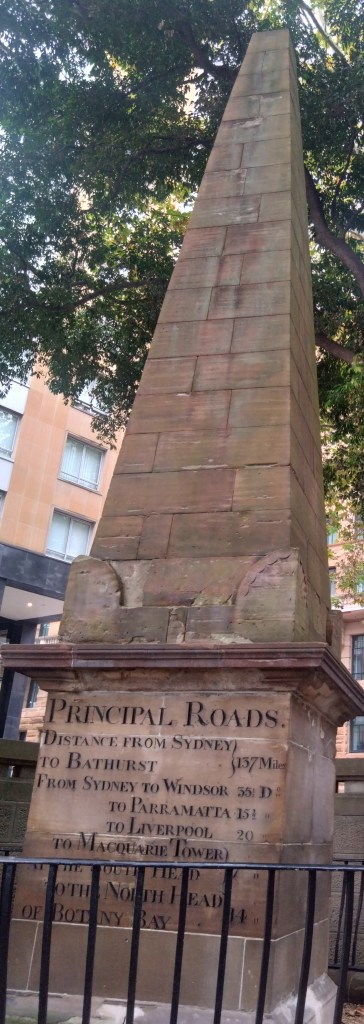
Author Luke Slattery focuses on the role of Francis Greenway, an architect who had been transported for forgery but on whose arrival was almost immediately freed by Macquarie. Greenway designed and oversaw the building of several key buildings, including Hyde Park Barracks and St James’s church (originally designed as a courthouse), which stand opposite each other across what is now Macquarie Street. Greenway also created the obelisk from which road distances in the colony were to be measured, still standing in Macquarie Place. Another such example was stonemason Richard Byrne, pardoned in 1812, the stone footings of whose house can be seen at The Rocks following excavation in the 1990s.

Macquarie went further and welcomed former convicts – known as emancipists – into his home, encouraging his military officers to do the same (they largely ignored him). He also founded and funded schools, in itself a revolutionary step for those days. He clearly was trying to create a society where people were to be treated equally, could rise on merit, perhaps even one where all could be seen as mates.
Slattery’s book reflects anger at the way Macquarie and his programme were treated both by the local elite population – those who had chosen to emigrate rather than being transported as punishment, and whose status consciousness is shown by their being known as ‘exclusives’ – and by the reactionary English government of the time. In the end, the governor was ignominiously removed from office and replaced by Sir Thomas Brisbane, who proved less interested in rehabilitation of convicts, and indeed in civic architecture.
There may not be much evidence that Macquarie did in fact invent the ‘fair go’ as such – recent research by academics from Griffith University shows that the term wasn’t much talked about pre-1900, certainly beyond sporting arenas, and doesn’t appear at all in Australian newspapers prior to 1860 – but his intent in freeing the more skilled of the convict arrivals certainly does seem a step towards fairness, a recognition that one error should not mean an individual is marked for life. The contrast with the heavily stratified society sought by his opponents, in which convicts could never lose their status as wrongdoers, emphasises his ideas as ones of fairness of opportunity, as well as a literal building of society.
It is not without irony that Macquarie’s name is nowadays most often attached to a bank variously referred to as the millionaires’ factory and the vampire kangaroo. Macquarie investments have on occasions seemed to work well for its staff and rather less well for the customers of the utilities and infrastructure in question. No doubt its proponents would argue the intensity of its focus on meritocracy, allowing all staff a fair go at riches. But none would argue that the bank’s approach has led to greater equality overall.
I reference in my forthcoming book recent research that heightened income inequality in Australia – not all of which can be laid at the door of Macquarie Bank – is closely associated with dissatisfaction with democracy. As the researchers say, these perceptions may be particularly debilitating in a country where a ‘fair go’ is central to the national psyche. Others have highlighted how current inequalities are undermining belief in the ‘fair go’ and in society more broadly.
Such is the extent of our current inequalities that we risk hollowing out our societies and reintroducing social and economic stratifications reminiscent of the colonial era. That isn’t fair, it isn’t democratic, and it runs counter to the egalitarian concepts of mateship and the fair go. It’s especially painful to see these concepts eroded in countries and cultures where fairness is so central.
Dark Emu: Aboriginal Australia and the birth of agriculture, Bruce Pascoe. Scribe, 2018
Mateship: secular Australia’s religion and how John Howard hijacked it, Nick Dyrenfurth. Australian Fabians, September 2015
“Friendship, but Bloke-ier”: Can Mateship Be Reimagined as an Inclusive Civic Ideal in Australia?, Na’ama Carlin, Benjamin Jones, Amanda Laugesen. Journal of Australian Studies, Vol 46 Iss 2, 2022
Australianness as fairness: Implications for cosmopolitan encounters, Stefanie Plage, Indigo Willing, Zlatko Skrbis, Ian Woodward. Journal of Sociology, 53(2), 2017
Australian values, Australian Government Department of Home Affairs
The First Dismissal, Luke Slattery. Penguin, 2014
What did a ‘fair go’ originally mean to Australians?, Cosmo Howard. Australian Journal of Political Science, Vol 58, No 2, 2023
Income inequality and democratic resilience – Impacts and policy choices, Nicholas Biddle, Matthew Gray. Australian Resilient Democracy Research and Data Network Discussion Paper 1, Australian National University 2024
Inequality and the ‘fair go’ in Australia, John van Kooy. Scanlon Foundation Research Institute Social Cohesion Insights Series, 2023


I’m interested to see how ‘mateship’ survives the fuel crisis etc (Australia is very much on the front-lines of it)
LikeLike
I suspect that Aussies would tell you that mateship will never be at risk – but the sense of the fair go is certainly under pressure, for reasons predating the most recent issues.
LikeLike