Having sent my draft book to my publisher – more news on that when I have it – I can re-devote my fairness writing energies to this blog. One side-effect of the book-writing process, and particularly of the editing process, is that I’ve much material that didn’t make it into the manuscript, at least not in full. This then is likely to be the first of a few (or more!) blogs that are based on materials from the cutting room floor.
Many take it as a given that treating employees well encourages them to deliver more, not least because workers value dignity. There’s been a formal economic theory to that effect since at least 1990, in the form of the Fair Wage-Effort Hypothesis put forward by an illustrious pair, future Nobel prize winner George Akerlof and future Treasury Secretary Janet Yellen. This says that workers treated fairly, and specifically paid fairly, put in greater effort; those treated unfairly don’t bother so much.
Sometimes particularly strong evidence is provided that backs the hypothesis, showing greater productivity of workers who are inspired by being treated fairly. In at least one case, that evidence shows the productivity effect not in terms of fairness facilitating the creation of higher numbers of goods, but in the way that unfair treatment led to the creation of products that were in fact lethal for customers.
That case dates back to the era in which the Fair Wage-Effort Hypothesis was developed: the Bridgestone/Firestone defective tyre issue of the 1990s, and the subsequent product recalls. Some 271 deaths and more than 500 injuries in the US alone have been attributed to the defective tyres. In the end, Bridgestone/Firestone’s costs of the scandal were over $800 million, and those for the other company implicated, Ford, more than $500 million. The detail of the research into the case – particularly a study with the surprising name for an academic paper of Strikes, Scabs, and Tread Separations – is such that it not only succeeds in identifying the implicated plant, but also with some precision the times when most defective tyres were produced. This precision allows us to attribute clearly the defects to failures of fairness in how workers were treated.
Japanese tyre manufacturer Bridgestone had bought US rival Firestone in 1988. Increasingly, it put pressure on Firestone’s loss-making operations. As pressure increased to reduce those losses, the focus came onto staff costs, perhaps inevitably giving rise to industrial unrest. There were three main facilities in North America; the one where the greatest industrial dispute arose was Decatur in Illinois. The Wilson, North Carolina plant wasn’t unionised and saw no strike, while the strike in Joliette, Quebec was brief and no replacement workers were hired there (not least because that’s illegal in Canada). At Decatur, tensions were much greater and longer-lived.
The key trigger to industrial unrest was the process of negotiating a new contract from 1994. The company was seeking to change from 8-hour to 12-hour shift patterns, and wanted to cut pay for newly hired workers by 30%. The prior contract expired in April 1994 and workers continued without a contract for three months before going on strike in July 1994. The company hired replacements, and refused to consider rehiring the strikers. A final contract, under which former strikers were in the end rehired, was agreed only in December 1996.
The issues with the tyres in question were associated with their role on the first Ford Explorer SUVs. In moves that to modern ears have echoes of Boeing’s failed decision-making in the development of the 737 Max, Ford didn’t design the Explorer from scratch but put a new body on an existing pickup chassis. However, the new body was heavier and so the Explorer had a higher centre of gravity and was more prone to roll in an accident. Avoiding a redesign, Ford chose to shorten the suspension and lowered the recommended tyre pressure. Such lower tyre pressure can increase the operating temperature of the tyres, making any faults more likely to cause blowouts or other less catastrophic forms of tyre failure.
No one fault in the tyres has been identified that made them particularly prone to failure, so there was probably a range of possible defects. While the tyres in question were manufactured at all of the three North American facilities, the evidence is that the bulk of the tyres that failed came from Decatur.
In particular, the Strikes, Scabs, and Tread Separations study of the timing and sourcing of the failed tires shows a clear linkage between the labour dispute – and particularly the most contentious moments in the dispute, those that will have generated the greatness sense of unfairness for the workforce – and the production of the substandard tires. Workers that feel themselves to be being treated unfairly are likely to take less care over their work. In some cases, the treatment is seen as so unfair and the lack of care is so significant that there are major quality problems. The study concludes simply that: “the strike and associated labor strife in Decatur was a major contributing factor to the production of defective tires”.
In more detail, it says: “Four years after production, tires that were made in Decatur during the labor dispute were at least 15 times more likely to have resulted in a claim than were tires manufactured in other plants.” As the chart from the research shows, in internal engineering testing to destruction, the top quartile Decatur tires from the relevant period performed at the same level as bottom quartile tires from the other factories.
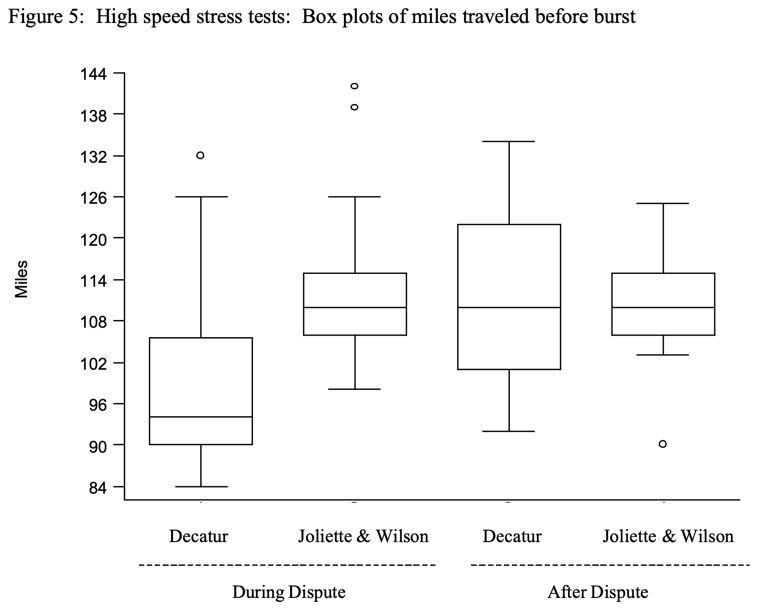
The evidence doesn’t suggest that the replacement workers were more prone to error (as some commentators alleged), but rather that periods when union members operated alongside replacement workers before the final contract was agreed were more likely to see defective tires produced. Similarly, defective tires were produced in much higher quantities in the months leading up to the old contract coming to an end, when the company was pressurising workers for concessions. These were the moments of greatest industrial tension, the greatest sense of failures of fairness.
Simply, it was the poor industrial relations, the unfairness in the dealings between company and its workforce, that seems to have made production catastrophically less reliable. It turns out that the Fair Wage-Effort hypothesis came to pass in a very direct way in terms of quality and safety outcomes for customers. A Fair Treatment-Production Quality hypothesis perhaps.
See also: Workers value dignity
People matter, but not like that
An inequality in dignity, or the dignity deficit
I am happy to confirm as ever that the Sense of Fairness blog is a purely personal endeavour
The Fair Wage-Effort Hypothesis and Unemployment, George Akerlof and Janet Yellen, The Quarterly Journal of Economics, Vol. 105, No. 2 (1990)
Strikes, Scabs, and Tread Separations: Labor Strife and the Production of Defective Bridgestone/Firestone Tires, Alan Krueger, Alexandre Mas, Journal of Political Economy, Vol 112, No 2 (2004)

 The Sense of Fairness blog