Readers (at least those that read the small print at the foot of every blogpost) will know that the Sense of Fairness blog is a purely personal endeavour. But naturally I am sometimes inspired to write things by events in my working life.
So it is this week, following a gathering on Tuesday hosted by fund manager Impax on the role of corporate culture in business performance. Naturally, the firm has a product to sell and wants to demonstrate its prowess in identifying share price performance drivers in what is still a surprisingly under-researched area.
Impax showed us striking charts showing stronger performance by companies with better culture, on the metrics that they have been able to garner from company reporting and more independent sources on employee satisfaction such as Glassdoor. Note that of course I am not making any investment recommendation.
Perhaps more striking than the performance statistics were the anecdotes from active fund manager Charles French, who relayed stories from the front line of asking CEOs about culture. As I too used to find when I asked my favourite “How are your people?” question, the range of responses to questions about culture tells you a great deal about the attitude and mindset of bosses. Some literally have nothing to say and do not know how to begin an answer; others become energised and demonstrate very clearly how much of a focus for them is inspiring their staff. You are left in no doubt which bosses – and so businesses – you would prefer to work for.
The event also featured a presentation and panel discussion on corporate culture. The panel featured a couple of my favourite people who have done great work on corporate culture, Tina Mavraki and Annabel Gillard. Most striking for this blog were a pair of word clouds within the initial, energising presentation from Jenny Segal, whose headline offer is ‘Building better workplace cultures through creativity and understanding motivation’.
She had asked a representative group of people what motivated them at work. Fairness appears with reasonable prominence, as do a series of other words that have concepts of fairness attaching to them:
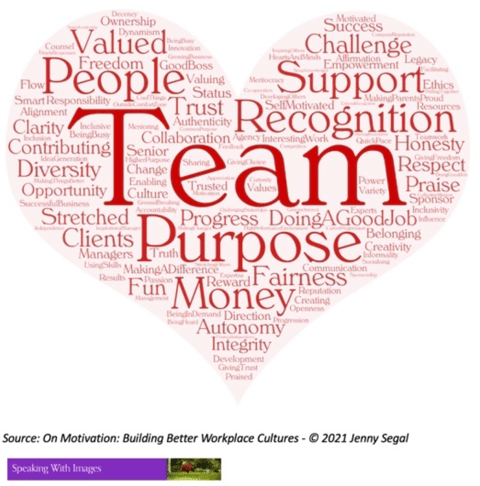
As noted in a previous post, there are very different motivations for workers at companies which have a clear purpose and seek to inspire their staff. It’s unsurprising that unfairness at work is demotivating.
Jenny also asked people what makes a good boss. Again, fairness clearly matters:

Another striking comment from the panel came from Christine Cappabianca, one of Impax’s quant team, who leads their work uncovering data on culture. Clearly the reporting dynamic around diversity, equity and inclusion factors – one of the areas she has been mining for insight – varies around the world and is shifting notably at the moment. One of the shifts that she expects to happen as diversity is downplayed is that the language of fairness will see more use, as it’s a much less divisive way of capturing the intent of these programmes. That fits with the the most forward-thinking research in this space.
Fairness matters, viscerally, to people. It’s not surprising that its presence fires us up at work and that its absence demotivates. The best managers know this viscerally too.
See also: Operating on purpose – hampered by inequality
Diversity and fairness
People matter, but not like that
Better ways of showing how people matter
I am happy to confirm as ever that the Sense of Fairness blog is a purely personal endeavour
Jenny Segal, Speaking with Images

 The Sense of Fairness blog