An archaeology of equality

Reading an old book can sometimes feel like an archaeological dig – you find fragmented artefacts of how people used to think and have to try to piece together an understanding of their world, and their world view. Very often it serves to illuminate our own.

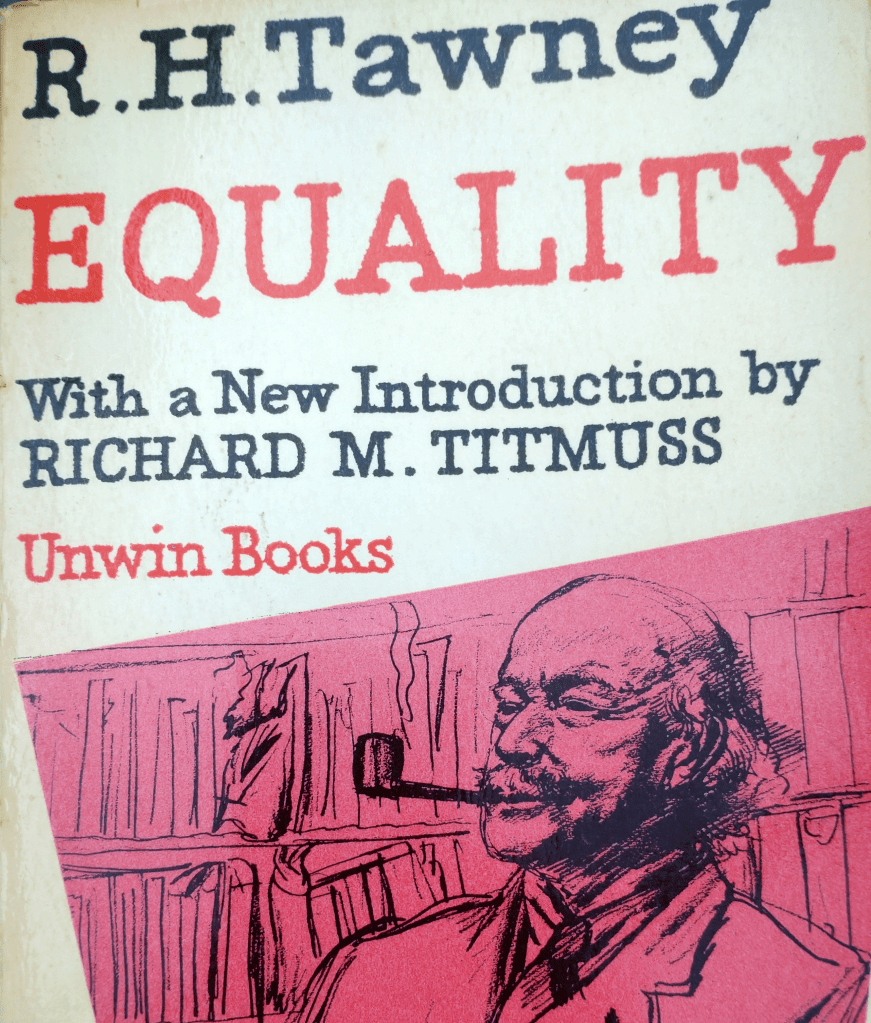
That’s definitely my sense while reading a book called Equality by an old socialist and economic historian, RH (Richard Henry) Tawney. My edition dates from 1964 but the original book was published in 1931, based on lectures given in 1929. This version enjoys a 1964 introduction by founding father of social policy Richard Titmuss, and no fewer than two prefaces by Tawney himself, one from the 1951 revised edition and one from the ‘substantially revised’ 1938 edition. Reading through these in this order is like uncovering historic layers of English inequality, and repeated aspirations for greater equality. What’s more, the first chapter of the book, The Religion of Inequality, starts by referring to a lecture by Matthew Arnold from I think 1878, to which it attributes the coining of that phrase.

I find it impossible to read these archaeological artefacts and not reflect on our own age. This blogpost aims simply to capture a few sentiments from each of these layers of history. Readers will no doubt be conscious of the great ruptures and attempts towards greater equality that provided the context for the writing of each of these layers of commentary, from the heights of the Cold War, the challenges of the Second World War and the creation of the welfare state that followed it, the Great Depression and the rise of fascism – and even, back around the 1870s, the first steps to broad enfranchisement (and while the right to vote did not then extend to women, that decade did see them permitted for the first time to retain their own property rather than simply surrender it on marriage).
Titmuss in his 1964 introduction:

“We…delude ourselves if we think we can equalize the social distribution of life chances by expanding educational opportunities while millions of children live in slums without baths, decent lavatories, leisure facilities, room to explore and the space to dream. Nor do we achieve with any permanency a fairer distribution of rewards and a society less sharply divided by class and status by simply narrowing the differences in cash earnings among men during certain limited periods of their lives.”

“Long years of economic depression, a civilians’ war, rationing and ‘fair shares for all’, so-called ‘penal rates’ of taxation and estate duty, and ‘The Welfare State’ have made little impression on the holdings of great fortunes…Wealth still bestows power, more power than income, though it is probably exercised differently and with more respect for public opinion than in the nineteenth century.”

“These consequences of technology in an age of abundance are more likely to increase than to decrease differentials in income and wealth if no major corrective policies are set to work…Without a major shift in values, an impoverishment in social living for some groups can only result from this new wave of industrialism.”

Tawney in his 1951 preface:

“Like earlier wars of religion, the credal conflicts of our day will find varying issues in different regions; but, if Europe survives, societies convinced that liberty and justice are equally indispensable to civilization will survive as part of her. The experience of a people which regards these great abstractions, not as antagonists, but as allies, and which has endeavoured, during six not too easy years, to serve the cause of both, is not barren of lessons which may profitably be pondered.”

And he quotes The Times from 1 July 1940:

“If we speak of democracy, we do not mean the democracy which maintains the right to vote, but forgets the right to live and work. If we speak of freedom, we do not mean a rugged individualism which excludes social organization and economic planning. If we speak of equality, we do not mean a political equality nullified by social and economic privilege. If we speak of economic reconstruction, we think less of maximum production…than of equitable distribution.”

Tawney in his 1938 preface:

“It is still sometimes suggested that what Professor Pigou, in his latest work, calls ‘the glaring inequalities of fortune and opportunity which deface our present civilization’ are beneficial, irremediable, or both together. Innocent laymen are disposed to believe that these monstrosities, though morally repulsive, are economically advantageous, and that, even were they not, the practical difficulties of abolishing them are too great to be overcome. Both opinions, it may be said with some confidence, are mere superstitions.”

“Institutions which enable a tiny class, amounting to less than two per cent of the population of Great Britain, to take year by year nearly one quarter of the nation’s annual output of wealth…are an economic liability of alarming dimensions. They involve…a perpetual misdirection of limited resources to the production or upkeep of costly futilities, when what the nation requires for its welfare is more and better food, more and better houses, more and better schools.”

“Today, when three-quarters or more of the nation leave less than £100 at death, and nearly two-thirds of the aggregate wealth is owned by about one per cent of it, inheritance is on the way to become little more than a device by which a small minority of rich men bequeath to their heirs a right to free quarters at the expense of their fellow-countrymen. The limitations imposed on that right during the past half-century were greeted, when first introduced, with the usual cries of alarm; and the alarm, as is not less usual, has been proved by experience to be mere hysteria. It is perfectly practicable, by extending those limitations and accelerating their application, to reduce the influence of inheritance – at present a strong poison – to negligible dimensions.”

“To make [democracy] a type of society requires an advance along two lines. It involves, in the first place, the resolute elimination of all forms of special privilege, which favour some groups and depress others, whether their source be differences of environment, of education, or of pecuniary income. It involves, in the second place, the conversion of economic power, now often an irresponsible tyrant, into the servant of society, working within clearly defined limits, and accountable for its action to a public authority.”

Tawney reports that Matthew Arnold said, in c1878:

“Arnold observed that in England inequality is almost a religion. He remarked on the incompatibility of that attitude with the spirit of humanity, and sense of the dignity of man as man, which are the marks of a truly civilized society. ‘On the one side, in fact, inequality harms by pampering; on the other by vulgarizing and depressing. A system founded on it is against nature, and, in the long run, breaks down.’”

As LP Hartley says in another old book, one that deliberately plays with memory and history, “The past is a foreign country; they do things differently there.” But often ‘they’ worried about the same challenges we do, and sought similar solutions.

I am happy to confirm as ever that the Sense of Fairness blog is a purely personal endeavour.

See also: Plague and planning: a long history of English unfairness
Unveiled: fleeced by power and business as usual

RH Tawney, Equality, 1964, Unwin

Arthur Pigou, Socialism versus Capitalism, 1937

LP Hartley, The Go-Between, 1953

Is enough enough? Addressing the problem of the super-rich

“To make the poor richer, you have to make the rich poorer.”

It’s one of the bolder early assertions made in a new book, Enough: Why it’s time to Abolish the Super-Rich, from my friend Luke Hildyard, who leads the High Pay Centre, the think tank dedicated to considerations of pay and employment rights. Given the hours he put into it, he’ll hate that I note it’s a short book, but that means it is a quick read – which its brisk and energetic style greatly assists. It includes extensive references to the evidence of academic and other studies, but Hildyard doesn’t let them weigh down his central messages and arguments.

Much of the book is dedicated to demonstrating the truth of this early assertion. Beyond that, Enough also aims to show that there would be benefits from a more equal income and wealth distribution and that much current income and wealth is unearned and undeserved. It argues that it is possible to address the issue of the super-rich, both politically and practically – but that at present the political will isn’t there and the social pressure for change isn’t yet great enough. “The super-rich are tragically unloathed,” says Hildyard in one of his typically crisp and blunt phrases.

As is perhaps obvious, this is a polemic, using vigorous and direct language to make its points – and it is none the worse for it. It’s also funny. I didn’t expect to laugh out loud at the book, but its dogged pursuit of a thought experiment of carpeting the nation in £5 notes is only one among its amusing moments.

Hildyard also charts a path for addressing the issue of the super-rich, one part of which would be wealth taxes. That particular path became potentially much easier just yesterday when a UN committee of tax experts agreed to develop a clear map for it: the Committee of Experts on International Cooperation in Tax Matters approved guidance for the creation of wealth taxes. This will not be called a ‘model law’ but rather an ‘example law’, but the intent is clear, and the idea of international cooperation in this area is aimed to reduce incentives for individuals to move to avoid such tax burdens. We’ll see how far these proposals progress in practice.

There is clearly some political will, and indeed some general willingness to engage in these issues. If the interest shown by those seeing me reading Enough on public transport are anything to go by, this is a book whose time has come. I would certainly heartily commend it. It was formally published this last week.

In many ways, vigorous and blunt as it is, Hildyard’s language is less hardline than others’. For example, the authors of the wonderful Spirit Level, Kate Pickett and Richard Wilkinson, both professors of epidemiology at York University, recently wrote a comment piece published in venerable journal Nature entitled Why the world cannot afford the rich.

As well as noting the disproportionate greenhouse gas emission impacts of the lifestyles of the wealthy (as previously noted in this blog), Wilkinson and Pickett state: “large differences in income are a powerful social stressor that is increasingly rendering societies dysfunctional”.

They continue:

“bigger gaps between rich and poor are accompanied by higher rates of homicide and imprisonment. They also correspond to more infant mortality, obesity, drug abuse and COVID-19 deaths, as well as higher rates of teenage pregnancy and lower levels of child well-being, social mobility and public trust.”

Most strikingly, the epidemiologists argue that “Even affluent people would enjoy a better quality of life if they lived in a country with a more equal distribution of wealth”. They complain about the wastefulness of unfair distributions: “Inequality also increases consumerism…Studies show that people who live in more-unequal societies spend more on status goods.” It’s certainly clear that this is happening. For example, ultra-luxury carmaker Bentley recently revealed its financial results, making revenues of €2.9 billion on sales of just 13,560 cars (or over €200,000 per vehicle), with margins improved by a record of nearly 10,000 of those vehicles including personalised features costing upwards of €40,000. For these buyers, it appears, it’s not enough to be able to buy a car that costs more than many houses. They also want the additional status of a still more expensive and truly unique vehicle.

The wealthy also buy other trappings of status – like the arts building branding that was part of the focus of the Sackler family in deploying their immoral earnings from Purdue Pharma’s role in the opioid crisis, or political donations. Evidence shows that rarely are such gifts really generosity – something is expected in return (as the reliably brilliant Tom Burgis amply shows in his excoriating new book Cuckooland). Sadly, rarely do the super-rich now feel the need to be genuinely generous in sharing their wealth in the ways their predecessors in earlier generations did. Alms houses are among our most beautiful old buildings, mostly built by our wealthy Tudor or Victorian forbears, but there seems to be no modern equivalent being created now.

This urge towards status skews our whole business sector. When you now look at the market capitalisations of major businesses, it is notable how much more valuable are the luxury goods companies that cater to the demands of a tiny minority than those that provide much larger markets with less luxurious versions of the same products. Germany’s Porsche is valued at more than $90 billion and Italy’s Ferrari (actually listed in the Netherlands to benefit from rules allowing unequal voting rights) is touching a valuation of nearly $80 billion; Ford and General Motors hover around the $50 billion mark, while producing orders of magnitude more vehicles. In a similar way, the valuation of Hermes (around $270 billion) is nearly double that of Inditex, whose major brand is Zara (valued at some $150 billion). The mass market isn’t where the money is made any more: even collectively, the centre doesn’t hold as much spending power.

Pickett and Wilkinson capture their findings in a striking chart that sets the Gini coefficient measure of inequality against an index the authors created of environmental, health and social issues (including measures such as air pollution and recycling; infant mortality, life expectancy, and obesity; and educational attainment, teenage births, social mobility and trust). As they say, “There’s a clear trend, with more-unequal societies having worse scores”:

As an earlier editorial in Nature raged, Reducing inequality benefits everyone — so why isn’t it happening? Essentially, that’s the challenge that Hildyard is attempting to rise to, and he provides some useful answers, and relevant solutions, as well as amusing challenge to the status quo. Do we need to make the rich poorer in order to make the poor richer? Probably, yes. The greatest political challenge on this issue though is likely to be defining what amounts to ‘rich’ or ‘super-rich’ for these purposes. One hindrance to action may be that definitions of what is too much are hard to draw. It’s hard to build a coalition of the willing among those who fear they may be next to face reductions (even if intellectually they might accept the idea that they would benefit from less inequality), and that – for the present at least – seems to limit the political pressure for change.

Hildyard himself blurs these lines, at times railing only and specifically at the truly (absurdly) super-rich, the billionaires, and at other times focusing on broader wealthy groups, including all public company bosses, top lawyers and bankers, and anyone earning in the top 1%, or having wealth among the top 1%. He quotes income of £183,000 and wealth of £3.7 million for the UK, and $400,000 and $11 million respectively for the US, as placing people into the respective 1% groups. These are huge numbers, clearly, but not close to being in the same league as the billionaires. A focus on a loosely defined super-rich elides this challenge – and while Hildyard demonstrates just how much might be available from the individuals at the very top of the income and wealth distributions, were they taxed more effectively (a simple function of their extreme wealth), he leaves open the question of seeing changes lower down the income levels too. This doesn’t undermine his arguments, but clarity is likely to be helpful in garnering political support and leveraging real change.

Hildyard ends the book saying:

“Indeed, it will be impossible to achieve our full potential to build a fairer, happier, more prosperous society without a major rebalancing of incomes and wealth. This ought not to be a question of partisan ideology – the logic, feasibility and urgent importance of the issue are clear. It is time to abolish the super-rich.”

I’d argue that all of this but the final sentence is unarguably true – that last sentence probably remains open to some debate, not least as to where the threshold for super-richness lies.

As the phrase goes, the poor are always with us. It is less clear that the super-rich need to be.

See also: Unfairness in carbon emissions

The centre cannot hold

As ever, I am pleased to confirm that the Sense of Fairness blog is a purely personal endeavour.

Enough: Why it’s time to Abolish the Super-Rich, Luke Hildyard, Pluto Press, 2024

Subcommittee on Wealth and Solidarity Taxes Guidance as of 1 March 2024, UN Committee of Experts on International Cooperation in Tax Matters

Why the world cannot afford the rich, Richard Wilkinson, Kate Pickett, Nature 627, 268-270, 12 March 2024

The Spirit Level: Why Equality is Better for Everyone, Kate Pickett, Richard Wilkinson, Penguin, 2010

Highest Levels of Personalisation Drive Second Best Financial Performance on Record for Bentley Motors, Bentley, 19 March 2024

Cuckooland: Where the Rich own the Truth, Tom Burgis, HarperCollins, 2024

Reducing inequality benefits everyone — so why isn’t it happening?, Nature 620, 468, 16 August 2023