“We need a major repair that is not going to be found in the traditional economic models that consider the social impact of our decisions as something to be fixed ex post through social policies and redistribution. It needs a major change in the economic narrative, that brings equality and sustainability objectives on an equal footing with productivity and growth when measuring success. And it needs to bring in the private and the financial sector to change the way they define and measure their objectives and actions ex ante.”
So said Gabriela Ramos, Assistant Director-General for Social and Human Sciences of UNESCO, at the launch of the mouthful that is the Taskforce on Inequality and Social-related Financial Disclosures, or TISFD – an organisation she will co-chair – at the end of September.
Ramos went on to express the hope that the TISFD disclosure framework “will encourage organisations to consider the broader impact of their operations in an ex ante manner and make the social implications of business models transparent … We need to integrate the private sector and the financial sector in the solution because with that we can drive meaningful change that aligns economic progress with positive social impact.”
One of her fellow co-chairs, Arunma Oteh, former World Bank Vice President and Treasurer, and former Director General of Nigeria’s Securities and Exchange Commission, took the opportunity of the launch webinar to invite the investment and business communities to take part in the development of the TISFD standards: “By participating in this process businesses and financial institutions in my view will gain a deeper understanding of how social and inequality issues contribute to systemic risks that can affect financial markets and the global economy.”
Her aspiration is clear: “By standardising how organisations report on social-related issues we can also empower all stakeholders to hold businesses and financial institutions accountable for their social impact.”
These are not small ambitions. It’s clear that the new Taskforce will throw down a gauntlet for both business and the investment community, to think more deeply about the negative implications of business models and investment for society, and particularly the danger that the current approaches further foster inequality. In the language of this blog, the ambition is to instil a greater sense of fairness in business and investment.
Fortunately, there are a few voices from the world of business talking about these issues. Professor Scott Galloway, a successful tech entrepreneur – with an unusual humility for someone with that background – turned educator, is typically excoriating in a recent blog on the US minimum wage: “We have epidemics in the US — depression, anxiety, high blood pressure, homelessness, obesity, and poverty — among young people, particularly men. (Though it’s worth noting here that the majority of people making the minimum wage in the US are women.) The most powerful means of addressing these ills, and the ‘deaths of despair’ that follow, is a good job at a fair wage that acknowledges the nobility of work. In addition, a good job creates incentives and illuminates a path to wealth creation and economic security.” He is clearly referencing the work of economist Angus Deaton, and in doing so highlights the opportunity for investors: economies with fairer pay will prosper more. But Galloway is an unusual figure, in multiple different ways.
Peter Bakker, CEO of World Business Council for Sustainable Development (WBCSD), and former CEO of Dutch logistics firm TNT, talked about the creation of the TISFD arising out of earlier work of the Business Commission to Tackle Inequality: “One of the key conclusions out of that work is that the way that business makes decisions today, the way that businesses are managed, the way that capital markets look and value businesses, does not incorporate the social- and inequality-related risks, the dependencies and the impacts that business actually has on society and on people in it.”
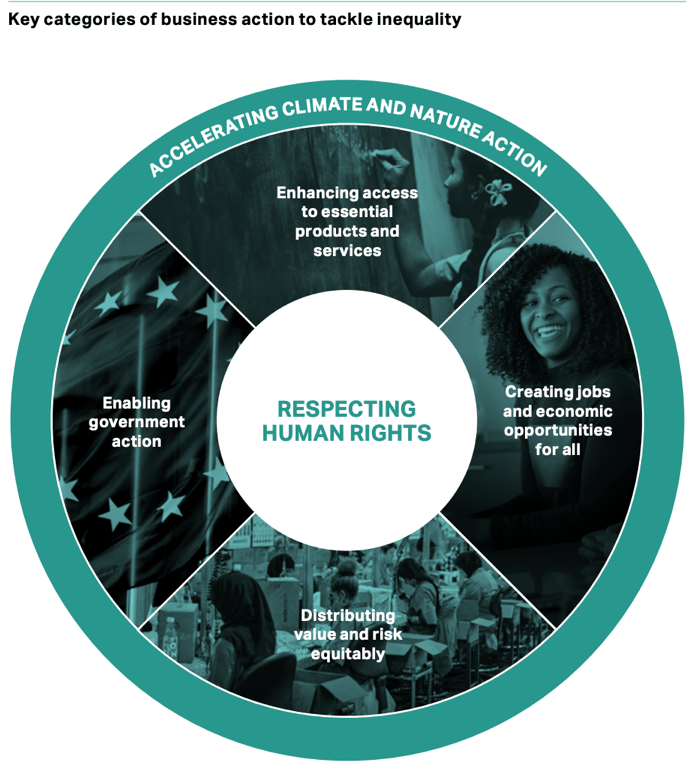
This image from the Business Commission to Tackle Inequality’s flagship publication shows the breadth of what that group sought to encompass. If anything, the breadth of the challenges that TISFD is intending to cover is still greater. The inclusive – even eclectic – nature of the issues covered by the new group readily demonstrated by the failure (at least so far) to find a streamlined name for the Taskforce. It represents the combination of separate groups, one considering inequalities and the other social issues. Of course there are multiple cross-overs between these areas but clearly neither group felt able to compromise over the name.
As well as the spread of its ambitions, the inclusive nature of the TISFD is also shown by the breadth of the backgrounds of the co-chairs. The fourth co-chair is Sharan Burrow, the redoubtable former General Secretary of the International Trade Union Confederation. She noted that TISFD’s aim goes far beyond disclosure: “If we think about it as an end process which is just disclosure then we’re not actually considering what the recommendations must do, which is actually to put up front the sorts of issues that ought to be taken into the business model, the externalities, the risks that must be accounted for in planning.”
Bakker agreed: “Do not make the mistake that TISFD is about disclosures or reporting, because that’s the mistake that everybody always makes in the sustainability world. The reporting bit is the end of a process in which better decisions are made and that’s how you influence the social impacts towards a more positive outcome.”
Bakker went on, and laid down the crucial challenge particularly for the investment world:
“It is partly corporate decision making, partly corporate disclosures, but it’s also about how financial markets will then pick up this decision-useful information and provide incentives for a much fairer and more equal and inclusive world.”
We will see if investors are ready to rise to this challenge.
See also: Deaton’s economics: fair criticism?
I am happy to confirm as ever that the Sense of Fairness blog is a purely personal endeavour
Taskforce on Inequality and Social-related Financial Disclosures
TISFD Launch Webinar, September 27 2024
Doing the Minimum, No Mercy/No Malice blog, Professor Scott Galloway, September 13 2024
Business Commission to Tackle Inequality
Tackling inequality: An agenda for business action, Business Commission to Tackle Inequality, May 2023
 The Sense of Fairness blog