A new novel called Fair Play was of course irresistible for this blog – especially when it turned out that the author, debut novelist Louise Hegarty, was speaking at my local bookshop.
Fair Play is an intriguing, even odd, blend. It starts as a modern story of a group of friends at a New Year’s party in an Airbnb country house. When one of the party dies mysteriously, it fractures into two: a locked-room detective story of the traditional sort, aping Agatha Christie, Arthur Conan Doyle, Dorothy L Sayers and so on, and the story of the grief of the dead man’s sister, Abigail, as she tries to make sense of what makes no sense.
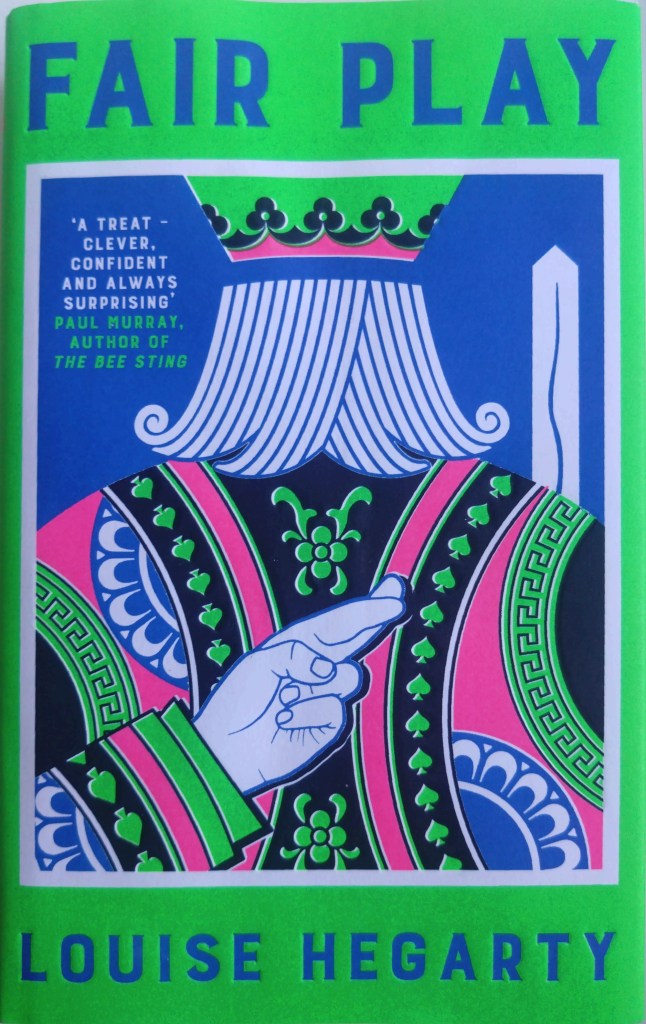
The title of the book comes from what Hegarty has gathered as the ‘Fair Play Rules’ of detective fiction, three sets of guidance from its heyday of the late 1920s. Essentially, these are about being fair to the reader, so that we feel we have a fair chance of finding the truth, just as much as the detective, and at least we are smarter than the detective’s foil, the person Father Knox in one of the three sets of guidance, his 1929 Introduction to The Best Detective Stories of 1928-29, cruelly calls “The stupid friend of the detective, the Watson”.
It’s not hard to think of especially famous examples that breach some of the ‘Twenty Rules for Writing Detective Stories’ by SS Van Dine in The American Magazine in September 1928, for example numbers 12 and 13:
- “There must be but one culprit, no matter how many murders are committed”; and
- “Secret societies, camorras, mafias et al have no place in a detective story”
But then, some of the best writers have always played with the genre, on occasions bending the rules, only to the greater pleasure of the reader. The sleights of hand to pass quickly over clues after having brought them to our notice is one of the joys of these books (even if we only spot them after the fact!).
It’s not just my admiration for him as a writer that means my favourite of the three sets of guidance is that from TS Eliot, in a 1927 New Criterion piece in ‘Homage to Wilkie Collins’, widely seen to have invented the detective novel. The fifth of these is that “The detective should be highly intelligent but not superhuman. We should be able to follow his inferences and almost, but not quite, make them with him.” While being superhuman is not allowed, odd habits are: Hercule Poirot’s fastidiousness was clearly invented to hide (in plain sight) a decisive clue from the reader. It’s likely that same fastidiousness is what eventually came to annoy Christie so much about her character.
The key point of each of the guides is that the reader of a detective novel must emerge from the story not feeling cheated but feeling we could have got the answer for ourselves if only we had paid more attention, thought a little harder or taken a little more time to mull the clues available to us. We wouldn’t recommend to others a detective novel that was unfair by failing to live up to these expectations, and we probably wouldn’t read more from that writer. In reading, as in other things, humans favour fairness.
It needed no confirmation that Hegarty is a fan of detective stories, and of Christie in particular. Her handling of various of the standards of the genre, and particularly the playful repeated versions of different revelations of alternative murderers, show that very clearly. But in many ways the half of the book that is the detective novel is slight. What elevates Fair Play, and makes it linger in my mind, is the half that is the story of the sister’s grief. This, sparsely told and without easy answers, carries heft without being heavy.
The thing that seemed off limits at the talk was Hegarty’s own experience of grief. But it appears clear from the way she writes of it that she knows whereof she writes. We all have our experiences of grief, and this writing rings true, if anything helped by its sparseness. There are different short vignettes giving a vivid expression. Some of these are jarringly within a workplace setting, memorably a dull business meeting that comes to echo only with the words ‘my brother’s dead’. This feels very real, as does Abigail’s search for the answer, the simple revelation that will give her resolution. But life rarely offers the simple resolutions of a brilliant detective’s summing up.
Though there are no easy answers, I never felt cheated by what is an admirable first novel.
I am happy to confirm as ever that the Sense of Fairness blog is a purely personal endeavour. I am also happy to wish readers the compliments of the season.
Louise Hegarty, 2025. Fair Play, Picador
Father Knox, 1929. Introduction to The Best Detective Stories of 1928-29, Faber
SS Van Dine, 1928. Twenty Rules for Writing Detective Stories, The American Magazine
TS Eliot, 1927. Homage to Wilkie Collins: An omnibus review of nine mystery novels, New Criterion
 The Sense of Fairness blog