Reading an old book can sometimes feel like an archaeological dig – you find fragmented artefacts of how people used to think and have to try to piece together an understanding of their world, and their world view. Very often it serves to illuminate our own.
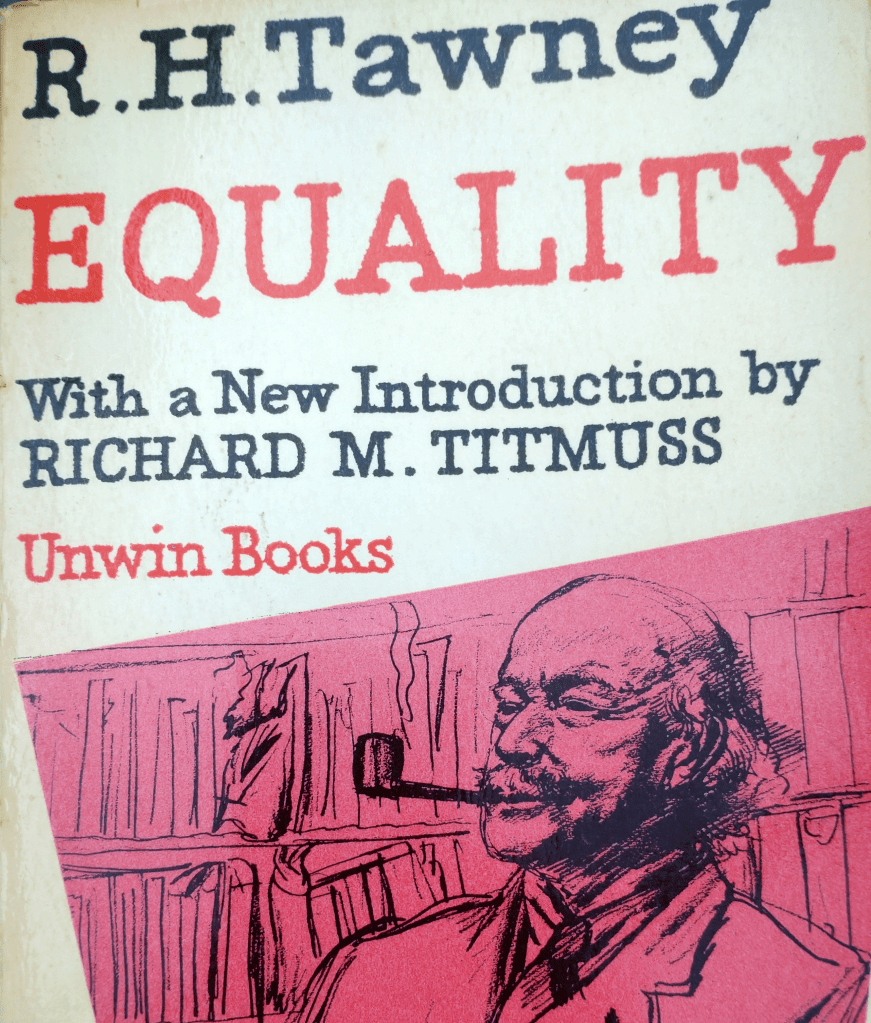
That’s definitely my sense while reading a book called Equality by an old socialist and economic historian, RH (Richard Henry) Tawney. My edition dates from 1964 but the original book was published in 1931, based on lectures given in 1929. This version enjoys a 1964 introduction by founding father of social policy Richard Titmuss, and no fewer than two prefaces by Tawney himself, one from the 1951 revised edition and one from the ‘substantially revised’ 1938 edition. Reading through these in this order is like uncovering historic layers of English inequality, and repeated aspirations for greater equality. What’s more, the first chapter of the book, The Religion of Inequality, starts by referring to a lecture by Matthew Arnold from I think 1878, to which it attributes the coining of that phrase.
I find it impossible to read these archaeological artefacts and not reflect on our own age. This blogpost aims simply to capture a few sentiments from each of these layers of history. Readers will no doubt be conscious of the great ruptures and attempts towards greater equality that provided the context for the writing of each of these layers of commentary, from the heights of the Cold War, the challenges of the Second World War and the creation of the welfare state that followed it, the Great Depression and the rise of fascism – and even, back around the 1870s, the first steps to broad enfranchisement (and while the right to vote did not then extend to women, that decade did see them permitted for the first time to retain their own property rather than simply surrender it on marriage).
Titmuss in his 1964 introduction:
“We…delude ourselves if we think we can equalize the social distribution of life chances by expanding educational opportunities while millions of children live in slums without baths, decent lavatories, leisure facilities, room to explore and the space to dream. Nor do we achieve with any permanency a fairer distribution of rewards and a society less sharply divided by class and status by simply narrowing the differences in cash earnings among men during certain limited periods of their lives.”
“Long years of economic depression, a civilians’ war, rationing and ‘fair shares for all’, so-called ‘penal rates’ of taxation and estate duty, and ‘The Welfare State’ have made little impression on the holdings of great fortunes…Wealth still bestows power, more power than income, though it is probably exercised differently and with more respect for public opinion than in the nineteenth century.”
“These consequences of technology in an age of abundance are more likely to increase than to decrease differentials in income and wealth if no major corrective policies are set to work…Without a major shift in values, an impoverishment in social living for some groups can only result from this new wave of industrialism.”
Tawney in his 1951 preface:
“Like earlier wars of religion, the credal conflicts of our day will find varying issues in different regions; but, if Europe survives, societies convinced that liberty and justice are equally indispensable to civilization will survive as part of her. The experience of a people which regards these great abstractions, not as antagonists, but as allies, and which has endeavoured, during six not too easy years, to serve the cause of both, is not barren of lessons which may profitably be pondered.”
And he quotes The Times from 1 July 1940:
“If we speak of democracy, we do not mean the democracy which maintains the right to vote, but forgets the right to live and work. If we speak of freedom, we do not mean a rugged individualism which excludes social organization and economic planning. If we speak of equality, we do not mean a political equality nullified by social and economic privilege. If we speak of economic reconstruction, we think less of maximum production…than of equitable distribution.”
Tawney in his 1938 preface:
“It is still sometimes suggested that what Professor Pigou, in his latest work, calls ‘the glaring inequalities of fortune and opportunity which deface our present civilization’ are beneficial, irremediable, or both together. Innocent laymen are disposed to believe that these monstrosities, though morally repulsive, are economically advantageous, and that, even were they not, the practical difficulties of abolishing them are too great to be overcome. Both opinions, it may be said with some confidence, are mere superstitions.”
“Institutions which enable a tiny class, amounting to less than two per cent of the population of Great Britain, to take year by year nearly one quarter of the nation’s annual output of wealth…are an economic liability of alarming dimensions. They involve…a perpetual misdirection of limited resources to the production or upkeep of costly futilities, when what the nation requires for its welfare is more and better food, more and better houses, more and better schools.”
“Today, when three-quarters or more of the nation leave less than £100 at death, and nearly two-thirds of the aggregate wealth is owned by about one per cent of it, inheritance is on the way to become little more than a device by which a small minority of rich men bequeath to their heirs a right to free quarters at the expense of their fellow-countrymen. The limitations imposed on that right during the past half-century were greeted, when first introduced, with the usual cries of alarm; and the alarm, as is not less usual, has been proved by experience to be mere hysteria. It is perfectly practicable, by extending those limitations and accelerating their application, to reduce the influence of inheritance – at present a strong poison – to negligible dimensions.”
“To make [democracy] a type of society requires an advance along two lines. It involves, in the first place, the resolute elimination of all forms of special privilege, which favour some groups and depress others, whether their source be differences of environment, of education, or of pecuniary income. It involves, in the second place, the conversion of economic power, now often an irresponsible tyrant, into the servant of society, working within clearly defined limits, and accountable for its action to a public authority.”
Tawney reports that Matthew Arnold said, in c1878:
“Arnold observed that in England inequality is almost a religion. He remarked on the incompatibility of that attitude with the spirit of humanity, and sense of the dignity of man as man, which are the marks of a truly civilized society. ‘On the one side, in fact, inequality harms by pampering; on the other by vulgarizing and depressing. A system founded on it is against nature, and, in the long run, breaks down.’”
As LP Hartley says in another old book, one that deliberately plays with memory and history, “The past is a foreign country; they do things differently there.” But often ‘they’ worried about the same challenges we do, and sought similar solutions.
I am happy to confirm as ever that the Sense of Fairness blog is a purely personal endeavour.
See also: Plague and planning: a long history of English unfairness
Unveiled: fleeced by power and business as usual
RH Tawney, Equality, 1964, Unwin
Arthur Pigou, Socialism versus Capitalism, 1937
LP Hartley, The Go-Between, 1953
 The Sense of Fairness blog