A historical meander through the countryside for the holidays
The quintessential vision of England is of a village set in rolling countryside. Depending on the topography, this may be hills cropped by sheep, or less frequently other farm animals, or flatter lands growing cereal. But whatever the countryside, the village is consistently there (whether or not, like former prime minister John Major, we include in our image cricket and warm beer and spinsters cycling across the village green). We imagine these villages as images of fairness and justice, representing the ordinary people of England, strong, independent and free.
But those villages have not always been there. And they do not always represent fairness, independence or freedom (even if we can set aside modern concerns about incomers pricing out locals). Any settlement and community is the creation of a set of decisions. Some of those decisions were by ordinary folk choosing to come together for their own reasons. But many times what are now viewed as symbols of peace and tranquillity were created by force at the whim of the local landlord, a feudal founding created to control the population and ensure that it was productive – to the benefit of the seigneur.
The bucolic beauty that we tend to take for granted was often an emblem of power and an assertion of unfairness. The same villages have also over centuries witnessed further episodes of the ebb and flow of power, and of fairness. We tend to imagine these places unchanged forever. They are not.
It used to be thought that there was a ‘village moment’ in England, when villages suddenly appeared in the landscape. My use of the term ‘seigneur’ was deliberate, for this ‘moment’ was for decades ascribed to the Norman invasion of 1066 and the following years, when newly created feudal lords established villages as power bases to control the population and its work effort. It is not just that the Domesday Book (which dates to 1086) provides us with the first consistent written record of the existence of English villages (though often it refers to individual farmsteads or small hamlets that later developed, or were developed, into villages).
This belief in a particular moment of village creation was reinforced by the archaeological digs of abandoned (or shrunken) mediaeval settlements, which “showed very little evidence for occupation earlier than the eleventh or twelfth century” as Carenza Lewis and colleagues explain in their key work Village, Hamlet and Field. But the belief eroded as further investigations, not least of settlements that continue to exist, tended to extend the moment to a rather broader period: they “seemed to push forward the origin of the large nucleated village to the period between about 850 and 1200”. It’s tempting to suggest that the disproportionate representation of the Norman-created villages among those that were subsequently abandoned is a sign that their artificial creation meant they were less sustainable than those created organically by a population choosing to move closer together, but I suspect that’s a little pat.
While landscape historians have pushed back the creation of many villages, it is undoubtedly true that many others were created soon after the Norman invasion, by those new feudal landlords: “lordly authority was clearly a key motor in the planning of settlements,” explains Oliver Creighton in his Designs Upon the Land. He further says: “The well attested phenomenon of seigneurial village planning, which in many cases extended to embrace field systems, can be taken as further evidence for the expression of lordly authority.”
These Saxon and mediaeval creations were of course not the first villages, though they were the first of a scale that we would recognise, and the first to include a village church (typically seen as the signifier of the distinction between village and hamlet). There were Neolithic villages – examples of these can still be seen at Scara Brae in Orkney, Carn Euny in Cornwall and Ty Mawr on Anglesey (preservation is better in remote places). But life generally remained scattered until towards the end of the Anglo-Saxon period.
These were not the first villages, but these were the first that we might recognise today. And, whatever the timing of their creation, all were under tight command and control arrangement, “a tightly managed landscape” says Trevor Rowley in the classic Villages in the Landscape. “The manorial court was responsible for the regulation of internal field boundaries, the precise amount of grazing and rights of gathering on the common waste, and it also had responsibility for the trackways and streams. The manor courts collectively administered rules of husbandry, watched over local customs of tenure and inheritance and enforced local peace and order. By 1300 we would have looked on a landscape which was intensively used at a subsistence level.” This was not a fair landscape: most lived the hardest of subsistence existences while a small handful prospered.
As Rowley summarises: “the permanent nucleated village so familiar to us today was a factor not of ethnic or cultural change, but of economic and social forces. It was brought about by a complex combination of increasing population and increasing authoritarian control through the manorial system”.
And it wasn’t only the villages, but the landscape more broadly. Creighton takes a particular interest in parkland, land taken into private ownership as a venue for hunting. He points out that taking land out of agricultural production and creating parks was not an economic decision, but a social one driven by concerns of status. “The right to empark was a jealously guarded privilege and badge of lordly authority,” he writes. “The huge outlay involved in the creation of parks and the challenges of maintaining them, combined with the minimal financial returns that accrued, shows that they were not geared to maximise profit by cold, hard businesslike patrons.”
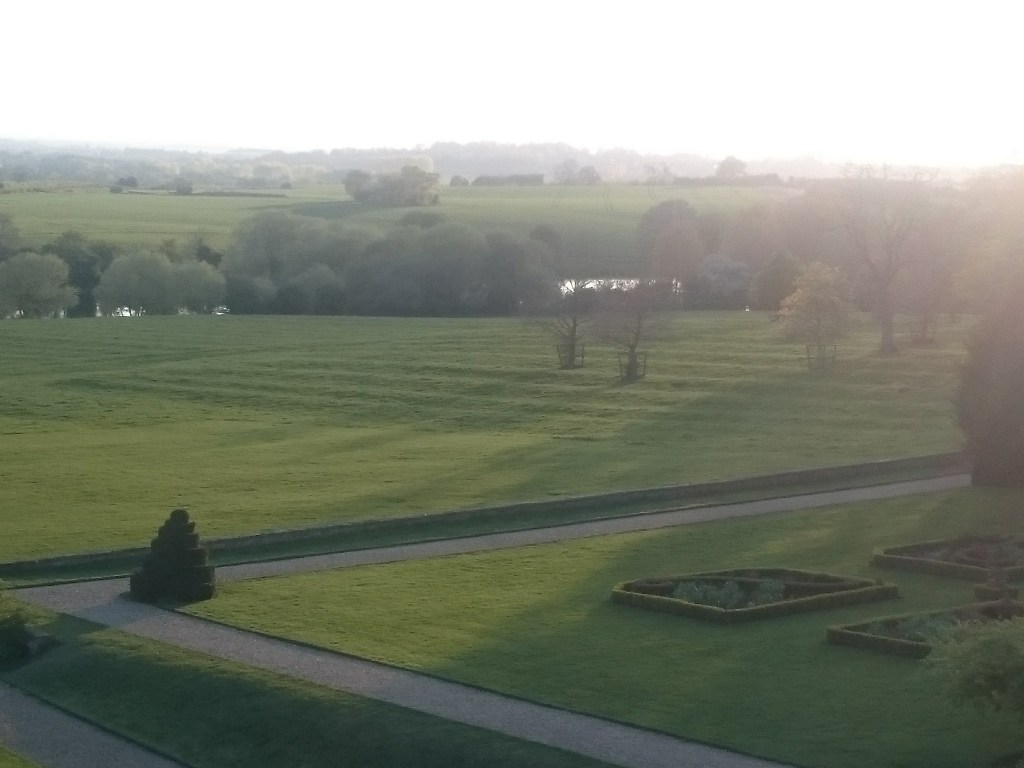
This contrasts of course with the much later enclosure movement when the wealthy took land out of common usage by the general population and asserted their direct ownership of it (often with the formal endorsement of acts of parliament – the law being used to enforce the demands of the powerful). Enclosure coincided with the agricultural revolution, making the productivity of the seized lands more than recompense the cost of the creation of the hedges, walls and fencing – and of the policing of the protests from the dispossessed population. Susanna Wade Martins in Farmers, Landlords and Landscapes reports that after enclosure, “Productivity could sometimes be doubled and rents went up by an equivalent amount.” That wasn’t the case with mediaeval seizures.
Parks in the mediaeval era were just as contested as the enclosed lands, though. As Creighton points out, “Many parks were recorded for the first time not when they were licenced or created, but when they were first broken into.” He suggests that poaching may have been just an assertion of continuing rights to seek food in emparked land.
Alongside this privatisation of land, from 1250, the elite turned more aloof, power and wealth enabling them to distance themselves from ordinary folk. Increasingly, the wealthy kept themselves apart, both in the siting of their own property and in the design of their buildings also. Creighton says: “an increasingly aloof aristocracy … was progressively increasing the social distance between the household and the world beyond the walls… This is part of a pan-European phenomenon evident at key lordship sites in France, Germany and Scandinavia and, in turn, part and parcel of a broader phenomenon of the increased privatisation of space, as manifested particularly clearly in the changing function of the hall and modes of domestic planning that enabled individuals to spend more time in individual rooms.” This period seems to coincide with a trend towards moated sites for elite dwellings – typically a symbolic separation rather than offering any degree of protection. This trend towards status symbols and separation was reflected in food also, for example it is at this period when the eating of more exotic birds becomes an activity for the elite, and the poor were excluded from certain foods.
This move is not to be taken lightly. In his The Archaeology of Power, John Steane discusses the ceremonial role of the lordship’s property, in particular the community role fulfilled by his hall, “the architectural expression of the household”. He quotes from William Langland, the 14th century supposed author of Piers Plowman, who criticises those lords whose halls have become a “sorry, deserted place” because “the rich nowadays have a habit of eating by themselves in private parlors”. The implications of the harm caused to community and society as a whole by this withdrawal are significant.
This was an age of remarkable unfairness. The majority toiled, a few did well – and increasingly turned their backs on the toilers, living very separate lives. It took a devastating event, or series of events, to reawaken fairness in our country. Those events were the repeated scourges of the Black Death (which first swept across Europe in the years either side of 1350), devastating the population and bringing enormous changes in its diseased wake.
I wrote in my last post about the impact of the Second World War in sweeping away some of our nation’s then ossified unfairness and injustice. And I noted that we must hope that it doesn’t take such an event to sweep aside the unfairness that has built up again in our society. The Black Death was a still more lethal and traumatic event that led to an even more remarkable reversal of inequalities. According to James Belich’s analysis in his remarkable and epic history of the consequences of the plague era, The World the Plague Made, around half of Europe’s population died from the initial outbreak of the plague (he spends a whole chapter justifying this conclusion, which is greater than the usually quoted one-third, a death toll that would have been remarkable enough).
As Belich explains, this halving of the population dramatically increased the value put on labour – meaning that the poorest suddenly began to be paid more. The poorest may have doubled their available spending capacity (even the smallest increment in pay for someone operating at subsistence levels will enable this), as well as giving them more leisure time; others fared better in absolute terms. The decrease in the availability of labour, and the increase in its cost, led to a productivity revolution – and with the same capital goods now shared between a halved population there was significant scope for such a productivity shift. This, together with increases in money available across the economy, led to a boom in demand for what had previously been luxuries available only to the few. Trade boomed, deploying the same shipping capacity for the benefit of the halved population. Many were freed from subsistence farming and agricultural patterns shifted to favour more specialisation.
Belich argues that it was the plague that led to Europe’s imperial dominance of the globe over subsequent centuries. One vehicle for this, he suggests, is that the fairness of the post-plague era lingered long enough in folk memories that it made ordinary people willing to risk everything to travel to far off lands in search of a better life, a life more like the less unequal era post-plague.
Those with Scottish and Irish heritage will no doubt baulk at this, pointing to the enforced movements caused by those great historic injustices the Clearances and the Great Hunger (the capital letters just a nod to their cultural significance) – and others will point to other causes in other lands. There’s truth that many travelled the world (and do so now as well as then) because their homeland no longer offered them a home, but both events came later than Belich intends. He is thinking about the start of the European imperial era, in the fifteenth and sixteenth centuries, when the journey itself was extremely hazardous, with around 30% dying even before they reached their destination – let alone the challenges of the precarious imperial outposts that were created. Those of course are the odds of those who travelled freely as free people, not of those who were enslaved, nor those of the indigenous peoples whose lands were taken from them.
European people travelled in spite of these odds, Belich believes, because they remembered the freedom and fairness that followed the horrors of the Black Death. A small hope for fairness will inspire many to action.
As we walk the countryside, we should recognise how it offers insights into past unfairness, and not the simple bucolic beauty that is all we sometimes see.
I am happy to confirm as ever that the Sense of Fairness blog is a purely personal endeavour.
Village, Hamlet and Field: Changing Mediaeval Settlements in Central England, Carenza Lewis, Patrick Mitchell-Fox, Christopher Dyer, Windgather Press, 2001
Designs Upon the Land: Elite Landscapes of the Middle Ages, Oliver Creighton, Boydell Press, 2009
Villages in the Landscape, Trevor Rowley, Dent, 1978
Farmers, Landlords and Landscapes: Rural Britain 1720-1870, Susanna Wade Martins, Windgather Press, 2001
The Archaeology of Power, John Steane, Tempus Publishing, 2004
The World the Plague Made: The Black Death and the Rise of Europe, James Belich, Princeton University Press, 2022
 The Sense of Fairness blog