With all the talk about a bubble in investment in so-called ‘AI’*, I have taken a moment to reread the classic on the 1929 Wall Street bubble bursting, US economist John Kenneth Galbraith’s The Great Crash 1929, first published in the 1950s.
Speculative market bubbles do come and go. As Galbraith notes, the reason that 1929 is most remembered is not so much that the speculative bubble had grown so large before bursting (though it was unusually large) but that there were such broad real economy impacts from the bursting of the bubble – the lost years known as the Great Depression. A pair of Galbraith datapoints start to capture the scale of the Great Depression in the US and its searing impact on ordinary people: unemployment in 1933 was 13 million, one in four of the labour force; and even in 1938 still one in five were out of work.
So trying to understand why the Great Crash sparked the Great Depression is of real interest and seems like a timely thing to consider. Galbraith has no patience for the Wall Street apologists who argue there was no connection between Crash and Depression, but he does see that there were vulnerabilities in the economy that made it particularly susceptible to the crisis.
The first of these is of most interest to this blog, and Galbraith headlines it ‘The bad distribution of income’, noting that in 1929 the top 5% received around 35% of all personal income, and that interest, dividends and rental income (the almost exclusive preserve of the wealthy) represented fully 22% of total family income.
“This highly unequal income distribution meant that the economy was dependent on a high level of investment or a high level of luxury consumer spending or both. The rich cannot buy great quantities of bread. If they are to dispose of what they receive it must be on luxuries or by way of investment in new plants and new projects. Both investment and luxury spending are subject, inevitably, to more erratic influences and to wider fluctuations than the bread and rent outlays of the $25-week workman. This high-bracket spending and investment was especially susceptible, one may assume, to the crushing news from the stock market in October 1929.”
Readers will recognise some of our current distortions in these reports of the imbalances of pre-crash 1929 (also see Is enough enough? Addressing the problem of the super-rich, and The centre cannot hold). Significant inequalities – especially unfair ones – make economies less robust, more risky and more prone to crisis.
That is the first of Galbraith’s linkages between Great Crash and Great Depression. The others are as follows (deploying my brief characterisations of his comments):
Bad corporate structure. A business sector including many swindlers and fraudsters.
Bad lending. Profligate lending to unsound businesses and investments.
Imbalanced trade positions. Long-term trading imbalances, sometimes exacerbated through the application of tariffs, with the resulting deficits sometimes filled by corrupt, or at least grey, payments.
Poor economic insight. Shonky economic data riddled with holes.
So clearly, we’ve nothing to worry about now.
I will leave Galbraith with the last words of this blogpost, without comment from me. In the last pages of the book, he writes: “during the next boom some newly rediscovered virtuosity of the free enterprise system will be cited. It will be pointed out that people are justified in paying the present prices – indeed, almost any price – to have an equity position in the system. Among the first to accept these rationalizations will be some of those responsible for invoking the controls. The newspapers, some of them, will agree and speak harshly of those who think action might be in order. They will be called men of little faith.”
* Seasoned readers may remember that I am an ‘AI’ sceptic – see A just AI Transition, for example
I am happy to confirm as ever that the Sense of Fairness blog is a purely personal endeavour – and also that I do not give, and am not authorised to give, personal financial advice. This blogpost should not be construed as such advice.
John Kenneth Galbraith, The Great Crash 1929. Hamish Hamilton 1955
Being poor brings many disadvantages. A lack of money squeezes options and reduces opportunity. It hampers health and makes ambition harder. But the effects aren’t just direct and physical. They are psychological too. Researchers are beginning to uncover just how debilitating being poor is for effective thinking.
The answer to the question posed in the title Do Financial Concerns Make Workers Less Productive? was a resounding yes. Not only did poor workers whose money troubles were temporarily alleviated produce more, they also made fewer mistakes in production, despite operating more quickly. There is a clear business productivity benefit from this poverty alleviation; and in work that pays piece rates – where workers are paid for their useful output in numbers of products – this alleviation of worry also enabled them to earn more.
In a world of unfairness in which many are kept poor, these are significant findings. In a world seeking greater growth, where growth has been held back by stagnant productivity, they are still more important.
The increase in productivity shown was much greater than that brought about by an increase in the piece rate paid (which in a control experiment was done alongside a cut in base pay so that overall earnings were steady). There was a small increase in output following the piece rate increase, but it was less than a tenth of the change brought about by removing money worries – and there was no discernable increase in the quality of production, meaning this piece rate change delivered much less than a twentieth of the improvement in productivity that alleviating poverty did.
It’s worth noting that the researchers were able to discard alternative explanations of why these workers become more productive. In particular, they specifically discounted the possibility that improved nutrition of the poverty-relieved workers was the cause, because of the speed of the effect of the early payments and the lack of difference in nutritional intake in that short period. The effect is a psychological one: workers who don’t need to worry constantly about money are more productive.
This means that our economies are being held back by workers who are less productive than they could be, simply because they do worry about money on an ongoing basis. GDP growth is being artificially depressed and poverty alleviation could help it recover. This represents a business, investment and economic opportunity.
These findings are depressing. But it’s worse to find that growing up in poverty also has debilitating effects on children.
A recent study finds that poor students underperform their usual standard on maths tests that use real-world scenarios involving money, food or social interactions. It’s not a small effect, either: their performance is on average 18% lower than it is on questions overall – and, the researchers note, it would look even worse if they compared performance against just those questions that are more neutral.
These results were surprising to the researchers, who were expecting to see outperformance in these more practical questions, revealing hidden talent among poor students (they use the jargon low SES, socioeconomic status) that may be untapped by traditional education. That’s the reason why such questions have increasingly been used in modern testing: they are thought to be more accessible to all students. But the result of this study indicates that accessibility comes at the price of triggering distracting thoughts for poorer young people. As the chart shows, performance is worst with regard to questions that refer to money specifically.
Another recent study also found evidence of underperformance on money-linked questions by poor students. It puts this down to ‘attention capture’ as the researcher identified an effect not only on the specifically money-linked questions but also underperformance on more neutral questions asked subsequent to them. It seems as though the question reminds the students to worry about money, and they then can’t shake off the concerns.
These results amount to another example of apparent meritocracy in fact acting to limit the opportunity of those who start with less. As the Fictional Money, Real Costs paper states:
“Examinations are an efficient mechanism to benchmark and rank a population based on a specific set of skills. The notion that they are fair, however, has increasingly been questioned. A significant concern is that performance differences reflect inequities in the testing process itself, rather than differences in underlying skills, and thus may contribute to the intergenerational transmission of existing inequality.”
“We need a major repair that is not going to be found in the traditional economic models that consider the social impact of our decisions as something to be fixed ex post through social policies and redistribution. It needs a major change in the economic narrative, that brings equality and sustainability objectives on an equal footing with productivity and growth when measuring success. And it needs to bring in the private and the financial sector to change the way they define and measure their objectives and actions ex ante.”
Ramos went on to express the hope that the TISFD disclosure framework “will encourage organisations to consider the broader impact of their operations in an ex ante manner and make the social implications of business models transparent … We need to integrate the private sector and the financial sector in the solution because with that we can drive meaningful change that aligns economic progress with positive social impact.”
One of her fellow co-chairs, Arunma Oteh, former World Bank Vice President and Treasurer, and former Director General of Nigeria’s Securities and Exchange Commission, took the opportunity of the launch webinar to invite the investment and business communities to take part in the development of the TISFD standards: “By participating in this process businesses and financial institutions in my view will gain a deeper understanding of how social and inequality issues contribute to systemic risks that can affect financial markets and the global economy.”
Her aspiration is clear: “By standardising how organisations report on social-related issues we can also empower all stakeholders to hold businesses and financial institutions accountable for their social impact.”
These are not small ambitions. It’s clear that the new Taskforce will throw down a gauntlet for both business and the investment community, to think more deeply about the negative implications of business models and investment for society, and particularly the danger that the current approaches further foster inequality. In the language of this blog, the ambition is to instil a greater sense of fairness in business and investment.
Fortunately, there are a few voices from the world of business talking about these issues. Professor Scott Galloway, a successful tech entrepreneur – with an unusual humility for someone with that background – turned educator, is typically excoriating in a recent blog on the US minimum wage: “We have epidemics in the US — depression, anxiety, high blood pressure, homelessness, obesity, and poverty — among young people, particularly men. (Though it’s worth noting here that the majority of people making the minimum wage in the US are women.) The most powerful means of addressing these ills, and the ‘deaths of despair’ that follow, is a good job at a fair wage that acknowledges the nobility of work. In addition, a good job creates incentives and illuminates a path to wealth creation and economic security.” He is clearly referencing the work of economist Angus Deaton, and in doing so highlights the opportunity for investors: economies with fairer pay will prosper more. But Galloway is an unusual figure, in multiple different ways.
Peter Bakker, CEO of World Business Council for Sustainable Development (WBCSD), and former CEO of Dutch logistics firm TNT, talked about the creation of the TISFD arising out of earlier work of the Business Commission to Tackle Inequality: “One of the key conclusions out of that work is that the way that business makes decisions today, the way that businesses are managed, the way that capital markets look and value businesses, does not incorporate the social- and inequality-related risks, the dependencies and the impacts that business actually has on society and on people in it.”
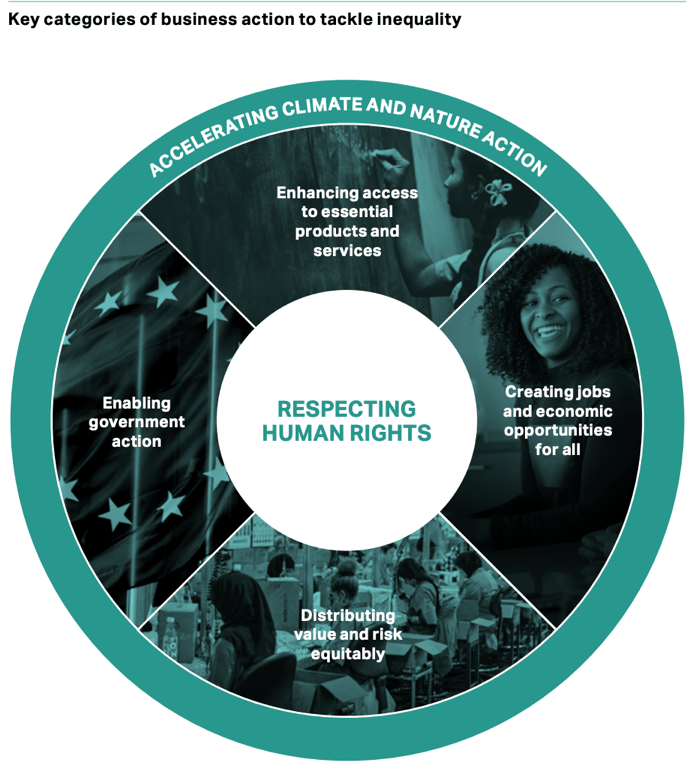
This image from the Business Commission to Tackle Inequality’s flagship publication shows the breadth of what that group sought to encompass. If anything, the breadth of the challenges that TISFD is intending to cover is still greater. The inclusive – even eclectic – nature of the issues covered by the new group readily demonstrated by the failure (at least so far) to find a streamlined name for the Taskforce. It represents the combination of separate groups, one considering inequalities and the other social issues. Of course there are multiple cross-overs between these areas but clearly neither group felt able to compromise over the name.
As well as the spread of its ambitions, the inclusive nature of the TISFD is also shown by the breadth of the backgrounds of the co-chairs. The fourth co-chair is Sharan Burrow, the redoubtable former General Secretary of the International Trade Union Confederation. She noted that TISFD’s aim goes far beyond disclosure: “If we think about it as an end process which is just disclosure then we’re not actually considering what the recommendations must do, which is actually to put up front the sorts of issues that ought to be taken into the business model, the externalities, the risks that must be accounted for in planning.”
Bakker agreed: “Do not make the mistake that TISFD is about disclosures or reporting, because that’s the mistake that everybody always makes in the sustainability world. The reporting bit is the end of a process in which better decisions are made and that’s how you influence the social impacts towards a more positive outcome.”
Bakker went on, and laid down the crucial challenge particularly for the investment world:
“It is partly corporate decision making, partly corporate disclosures, but it’s also about how financial markets will then pick up this decision-useful information and provide incentives for a much fairer and more equal and inclusive world.”
We will see if investors are ready to rise to this challenge.
It is remarkable that the International Monetary Fund, one of the bastions of our modern economic construct, should be so willing to test and challenge current economic thinking. But that is what it does in publishing a striking short blog by respected economist Angus Deaton. Deaton is best known for his remarkable work on the US epidemic of what he has dubbed deaths of despair and he also led a recently-completed eponymous review of inequality for the Institute of Fiscal Studies. Deaton offers what amounts to an apologia for modern economics, and suggests some routes that may be more productive for the future. Not only might they be more productive, I would suggest that they are also likely to be fairer.
In the blog, Deaton questions mainstream economics. He does so from a remarkably mainstream position. He won the Nobel Prize in 2015, and is a professor at Princeton. His criticism of the failings of current economics, and not least of current economic education, should therefore hit home.
The core of Deaton’s points are made in crisp discussions under a handful of bullet-point headings. These are: power, philosophy and ethics, efficiency, empirical methods and humility (doesn’t our entire world need a whole lot more of that last?). He comes most crisply to his point in the first of these: “Without an analysis of power, it is hard to understand inequality or much else in modern capitalism.” But the bullet points reflect a continuity of thought, not separate ideas. He complains at the loss of ethical thought from economics and its replacement by an emphasis on efficiency and a simplifying focus on the financial: “We often equate well-being with money or consumption, missing much of what matters to people.”
Under efficiency, he states:
“Many subscribe to Lionel Robbins’ definition of economics as the allocation of scarce resources among competing ends or to the stronger version that says that economists should focus on efficiency and leave equity to others, to politicians or administrators. But the others regularly fail to materialize, so that when efficiency comes with upward redistribution—frequently though not inevitably—our recommendations become little more than a license for plunder.”
I think that quote bears rereading.
Applying these five approaches as a new lens for approaching questions, Deaton reaches a range of fresh conclusions – or rather a reduced level of certainty – about a number of different issues. These include: unions, free trade, global poverty and immigration.
But though it is not among these bullet-points, or the issues about which Deaton now has less certainty, to my mind one of the most notable single words in the piece is ‘efficacy’. Deaton says: “today we [economists] are in some disarray. We did not collectively predict the financial crisis and, worse still, we may have contributed to it through an overenthusiastic belief in the efficacy of markets, especially financial markets whose structure and implications we understood less well than we thought.” Normally economists and investors talk about market efficiency, and certainly the financial crisis was in part due to overconfidence that markets are efficient, that they will find the right prices for things. The efficient market hypothesis – which many investors take as a certainty, even though it is merely an hypothesis, and even though there would be no ability of active investors to outperform if it were true (admittedly many are more lucky than genuinely generate outperformance, but nonetheless it is still possible to outperform a market). The crisis showed that market pricing can often be very wrong and the use of market prices as a foundation for valuations can be risky.
Deaton is clearly referencing the Efficient Market Hypothesis (and the use of ‘efficiency’ as one of his bullet-point headings makes more notable his decision not to use the term in his comment about the disarray of modern economics), but he is actually making a very different point. He is asking whether markets are always efficacious, whether they work and always add value to human society. And his clear view is that they are not always, and do not always. We should listen, particularly those of us who work in financial markets.
Deaton has never minced his words, but here he is remarkably cruel about his profession. He says he does not want to get into the question of corruption among his peers, though he notes that allegations “have become common in some debates”. But he does state, bluntly: “economists, who have prospered mightily over the past half century, might fairly be accused of having a vested interest in capitalism as it currently operates”. In a blog that clearly has real concerns about the operation of modern capitalism, that fair comment is one that should hang over the profession, challenging all to rethink with the confidence and honesty that Deaton has.
“To make the poor richer, you have to make the rich poorer.”
It’s one of the bolder early assertions made in a new book, Enough: Why it’s time to Abolish the Super-Rich, from my friend Luke Hildyard, who leads the High Pay Centre, the think tank dedicated to considerations of pay and employment rights. Given the hours he put into it, he’ll hate that I note it’s a short book, but that means it is a quick read – which its brisk and energetic style greatly assists. It includes extensive references to the evidence of academic and other studies, but Hildyard doesn’t let them weigh down his central messages and arguments.
Much of the book is dedicated to demonstrating the truth of this early assertion. Beyond that, Enough also aims to show that there would be benefits from a more equal income and wealth distribution and that much current income and wealth is unearned and undeserved. It argues that it is possible to address the issue of the super-rich, both politically and practically – but that at present the political will isn’t there and the social pressure for change isn’t yet great enough. “The super-rich are tragically unloathed,” says Hildyard in one of his typically crisp and blunt phrases.
As is perhaps obvious, this is a polemic, using vigorous and direct language to make its points – and it is none the worse for it. It’s also funny. I didn’t expect to laugh out loud at the book, but its dogged pursuit of a thought experiment of carpeting the nation in £5 notes is only one among its amusing moments.
Hildyard also charts a path for addressing the issue of the super-rich, one part of which would be wealth taxes. That particular path became potentially much easier just yesterday when a UN committee of tax experts agreed to develop a clear map for it: the Committee of Experts on International Cooperation in Tax Matters approved guidance for the creation of wealth taxes. This will not be called a ‘model law’ but rather an ‘example law’, but the intent is clear, and the idea of international cooperation in this area is aimed to reduce incentives for individuals to move to avoid such tax burdens. We’ll see how far these proposals progress in practice.
There is clearly some political will, and indeed some general willingness to engage in these issues. If the interest shown by those seeing me reading Enough on public transport are anything to go by, this is a book whose time has come. I would certainly heartily commend it. It was formally published this last week.
In many ways, vigorous and blunt as it is, Hildyard’s language is less hardline than others’. For example, the authors of the wonderful Spirit Level, Kate Pickett and Richard Wilkinson, both professors of epidemiology at York University, recently wrote a comment piece published in venerable journal Nature entitled Why the world cannot afford the rich.
As well as noting the disproportionate greenhouse gas emission impacts of the lifestyles of the wealthy (as previously noted in this blog), Wilkinson and Pickett state: “large differences in income are a powerful social stressor that is increasingly rendering societies dysfunctional”.
They continue:
“bigger gaps between rich and poor are accompanied by higher rates of homicide and imprisonment. They also correspond to more infant mortality, obesity, drug abuse and COVID-19 deaths, as well as higher rates of teenage pregnancy and lower levels of child well-being, social mobility and public trust.”
Most strikingly, the epidemiologists argue that “Even affluent people would enjoy a better quality of life if they lived in a country with a more equal distribution of wealth”. They complain about the wastefulness of unfair distributions: “Inequality also increases consumerism…Studies show that people who live in more-unequal societies spend more on status goods.” It’s certainly clear that this is happening. For example, ultra-luxury carmaker Bentley recently revealed its financial results, making revenues of €2.9 billion on sales of just 13,560 cars (or over €200,000 per vehicle), with margins improved by a record of nearly 10,000 of those vehicles including personalised features costing upwards of €40,000. For these buyers, it appears, it’s not enough to be able to buy a car that costs more than many houses. They also want the additional status of a still more expensive and truly unique vehicle.
The wealthy also buy other trappings of status – like the arts building branding that was part of the focus of the Sackler family in deploying their immoral earnings from Purdue Pharma’s role in the opioid crisis, or political donations. Evidence shows that rarely are such gifts really generosity – something is expected in return (as the reliably brilliant Tom Burgis amply shows in his excoriating new book Cuckooland). Sadly, rarely do the super-rich now feel the need to be genuinely generous in sharing their wealth in the ways their predecessors in earlier generations did. Alms houses are among our most beautiful old buildings, mostly built by our wealthy Tudor or Victorian forbears, but there seems to be no modern equivalent being created now.
This urge towards status skews our whole business sector. When you now look at the market capitalisations of major businesses, it is notable how much more valuable are the luxury goods companies that cater to the demands of a tiny minority than those that provide much larger markets with less luxurious versions of the same products. Germany’s Porsche is valued at more than $90 billion and Italy’s Ferrari (actually listed in the Netherlands to benefit from rules allowing unequal voting rights) is touching a valuation of nearly $80 billion; Ford and General Motors hover around the $50 billion mark, while producing orders of magnitude more vehicles. In a similar way, the valuation of Hermes (around $270 billion) is nearly double that of Inditex, whose major brand is Zara (valued at some $150 billion). The mass market isn’t where the money is made any more: even collectively, the centre doesn’t hold as much spending power.
Pickett and Wilkinson capture their findings in a striking chart that sets the Gini coefficient measure of inequality against an index the authors created of environmental, health and social issues (including measures such as air pollution and recycling; infant mortality, life expectancy, and obesity; and educational attainment, teenage births, social mobility and trust). As they say, “There’s a clear trend, with more-unequal societies having worse scores”:
As an earlier editorial in Nature raged, Reducing inequality benefits everyone — so why isn’t it happening? Essentially, that’s the challenge that Hildyard is attempting to rise to, and he provides some useful answers, and relevant solutions, as well as amusing challenge to the status quo. Do we need to make the rich poorer in order to make the poor richer? Probably, yes. The greatest political challenge on this issue though is likely to be defining what amounts to ‘rich’ or ‘super-rich’ for these purposes. One hindrance to action may be that definitions of what is too much are hard to draw. It’s hard to build a coalition of the willing among those who fear they may be next to face reductions (even if intellectually they might accept the idea that they would benefit from less inequality), and that – for the present at least – seems to limit the political pressure for change.
Hildyard himself blurs these lines, at times railing only and specifically at the truly (absurdly) super-rich, the billionaires, and at other times focusing on broader wealthy groups, including all public company bosses, top lawyers and bankers, and anyone earning in the top 1%, or having wealth among the top 1%. He quotes income of £183,000 and wealth of £3.7 million for the UK, and $400,000 and $11 million respectively for the US, as placing people into the respective 1% groups. These are huge numbers, clearly, but not close to being in the same league as the billionaires. A focus on a loosely defined super-rich elides this challenge – and while Hildyard demonstrates just how much might be available from the individuals at the very top of the income and wealth distributions, were they taxed more effectively (a simple function of their extreme wealth), he leaves open the question of seeing changes lower down the income levels too. This doesn’t undermine his arguments, but clarity is likely to be helpful in garnering political support and leveraging real change.
Hildyard ends the book saying:
“Indeed, it will be impossible to achieve our full potential to build a fairer, happier, more prosperous society without a major rebalancing of incomes and wealth. This ought not to be a question of partisan ideology – the logic, feasibility and urgent importance of the issue are clear. It is time to abolish the super-rich.”
I’d argue that all of this but the final sentence is unarguably true – that last sentence probably remains open to some debate, not least as to where the threshold for super-richness lies.
As the phrase goes, the poor are always with us. It is less clear that the super-rich need to be.



 The Sense of Fairness blog