It shouldn’t really be a surprise, but dignity at work – a combination of things such as the sense of autonomy and relationships with colleagues and bosses, and being treated fairly – matters to people. It’s as true at the bottom of the income scale, where observers might assume concerns about pay outweigh all other considerations, as it is higher up. Dignity matters to people, as I’ve been exploring in recent blogs.
For the book I am writing (on fairness in business and investment) I am currently investigating the literature on monopsony and oligopsony in labour markets. Monopsony is the distorted market situation arising from there being a single buyer of a good or service (a monopoly is where there’s a single seller); oligopsony is where there is a narrow enough group of buyers that they distort the marketplace. Economists are increasingly observing evidence that the labour market suffers inefficiencies that are consistent with oligopsony – employers having excess power in setting pay. Most workers would probably agree that their experiences too are consistent with this.
The study included four sentences exploring the degree to which workers had a sense of dignity in their jobs (these sentences were developed based on prior interviews with Wal-Mart workers that sought to understand their experience in the workplace, as well as earlier academic work). The overarching question was Indicate to what extent the sentence describes the workplace of your job at Walmart, and each time respondents were offered four responses (Almost Always; Often; Sometimes; Never). The four sentences were:
You [have/had] the opportunity to express yourself while at work.
You [can/could] rely on your co-workers to help you with work.
Your supervisor [treats/treated] you with respect.
Your supervisor [treats/treated] everyone fairly.
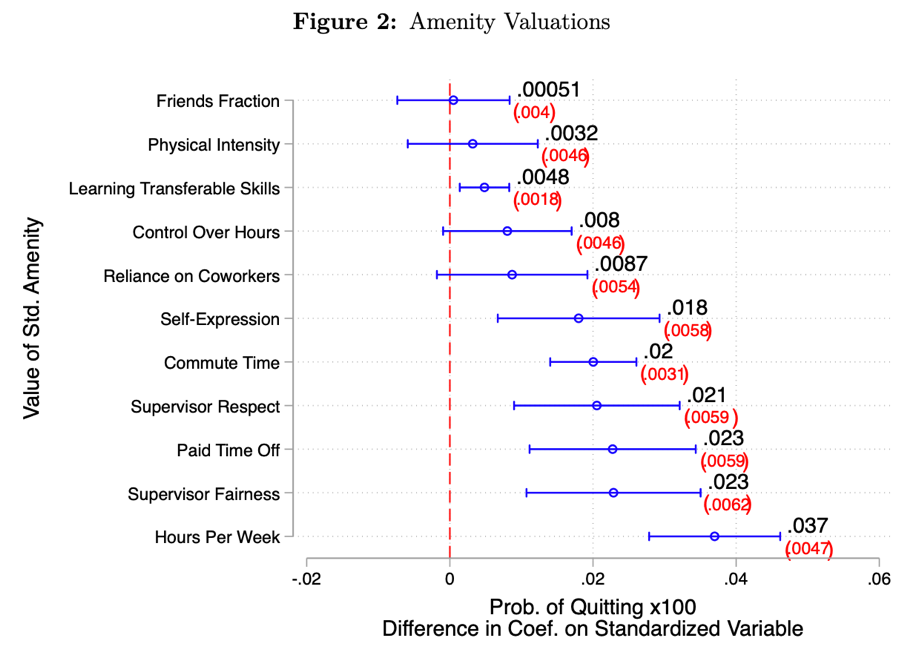
And of these four measures of dignity, it appears to be fairness that matters most. Indeed, a lack of fair treatment by one’s boss is in essence the greatest determinant of likelihood of quitting a job in the study, with the obvious exception of pay (and of the availability of hours of work a week, which is a clear part of the pay equation for those paid on an hourly basis):
Consistently, the study confirms that fairness and dignity are powerful drivers of work satisfaction, and thus in willingness to stay with an employer.
As the study states:
“A natural question is whether firms can adjust the level of dignity at work. While immediate supervisors likely have the most discretion over workplace dignity, supervisors can be incentivized by higher-level managers to treat subordinates fairly and with respect, and workplace rules can be designed to allow opportunities for self-expression and co-worker support. While it may take time to alter workplace experiences, and agency costs might be considerable, the significant cross-store variation we document below suggests that managers have some control over the level of workplace dignity.”
Our bosses, and how they treat us, matter.
As well as enhancing people management, the authors raise the interesting challenge of whether improving the competitive context of the labour market is necessary to increase dignity in the workplace, the experience of fairness for workers:
“any effort to increase workplace amenities (including subjective experiences at low-wage jobs) may require policies that reduce monopsony power in the low-wage labor market. The high levels of labor market competition in the immediate post-COVID labor market may have given workers the opportunity to quit jobs that didn’t provide dignity. Whether this results in firms upgrading the subjective experience of work remains to be seen.”
I’m not sure that we’ve yet seen significant enhancements to workplace dignity and fairness, but perhaps we should continue to live in hope.
The modern mind profoundly misunderstands our ancient ancestors. Take the mystery of ancient stone circles. One of the oldest is the Ring of Brodgar on Orkney, probably a creation of the culture that later built Stonehenge. Most guidebooks assert that the 21 currently standing stones (8 of them re-erected between 1906 and 1908) are the remnants of a circle of 58 or 60 stones.
The trouble is, this common assertion just isn’t true. There is no sign that there were ever more than 40 standing stones in the Ring – the latest archaeology, using a range of techniques, cannot find evidence for more than 16 sockets for stones other than those still standing. The modern mind has extrapolated from the stones that remain and calculated how many there would be if there had once been a circle of that circumference made up of stones with similar gaps between them (and ignoring the fact that the gaps vary). But that wasn’t the point for the ancient mind. Our ancestors thought differently from us, sometimes in ways that are even odder to our modern eyes: some stones weren’t ever deeply planted in the ground and so may have fallen very quickly.
The point is that the Ring of Brodgar wasn’t a thing, it was a doing: for our ancestors it was the collective action that mattered, its creation, not so much the resulting thing. Brodgar was a community event that brought people together in a shared effort. The stones aren’t matching: they come from different spots around the islands (at least 7), presumably transported by different families the miles from their best quarry, and raised as part of a communal effort. The ditch around the stones was certainly dug in small patches that were then joined together, perhaps further evidence of the bonding process of each family doing its own portion of the work before they were brought together as a unified whole – overall a work requiring an estimated 80,000 person hours.
The Ring of Brodgar, both stones and gaps between them
It’s like Peru’s ancient Nazca lines, about which modern people, flying over them in aeroplanes, puzzle as to the creation of images that can only be seen from above in this way. Most archaeologists now agree that the Nazca images were ceremonial paths, walked by people on special days or for particular reasons. They were not meant to be seen but to be experienced, perhaps to be made anew. The Nazca lines too were a doing, not a thing.
I keep coming back to these thoughts as I read a thoughtful and thought-provoking recent book, Don’t Talk About Politics. Author Sarah Stein Lubrano notes that we fail to persuade each other on politics and are wasting time and energy in talking at – and past – people with whom we disagree. Her core point is that politics is a doing, it is something that we need to participate in rather than see as separate to us, as something about which we can debate while remaining dispassionate observers: “To think effectively about politics…is not only to think about action; it is also, by necessity, to take action. Good political reasoning cannot happen simply by reading and debating.”
She goes on:
“When it comes to politics, we’ve probably placed too much societal emphasis on words and too little on action. Many people would say that democracy is about whether people can make up their own minds and then vote. But this is, in fact, a fairly passive idea of political involvement…our collective common sense of what politics is has, I’d suggest, become hollowed out. It involves too little of what truly changes people, their priorities and their actions.”
Stein Lubrano’s focus is politics, but society too is a doing, and so is the economy. We need to be active participants in both, and dangers lie where many members of a population are not. And at present, too many people do not feel like active participants in either the society or the economy.
This thought process echoed for me across a recent discussion co-hosted by my friends at the Fairness Foundation. They’ll write more fully and directly on what was a discussion under the Chatham House rule, so I will stick with my reflections. The core of the conversation centred on the issues I touched on in An Inequality in Dignity, or the Dignity Deficit; one participant talked about there being a ‘crisis of belonging’ that we all need to seek to address actively.
We discussed the way in which many people currently feel profoundly uninvolved in the economy. It isn’t just that they own little and lack a stake in the economy; more, they feel that the economy is something that occurs elsewhere in which they are not engaged. They lack both belongings and belonging. The unfairness embedded in the current economy, where so many are have-nots, is profoundly alienating and destructive of human dignity. Similarly, a dignity deficit arises because people do not feel they have a place in society, that their voices are not heard and will not be heard, that they have no agency. They withdraw into fury and anger because they feel that they no longer have a place in which they are welcomed as belonging.
This is true in the economy and in society more broadly, and the tensions and disconnects it fuels are plain to be seen. Stein Lubrano devotes a whole chapter to the psychological side of these sentiments. She refers to it as social atrophy, a sense that everyone is becoming isolated, detaching themselves from society and community. She notes the disastrous consequences that arise. As she points out, this is a much more fundamental risk than the way it is usually discussed, as an individual crisis of loneliness; it is a broader communal fracturing. “We may…distrust society more not only because it no longer provides everyone with what they need, but also because, as we become more isolated, the suspicious and paranoia-inducing structures in our brains become more and more activated,” she argues.
If we are to address the dignity deficit, the crisis of belonging, we need to involve people, we need for them to feel that society and the economy (and yes, politics too) is something in which they have a role to play, that these are not just issues that happen elsewhere between other people, but rather that they can act and be engaged. That will require more physical venues for people to meet face to face, for society physically to thrive. It will require a democratisation of finance, so that ordinary people understand that they do literally have a stake in the economy and are economic actors in their own right – an understanding that their pension savings make them part-owners of assets and of companies around the world. This needs to be understood as giving them agency, the scope to be involved and to act, not simply to be onlookers at activity involving others.
It turns out that our ancestors were right: society is a doing, it isn’t about things. We need to get out of the trap of the modern mind, that emphasises the thing rather than the doing. We need less emphasis on belongings and more on belonging.
I am happy to confirm as ever that the Sense of Fairness blog is a purely personal endeavour
Landscapes Revealed: Geophysical survey in the heart of the Neolithic Orkney World Heritage Area 2002-2011, Amanda Brend, Nick Card, Jane Downes, Mark Edmonds, James Moore, Oxbow, 2020
Building the Great Stone Circles of the North, Colin Richards (ed), Windgather, 2013
Don’t Talk About Politics: How to Change 21st Century Minds, Sarah Stein Lubrano, Bloomsbury Continuum, 2025
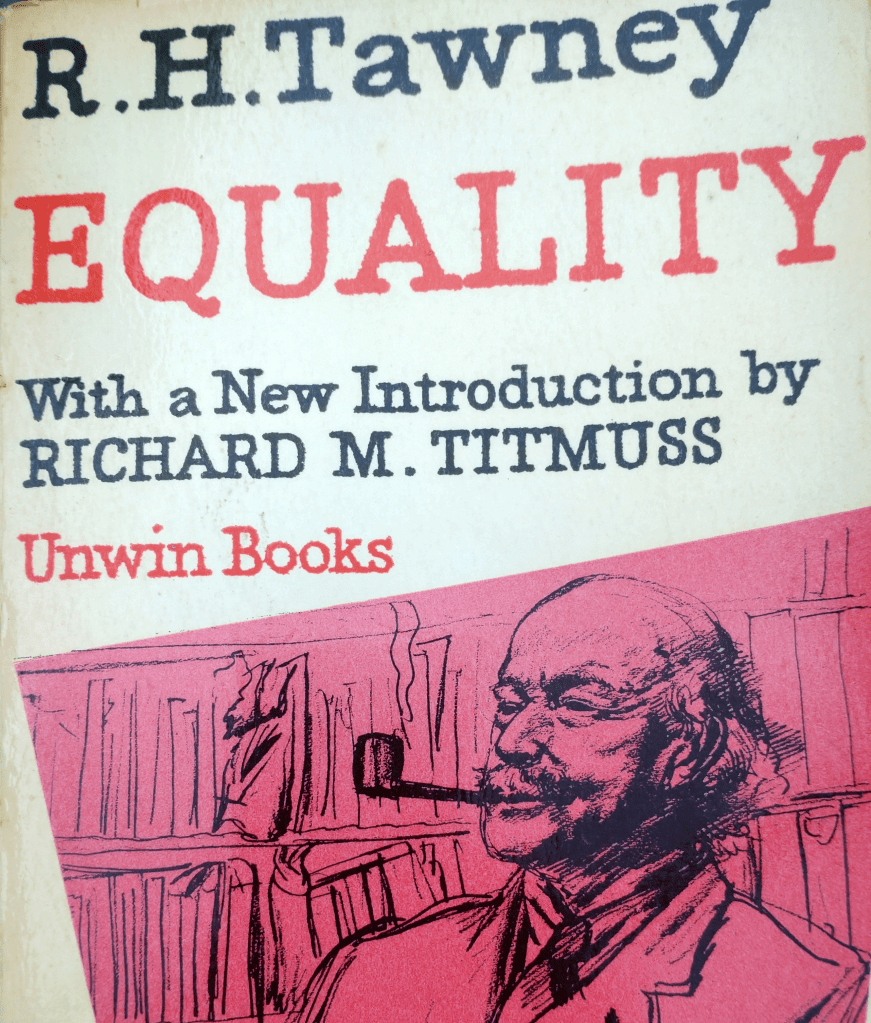
Reading an old book can sometimes feel like an archaeological dig – you find fragmented artefacts of how people used to think and have to try to piece together an understanding of their world, and their world view. Very often it serves to illuminate our own.
That’s definitely my sense while reading a book called Equality by an old socialist and economic historian, RH (Richard Henry) Tawney. My edition dates from 1964 but the original book was published in 1931, based on lectures given in 1929. This version enjoys a 1964 introduction by founding father of social policy Richard Titmuss, and no fewer than two prefaces by Tawney himself, one from the 1951 revised edition and one from the ‘substantially revised’ 1938 edition. Reading through these in this order is like uncovering historic layers of English inequality, and repeated aspirations for greater equality. What’s more, the first chapter of the book, The Religion of Inequality, starts by referring to a lecture by Matthew Arnold from I think 1878, to which it attributes the coining of that phrase.
I find it impossible to read these archaeological artefacts and not reflect on our own age. This blogpost aims simply to capture a few sentiments from each of these layers of history. Readers will no doubt be conscious of the great ruptures and attempts towards greater equality that provided the context for the writing of each of these layers of commentary, from the heights of the Cold War, the challenges of the Second World War and the creation of the welfare state that followed it, the Great Depression and the rise of fascism – and even, back around the 1870s, the first steps to broad enfranchisement (and while the right to vote did not then extend to women, that decade did see them permitted for the first time to retain their own property rather than simply surrender it on marriage).
Titmuss in his 1964 introduction:
“We…delude ourselves if we think we can equalize the social distribution of life chances by expanding educational opportunities while millions of children live in slums without baths, decent lavatories, leisure facilities, room to explore and the space to dream. Nor do we achieve with any permanency a fairer distribution of rewards and a society less sharply divided by class and status by simply narrowing the differences in cash earnings among men during certain limited periods of their lives.”
“Long years of economic depression, a civilians’ war, rationing and ‘fair shares for all’, so-called ‘penal rates’ of taxation and estate duty, and ‘The Welfare State’ have made little impression on the holdings of great fortunes…Wealth still bestows power, more power than income, though it is probably exercised differently and with more respect for public opinion than in the nineteenth century.”
“These consequences of technology in an age of abundance are more likely to increase than to decrease differentials in income and wealth if no major corrective policies are set to work…Without a major shift in values, an impoverishment in social living for some groups can only result from this new wave of industrialism.”
Tawney in his 1951 preface:
“Like earlier wars of religion, the credal conflicts of our day will find varying issues in different regions; but, if Europe survives, societies convinced that liberty and justice are equally indispensable to civilization will survive as part of her. The experience of a people which regards these great abstractions, not as antagonists, but as allies, and which has endeavoured, during six not too easy years, to serve the cause of both, is not barren of lessons which may profitably be pondered.”
And he quotes The Times from 1 July 1940:
“If we speak of democracy, we do not mean the democracy which maintains the right to vote, but forgets the right to live and work. If we speak of freedom, we do not mean a rugged individualism which excludes social organization and economic planning. If we speak of equality, we do not mean a political equality nullified by social and economic privilege. If we speak of economic reconstruction, we think less of maximum production…than of equitable distribution.”
Tawney in his 1938 preface:
“It is still sometimes suggested that what Professor Pigou, in his latest work, calls ‘the glaring inequalities of fortune and opportunity which deface our present civilization’ are beneficial, irremediable, or both together. Innocent laymen are disposed to believe that these monstrosities, though morally repulsive, are economically advantageous, and that, even were they not, the practical difficulties of abolishing them are too great to be overcome. Both opinions, it may be said with some confidence, are mere superstitions.”
“Institutions which enable a tiny class, amounting to less than two per cent of the population of Great Britain, to take year by year nearly one quarter of the nation’s annual output of wealth…are an economic liability of alarming dimensions. They involve…a perpetual misdirection of limited resources to the production or upkeep of costly futilities, when what the nation requires for its welfare is more and better food, more and better houses, more and better schools.”
“Today, when three-quarters or more of the nation leave less than £100 at death, and nearly two-thirds of the aggregate wealth is owned by about one per cent of it, inheritance is on the way to become little more than a device by which a small minority of rich men bequeath to their heirs a right to free quarters at the expense of their fellow-countrymen. The limitations imposed on that right during the past half-century were greeted, when first introduced, with the usual cries of alarm; and the alarm, as is not less usual, has been proved by experience to be mere hysteria. It is perfectly practicable, by extending those limitations and accelerating their application, to reduce the influence of inheritance – at present a strong poison – to negligible dimensions.”
“To make [democracy] a type of society requires an advance along two lines. It involves, in the first place, the resolute elimination of all forms of special privilege, which favour some groups and depress others, whether their source be differences of environment, of education, or of pecuniary income. It involves, in the second place, the conversion of economic power, now often an irresponsible tyrant, into the servant of society, working within clearly defined limits, and accountable for its action to a public authority.”
Tawney reports that Matthew Arnold said, in c1878:
“Arnold observed that in England inequality is almost a religion. He remarked on the incompatibility of that attitude with the spirit of humanity, and sense of the dignity of man as man, which are the marks of a truly civilized society. ‘On the one side, in fact, inequality harms by pampering; on the other by vulgarizing and depressing. A system founded on it is against nature, and, in the long run, breaks down.’”
As LP Hartley says in another old book, one that deliberately plays with memory and history, “The past is a foreign country; they do things differently there.” But often ‘they’ worried about the same challenges we do, and sought similar solutions.
I am happy to confirm as ever that the Sense of Fairness blog is a purely personal endeavour.
It’s no criticism of the other presenters at a recent seminar on political populism hosted by King’s College London’s Policy Institute and the Fairness Foundation – it was a consistently energising discussion – that (for me at least) the most striking comment was this from Liam Byrne MP:
“There’s a real inequality of dignity [in the UK] today. People who were prepared to fight for the dignity of working people would go a long way [politically].”
Byrne chairs the House of Commons Business & Trade Select Committee and went on to describe the committee’s recent work. In particular, he has been struck by the strong public reaction to the Committee challenging companies that are seen to have been acting unfairly. He sees this as evidence of a real thirst for a body that seeks to inject more fairness into the relationship of business with society.
This blog is of course all for such an injection of fairness, but this post in particular is about the question Byrne raises about the inequality in dignity. What might we mean by the term, and how might we address that particular area of inequality, of unfairness?
Fortunately, there’s an academic who has dedicated her career to considering dignity, who is permitted to benefit from it, and how it can be reinforced. She is Michèle Lamont, Professor of Sociology and of African and African American Studies and the Robert I Goldman Professor of European Studies at Harvard University. A proud French Canadian, she feels a profound affinity with those at the periphery of societies. Her work largely focuses on the US, but she collaborates internationally and the lessons to be learned are global.
Lamont says at one point in her latest book, Seeing Others, that it is an “exploration of how we decide who matters”; that description really applies to most of her work. The phrase for me is both encouraging and profoundly unsettling at the same time. If we are to deliver the equality of dignity that Byrne is in effect seeking then we need all people to matter, not just those we decide are worthy of dignity. That is Lamont’s aspiration too, but she recognises the reality that we are far away from that point currently: it’s not by chance that the subtitle of Seeing Others is How to Redefine Worth in a Divided World.
Seeing Others is mostly focused on further-educated members of Gen Z and their efforts to recognise the worth of others. Byrne discusses their deliberately inclusive disclosure of pronouns, which has become such a target for some – opponents of the approach ironically seeing it as exclusionary, in contrast to its inclusive intentions. But earlier work was more directly concerned with the perspectives of the working class – in particular The Dignity of Working Men.
Lamont’s core finding in that book is that people create their own framework of dignity for their lives, and the camaraderie of working life together reinforces it. Morality lies at the heart of this sense of self, in the form of straight-talking honesty and a strong self-discipline – importantly, these are characteristics that they believe are lacking in many of their bosses and those of higher social status (they are only partly believers in American meritocracy). Lamont finds that “morality plays an extremely prominent role in workers’ descriptions of who they are and, more important, who they are not. It helps workers to maintain a sense of self-worth, to affirm their dignity independently of their relatively low social status, and to locate themselves above others.” Providing for and protecting their family lies at the core of this moral life, not least because it is “a realm of life that gives them intrinsic satisfaction and validation – which is crucial when work is not rewarding and offers limited opportunities”.
Byrne himself in his excellent recent book The Inequality of Wealth doesn’t much deal with these issues of dignity. Subtitled Why it matters and how to fix it, the book is much more trying to develop a prescription for addressing broader unfairness in our society. But there is one discussion that is very relevant. Tellingly in a chapter called The Cost of Affluence, Byrne discusses the work of psychologist Dacher Keltner, whose experiments explore the sense of fellow feeling and the willingness of strangers to support one another. He quotes Keltner as saying: “we’ve done several studies that look at how your wealth, education and prestige of your career or family predict generosity. And the results are consistent: poorer people assist other people more than wealthy people.” Here too is a source of dignity – and also an indication that working people are right to be cynical about the morality of those better off than themselves.
The Dignity of Working Men was published in 2000, but its interviews date back to 1992 and 1993. And some of the comments feel all of their 30-plus years of age. In particular, this comment from postal worker Steve Dupont, who argues with his immediate boss on a regular basis, feels like it comes from a very distant time: “This has gotten me in trouble but as I always say to [my foreman], ‘I can always find another job, I can’t always recoup my pride and my own dignity.’” There may have been an element of bravado then, but now not even the most bragging of working men would feel able to assert their ability always to find another job.
And that seems to be the core of the dignity deficit: when the ability to stand up for what is right, when self-discipline isn’t enough to avoid being restructured out of employment, then there is little basis for this traditional source of dignity and pride. Where it is no longer possible, even with hard work and discipline, to protect and provide for one’s family, dignity becomes less possible too.
One consequence of this dignity deficit is a nationalistic fervour. In The Dignity of Working Men, Lamont finds that “Being an American is one of the high-status signals that workers have access to”. She amplifies this finding in Seeing Others: populist political messages “extend to downwardly mobile people one of the few high-status identities available to them: their “winning” status as Americans”.
There’s a danger if this loss of dignity goes too far. A sense of humiliation is probably the opposite of the sense of dignity. And humiliation is a dangerous feeling. A recent excellent paper published by the wonderful people at Psyche discusses the impacts of humiliation at a national level – or at least the impacts of narratives of national humiliation. These are the fuel for conflict, finds author Raamy Majeed (a lecturer in philosophy at the University of Manchester). His title, Does national humiliation explain why wars break out?, expresses where the loss of dignity may end. “When citizens of a nation feel humiliated, they become more likely to support aggressive foreign policy initiatives.” Fairness (naturally!) can lean against this sense; Majeed reports on the work of philosopher Avishai Margalit, especially in The Decent Society, which “argues that a just society does not necessarily prevent its citizens from feeling humiliated but instead avoids creating humiliating conditions”.
Even short of conflict, there are direct physical consequences of the inequality in dignity. In Seeing Others, Lamont makes a clear link to the work of Anne Case and Angus Deaton on deaths of despair: “dignity affects quality of life just as much as material resources do”.
So we need to address the dignity deficit. A just society will help limit humiliation, but are there other prescriptions from Lamont’s work? She attempts exactly that in her conclusion to Seeing Others, a chapter entitled Strengthening our Capacity to Live Better Together, and she is exploring it in her current work, which she calls a study of the three Manchesters (Oldham, near Manchester in the UK; Greater Manchester, New Hampshire; and Tampere in Finland, nicknamed the Manchester of the North; all former centres of industry). At a talk this month at the London School of Economics, Lamont discussed both Seeing Others and this three Manchesters work, which is considering how working class 18-30 year olds seek and gain recognition – another term for dignity perhaps – and the role of place, history, politics, exclusion and inclusion in that.
It’s too early to have conclusions from the Manchesters work, but the conclusion to Seeing Others does provide some insight. Much of this is relatively vague, emphasising the need for shared visions, hopes and narratives – and at its most simple, shared existences, rather than living very segregated lives. There is a hint at emphasising the proud inclusivism in national stories, rather than the exclusive aspects of them. Lamont also calls for the middle-classes not to ‘opportunity hoard’ as much as they (I should say we) do. She gets more specific when she says (without acknowledging the element of division she is encouraging):
“The Democratic Party could make significant gains by regaining working-class voters with not only redistributive policies, but also with messages of solidarity and dignity, as an alternative to the Republican Party’s populist messages of division and blame. Redirecting working-class anger toward the one percent is more likely to sustain fruitful alliances than driving wedges between diverse categories of workers who have so much in common.”
In the absence of such efforts, and the absence of efforts to build a shared sense of community, it may be no surprise that a lack of fairness in dignity, echoing wider unfairness in society, is fuelling political and social tensions. Many people have the sense that the status status quo isn’t working for them, and are willing to see dramatic change as a result. Byrne is right, we need to be working to close the dignity deficit, to instil a greater fairness, an equality, in dignity.
I am happy to confirm as ever that the Sense of Fairness blog is a purely personal endeavour


 The Sense of Fairness blog