AO Smith, a 150-year old family-dominated US company that manufactures water heaters and boilers, held its Annual General Meeting (AGM) last week. The Milwaukee-based company chose to hold the meeting at the National Association of Manufacturers in Washington DC.
One issue that faced the shareholders for consideration at the meeting was a resolution proposed by a fellow investor, NorthStar Asset Management. Headlined Eliminating Discrimination through Inclusive Hiring, the resolution was actually much more precisely focused than this slightly generic title indicates. The resolution called on AO Smith to consider afresh its hiring policies and practices to ensure that they appropriately consider people with records of having been arrested or imprisoned (technically, to meet the strictures of US regulation, the resolution is framed as seeking a report on these matters, but the intent is clear).
Such recruitments are known in the US, wonderfully, as ‘fair chance hires’.
One reason they are called fair chance hires is because of the racial discrepancies in imprisonment in the US. Blacks are around 14% of the US population but are 39% of its prison population (it isn’t clear how Hispanics are treated in the prison population data, but even if they were to be included in that ‘Black’ percentage, the over-representation is still 39% against around 30%). Similarly, Native Americans are around 1.5% of the overall population but 3% of those in prison. As NorthStar’s statement regarding its shareholder proposal states: “As people of color are disproportionately incarcerated, pursuing fair chance employment can also advance company diversity goals.”
The fund manager quotes AO Smith’s ambitions around diversity, as stated in previous annual reporting, and contrasts this with an apparent lack of progress on gender diversity as well as racial/ethnic diversity. It goes on to argue: “Shareholders believe that company value would be well-served by examining whether revisions to company practices related to recruiting formerly incarcerated individuals could decrease future risks related to discriminatory hiring.”
It’s the second year in a row that NorthStar has proposed such a resolution. According to its own website, in 2024 the proposal garnered 6.6% support. At a headline level, the voting results released this week seem to suggest that this year the asset manager was less successful, with around 5.5% of shareholders declining to back the company on the issue (this number aggregates those abstaining with those who supported the resolution outright). But because there are two classes of shares, and the Class A shares with 10 times the voting rights are almost entirely in the hands of the founding Smith family, the actual voting among shareholders other than the Smiths was more favourable: around 19.3% of the broader shareholder base appears to have backed the resolution (or at least to have not opposed the resolution). This is a notably high result given that many larger mainstream fund managers have reduced their support for shareholder resolutions in recent years. NorthStar proposed similar resolutions at three other companies last year, including Adobe; whether any others beyond the one at AO Smith make it to the ballot in 2025 remains to be seen.
The concept of ‘fair chance hires’ isn’t an international one. But there is a UK company with a proud record of hiring ex-offenders: another long-standing (160 years in its case) and eponymous family firm, Timpson. The retailer, famous for key-cutting and shoe repairs, proudly reports that 12% of its 4500 staff have a past criminal conviction. It provides training in prison, and has colleagues who are on Release on Temporary Licence (often referred to as day release), seeking to make the return to life outside prison more smooth. “We strongly believe in giving people a second chance in life,” Timpson asserts. This appears to work for the business: it reports that 75% of ex-offenders stay long-term with the business.
While the company has celebrated its sesquicentenary, the approach to recruiting offenders is much younger. It dates to 2002 and a visit to prison by CEO John Timpson. Timpson built a rapport with a guy called Matt, and hired him when Matt was released. But it’s now a significant part of the business: the corporate foundation spends over £1 million a year to support the employment of ex-offenders, and ‘Inclusion’ is one of five principles on which the business culture is built (the others are also wonderful words: Trust, Kindness, Loyalty, Generosity). The full principle reads: “We’re proud to employ people who find job hunting really tough, and 12% of our new recruits actually come from prison.”
There are huge positive externalities from this sort of activity: the value to the business of these loyal staff members is nothing to the value to society of successfully reintegrating those released from prison. The government’s own estimates put the cost of reoffending at over £18 billion, and the UK – like the US – has a poor record of supporting prisoners to train or to find any alternative way of making a living beyond crime.
Prison is only temporary for all but the worst offenders. We need to be better at rehabilitation, and we need to do more to reduce recidivism. We need more second chances, and more fair chance employers.
I am happy to confirm as ever that the Sense of Fairness blog is a purely personal endeavour
‘Beyond the regulatory boundary, “fairness” can be seen as an opportunity to generate value to both the enterprise and its wider community. Fairness frameworks can be aligned with corporate and brand values as part of the broader enterprise strategic and risk management framework.’
While the starting point for a recent report on fairness in health insurance is the regulatory consumer duty recently put in place by the UK’s Financial Conduct Authority (FCA), it’s clear that the paper is more interested in business risk and opportunity than in mere regulation. As this blog has long found, there are remarkable numbers among the challenges that modern business faces that can best be viewed through the lens of fairness – and many opportunities that can be uncovered by deploying that lens.
From those smart people at Milliman, the report, Fairness in UK health insurance: Developing a framework and best practices in health insurance, covers the full range of relevant issues. These include: fairness in the delivery of consumer relations, especially the treatment of vulnerable customers; fairness in the application of new technologies, including AI and algorithms; and considerations of structural biases in healthcare.
While the report is narrowly focused on health insurance, it naturally considers many of the wider fairness issues that apply in the field of health. Foremost amongst this is the sterling work of the wonderful Sir Michael Marmot (perhaps most accessibly in The Health Gap). Marmot’s consideration of the social determinants of health is reflected in this brief segment of the report:
‘With greater focus on protected characteristics, there has been a move to greater use of “lifestyle” factors as personal “choices.” ‘Certainly, smoking is widely accepted as a choice. Possibly exercise; but are postcode, income, occupation, education, children? Whilst at some point they may have been “choices”, at later points in life they may be fixed rather than changeable (or controllable).’
Marmot shows that many of these issues are not choices at all, but are the outcomes of inequalities in wider society. In brief, poor housing, work, education, income, are all among the clearest determinants of poor future health outcomes. Few of these are chosen, particularly in economies where meritocracy is failing. While people in poverty are unlikely to be accessing health insurance, Marmot’s analysis raises questions about how fair it might be to consider some of these lifestyle issues in the pricing of such insurance.
The use of technology in relation to healthcare is also a significant feature of the Milliman work. In particular, the paper argues that: “Greater personalised medicine and healthcare are likely to mean that trust, privacy and fairness are increasingly necessary parts of ensuring good customer outcomes.” Further, it is not enough that fairness be done, it must be demonstrable that it has been delivered in practice: “Risk-based pricing and underwriting approaches should be auditable with clear accountability and robust governance of decision-making processes.” It is certainly not enough to assume that AI or algorithms will generate fairness – as this blog has found previously, these technologies can encode and replicate pre-existing unfairnesses.
But it is in dealing with the FCA’s consumer duty requirements that the paper breaks most fresh ground. Given that these requirements are still new, we have not yet seen best practices developed. The paper is therefore one of the earliest detailed expositions that I have seen of how it might bite in practice, and what it may require of business. The Milliman summary of the application of the duty to health insurance seems clear and wholly appropriate to me:
“For UK health insurers this combines providing fair customer treatment and clear information with products that genuinely meet their needs. Particular attention is required to product design and suitability, customer communication, customer support and providing “fair value” as well as systems to track performance and make adjustments. There is also a need to give special attention to vulnerable customers.”
The paper later considers some of the detailed best practices that seem likely to be required under the duty, including “Being transparent with customers, in particular with terms and conditions around the inclusion or exclusion of pre-existing medical conditions, any moratorium and exclusion of any specific types of treatments (often highly complex, severe conditions)” and “Being clear and signposting these policies using laymen terms in the policy documentation so there is no ambiguity.”
And there is a particular need for fairness in the area of health insurance, a particular need for care regarding consumer duty. As the paper point out: “Almost all customers making health claims are vulnerable to some extent, with particular efforts required to meet the needs of the most vulnerable.”
Reinsurance firm Pacific Life Re was also recently inspired by the advent of the FCA consumer duty regime to consider the uneven distribution of insurance products across different communities. But its response is a rather more bluntly commercial one: “Understanding where communities are underserved, both within your own business, and that of the industry, offers an opportunity.” This has echoes of the fortune at the bottom of the pyramid thinking that seems slightly to have slipped from much business thought. But as the work of Citizens Advice continues to show, accessibility and pricing of various insurance products are not evenly distributed across consumer groups.
The Milliman paper also draws a fascinating analogy to the independent governance committees that are in place in the pensions provided by insurance companies. These IGCs have responsibility for overseeing the customer experience and defending consumer interests, with particular attention to value for money. The paper suggests that there is something in this model that would be worthwhile perhaps extending to health insurance: “We consider that these efforts can be a best practice governance framework for the health insurance sector and help tap into consumer groups’ understanding of “fairness” and how their expectations evolve over time.” IGCs are consumer champions in pensions – do we need something similar for other products?
For some, the very availability of commercial health insurance in the UK is itself a symbol of unfairness. Where there is (at least in theory) universal provision through our National Health Service, health insurance can often be seen as jumping the queues which seem the main form of rationing of that provision (and which can make its universality seem theoretical). But we have to recognise the reality of the use of health insurance – not least as a standard employee benefit from companies keen that their staff stay healthy. It is certainly better that it is deployed fairly than not. The Milliman paper provides a pathfinder for that, as well as useful insights into the consumer duty more broadly.
Readers (at least those that read the small print at the foot of every blogpost) will know that the Sense of Fairness blog is a purely personal endeavour. But naturally I am sometimes inspired to write things by events in my working life.
So it is this week, following a gathering on Tuesday hosted by fund manager Impax on the role of corporate culture in business performance. Naturally, the firm has a product to sell and wants to demonstrate its prowess in identifying share price performance drivers in what is still a surprisingly under-researched area.
Impax showed us striking charts showing stronger performance by companies with better culture, on the metrics that they have been able to garner from company reporting and more independent sources on employee satisfaction such as Glassdoor. Note that of course I am not making any investment recommendation.
Perhaps more striking than the performance statistics were the anecdotes from active fund manager Charles French, who relayed stories from the front line of asking CEOs about culture. As I too used to find when I asked my favourite “How are your people?” question, the range of responses to questions about culture tells you a great deal about the attitude and mindset of bosses. Some literally have nothing to say and do not know how to begin an answer; others become energised and demonstrate very clearly how much of a focus for them is inspiring their staff. You are left in no doubt which bosses – and so businesses – you would prefer to work for.
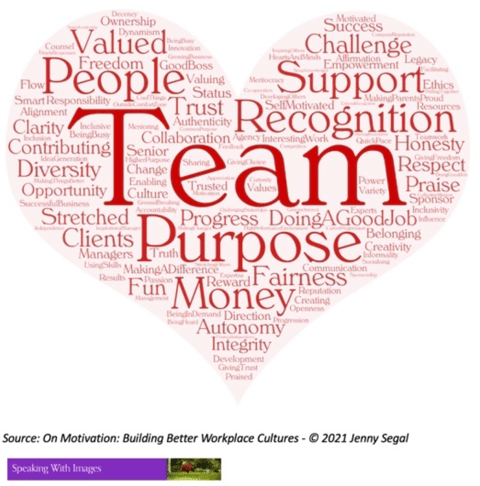
The event also featured a presentation and panel discussion on corporate culture. The panel featured a couple of my favourite people who have done great work on corporate culture, Tina Mavraki and Annabel Gillard. Most striking for this blog were a pair of word clouds within the initial, energising presentation from Jenny Segal, whose headline offer is ‘Building better workplace cultures through creativity and understanding motivation’.
She had asked a representative group of people what motivated them at work. Fairness appears with reasonable prominence, as do a series of other words that have concepts of fairness attaching to them:
As noted in a previous post, there are very different motivations for workers at companies which have a clear purpose and seek to inspire their staff. It’s unsurprising that unfairness at work is demotivating.
Jenny also asked people what makes a good boss. Again, fairness clearly matters:
Another striking comment from the panel came from Christine Cappabianca, one of Impax’s quant team, who leads their work uncovering data on culture. Clearly the reporting dynamic around diversity, equity and inclusion factors – one of the areas she has been mining for insight – varies around the world and is shifting notably at the moment. One of the shifts that she expects to happen as diversity is downplayed is that the language of fairness will see more use, as it’s a much less divisive way of capturing the intent of these programmes. That fits with the the most forward-thinking research in this space.
Fairness matters, viscerally, to people. It’s not surprising that its presence fires us up at work and that its absence demotivates. The best managers know this viscerally too.
For subscribers to the Financial Times, there’s a great little piece (dated yesterday online so I assume in today’s print edition) on the consumer experience of algorithmic fairness and unfairness by the ever-thoughtful and thought-provoking Sarah O’Connor.
O’Connor discusses the black box experience of technology decision-making for customers – particularly in terms of being barred from access to their own accounts – which isn’t improved, or at least isn’t made any less opaque, by the application of the required human overlay if the consumer complains.
As she indicates, it’s rarely clear how fairness fits into this process.
Even given my cynicism regarding the current hype about artificial intelligence (AI)*, I have to admit that it’s very clear this new technology will transform the world of work. The societal excitement about Chat GPT and other large language models (LLMs) has been matched by corporate excitement. Companies across the world are experimenting broadly, many of them keen to deploy this as a cost-saving tool.
Of course, as with every technology shift, cost-saving comes in the form of replacing people with machinery. Efficiency means being able to do things more quickly with less human intervention. If the current experiments with AI deliver, perhaps companies will redeploy those humans to other work. More likely they will remove those people, and their costs, from their business.
That’s how business, and economies as a whole, operate: moving to more efficient ways of delivering what customers and society want, to enable higher profits or simply to enable companies to compete with rivals which are also trying to reduce their costs. On the whole, this is good for economies too as more efficiency allows national resources to the deployed to where they deliver most value.
But that redeployment takes time, and technology transitions are painful processes, for individuals and for society. Discussions of efficiency, cost savings or redeploying resources divorce us from the very real human and emotional impacts of these changes, which are of individuals losing their jobs and livelihoods, and subsequently struggling for money and self-esteem. Even where a technological shift does create new opportunities (which has been the case with every such transition previously and so seems likely once again), that takes time – time in which individuals feel unanchored, unvalued, and perhaps reach an age where further employment is unavailable to them. That can serve to destabilise society further. We shouldn’t let the economics blind us to the personal and emotional.
There is much talk in sustainable investment circles of the need for a just transition (sometimes a fair and just transition) to a decarbonised world, ensuring that care is taken to protect and support those individuals whose jobs are impacted by the dramatic shift to economic activity that must come as the world finally faces up to the realities of climate change. There is also likely to need to be a fair and just transition to an AI-enabled world.
Recent work from the International Monetary Fund (IMF) begins to open a window on this challenge, building on the sentiment of managing director Kristalina Georgieva in a blog from a year ago called AI Will Transform the Global Economy. Let’s Make Sure It Benefits Humanity. The organisation is developing approaches to consider which jobs – and which economies overall – will be impacted by the advent of AI.
Most recently, IMF staff considered impacts in Asia. A blog this month, How Artificial Intelligence Will Affect Asia’s Economies, tries to map this out in more detail, based on analysis of the breakdown of jobs in each economy. The blog reflects a deeper discussion within the analytical note attached to the Fund’s most recent Asia and Pacific Regional Economic Outlook. This analysis suggests a greater exposure to AI impacts in the region in what IMF jargon terms advanced economies, while emerging economies are likely to face lower impacts. However, they also seek to assess whether those impacts will be positive or negative for jobs: around half the impacts in advanced economies are where AI is complementary to the job, potentially driving economic benefits; meanwhile in emerging economies the majority of impacts are where there is much more likelihood of workers finding their jobs replaced. The economists hedge this analysis with language such as ‘low complementarity’ and ‘displacement’ of work, but the thinking is clear.
The language was more blunt in some earlier less detailed work, suggesting AI “could endanger 33 percent of jobs in advanced economies, 24 percent in emerging economies, and 18 percent in low-income countries”. Those conclusions look more worrying than the most recent analysis, but even the lower levels of estimated disruption are very significant.
According to the most recent analysis, there is also a gendered split in the potential impacts, again potentially exacerbating existing inequalities:
The blog reads:
“The concentration of such [complementary] jobs in Asia’s advanced economies could worsen inequality between countries over time. While about 40 percent of jobs in Singapore are rated as highly complementary to AI, the share is just 3 percent in Laos. “AI could also increase inequality within countries. Most workers at risk of displacement in the Asia-Pacific region work in service, sales, and clerical support roles. Meanwhile, workers who are more likely to benefit from AI typically work in managerial, professional, and technician roles that already tend to be among the better paid professions.”
Georgieva was clear about the risks: “In most scenarios, AI will likely worsen overall inequality, a troubling trend that policymakers must proactively address to prevent the technology from further stoking social tensions.”
The IMF economists are increasingly clear about what needs to be done about these inequality risks. According to them, a just transition will require:
Effective social security nets
Reskilling programmes for affected workers
Education and training to enable effective application of the AI opportunity, particularly for those economies where AI is currently seen to have low impacts – so that the positive benefits can be enjoyed
Regulation to promote ethical AI use and data protection
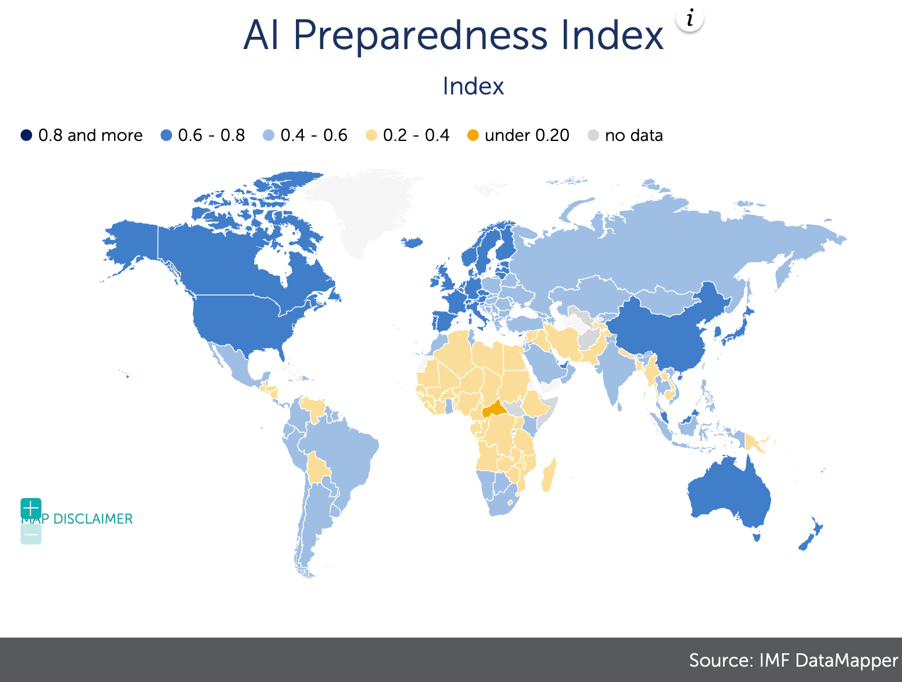
The IMF, in its AI Preparedness Index, suggests that there is a broad spread in the readiness of global economies for this coming wave of technological disruption:
Again, as things stand it seems that the greatest likelihood is for AI to exacerbate existing inequalities. Preparing for this major economic shift will demand fresh policies and investment. These are significant challenges for world economies, for companies as they embed AI into their workflows, and for global investors, to rise to.
*I have my doubts about each of the A and the I in artificial intelligence: calling an activity ‘artificial’ when it depends on the horrific grinding work of many people to scrub its results seems inaccurate; and calling it ‘intelligent’ when it is simply a logic puzzle about the likelihood of putting one word after another – the stochastic parrots as described in that prescient article (I particularly like the analogy of Emily Bender, one of the authors of that article and a professor at the University of Washington, that AI is reproducing text in the way people might if they had unrestricted access to the National Library of Thailand but without pictures or dictionaries to enable them actually to understand or translate the language). A more recent article touching on these matters is the excellent Ask me Anything! How ChatGPT got Hyped into Being, which among other things states this fundamental truth: “LLMs are not designed to represent the world. There is no understanding by the artificial agent (chatbot) of the meaning of the output it creates. It is us humans who create that meaning.” More directly, the word soups that I have been presented with by colleagues show very clearly the limits of the technology in doing anything without clear instruction and precise pre-existing materials to work with.
Nonetheless it is fascinating to read John Burn-Murdoch’s piece for the Financial Times this weekend, Inequality hasn’t risen. Here’s why it feels like it has, which is grounded wholly in the Gini coefficient. Burn-Murdoch is the FT’s Mr Statistics, and he is always readable and interesting, so I’ll forgive the obsession with the use of single datapoints that will always be flawed if viewed in isolation (and I’ll acknowledge also that he recognises the limits of Gini: “Aggregate inequality statistics certainly have their place, but they can mask important nuances,” he writes).
The core of Burn-Murdoch’s article is the data shown in these charts:
He notes the increased attention to inequality over the past decade, even though the Gini numbers suggest it is in fact falling in both the UK and US, and he attributes this to a squeezing of the middle class between improved treatment of the poorest paid (which appears to be the driver of more than the total drop in the Gini measurement) and an increased stretching of the advantages of those best off in our society (which has increased inequality, but less than the reduction driven by the improvements for those least well off). While it’s known that the minimum wage in the UK and its bolstering over time has helped those least well off here, it is more surprising to find that some similar improvements have also been experienced by the poorest in the US also, despite the notorious stagnation of the national minimum wage there. This squeezing effect is reflected in the title given to the article in the paper copy of the newspaper: Why the middle class is right to feel squeezed.
This blog would naturally suggest that one reason why there is increased noise about inequality now, despite the falls in the Gini coefficient, is that the problem as humans see it is unfairness, not inequality, and the bluntness of Gini fails to capture the richness of human experience. In particular, it’s hard to believe that the improvement in the incomes of the poorest is genuinely felt to be an improvement in their life experience – perhaps especially as they have experienced greater inflation than wider society over recent times. The moves in Gini may be masking insight as much as they are revealing.
Burn-Murdoch is clearly right when he highlights the reductions in sense of opportunity available to many in society – opportunity both for themselves and for their children. But, for this blog at least, these are questions of fairness, not of inequality (measured by Gini or in some other way).
A historical meander through the countryside for the holidays
The quintessential vision of England is of a village set in rolling countryside. Depending on the topography, this may be hills cropped by sheep, or less frequently other farm animals, or flatter lands growing cereal. But whatever the countryside, the village is consistently there (whether or not, like former prime minister John Major, we include in our image cricket and warm beer and spinsters cycling across the village green). We imagine these villages as images of fairness and justice, representing the ordinary people of England, strong, independent and free.
But those villages have not always been there. And they do not always represent fairness, independence or freedom (even if we can set aside modern concerns about incomers pricing out locals). Any settlement and community is the creation of a set of decisions. Some of those decisions were by ordinary folk choosing to come together for their own reasons. But many times what are now viewed as symbols of peace and tranquillity were created by force at the whim of the local landlord, a feudal founding created to control the population and ensure that it was productive – to the benefit of the seigneur.
The bucolic beauty that we tend to take for granted was often an emblem of power and an assertion of unfairness. The same villages have also over centuries witnessed further episodes of the ebb and flow of power, and of fairness. We tend to imagine these places unchanged forever. They are not.
It used to be thought that there was a ‘village moment’ in England, when villages suddenly appeared in the landscape. My use of the term ‘seigneur’ was deliberate, for this ‘moment’ was for decades ascribed to the Norman invasion of 1066 and the following years, when newly created feudal lords established villages as power bases to control the population and its work effort. It is not just that the Domesday Book (which dates to 1086) provides us with the first consistent written record of the existence of English villages (though often it refers to individual farmsteads or small hamlets that later developed, or were developed, into villages).
This belief in a particular moment of village creation was reinforced by the archaeological digs of abandoned (or shrunken) mediaeval settlements, which “showed very little evidence for occupation earlier than the eleventh or twelfth century” as Carenza Lewis and colleagues explain in their key work Village, Hamlet and Field. But the belief eroded as further investigations, not least of settlements that continue to exist, tended to extend the moment to a rather broader period: they “seemed to push forward the origin of the large nucleated village to the period between about 850 and 1200”. It’s tempting to suggest that the disproportionate representation of the Norman-created villages among those that were subsequently abandoned is a sign that their artificial creation meant they were less sustainable than those created organically by a population choosing to move closer together, but I suspect that’s a little pat.
While landscape historians have pushed back the creation of many villages, it is undoubtedly true that many others were created soon after the Norman invasion, by those new feudal landlords: “lordly authority was clearly a key motor in the planning of settlements,” explains Oliver Creighton in his Designs Upon the Land. He further says: “The well attested phenomenon of seigneurial village planning, which in many cases extended to embrace field systems, can be taken as further evidence for the expression of lordly authority.”
These Saxon and mediaeval creations were of course not the first villages, though they were the first of a scale that we would recognise, and the first to include a village church (typically seen as the signifier of the distinction between village and hamlet). There were Neolithic villages – examples of these can still be seen at Scara Brae in Orkney, Carn Euny in Cornwall and Ty Mawr on Anglesey (preservation is better in remote places). But life generally remained scattered until towards the end of the Anglo-Saxon period.
These were not the first villages, but these were the first that we might recognise today. And, whatever the timing of their creation, all were under tight command and control arrangement, “a tightly managed landscape” says Trevor Rowley in the classic Villages in the Landscape. “The manorial court was responsible for the regulation of internal field boundaries, the precise amount of grazing and rights of gathering on the common waste, and it also had responsibility for the trackways and streams. The manor courts collectively administered rules of husbandry, watched over local customs of tenure and inheritance and enforced local peace and order. By 1300 we would have looked on a landscape which was intensively used at a subsistence level.” This was not a fair landscape: most lived the hardest of subsistence existences while a small handful prospered.
As Rowley summarises: “the permanent nucleated village so familiar to us today was a factor not of ethnic or cultural change, but of economic and social forces. It was brought about by a complex combination of increasing population and increasing authoritarian control through the manorial system”.
And it wasn’t only the villages, but the landscape more broadly. Creighton takes a particular interest in parkland, land taken into private ownership as a venue for hunting. He points out that taking land out of agricultural production and creating parks was not an economic decision, but a social one driven by concerns of status. “The right to empark was a jealously guarded privilege and badge of lordly authority,” he writes. “The huge outlay involved in the creation of parks and the challenges of maintaining them, combined with the minimal financial returns that accrued, shows that they were not geared to maximise profit by cold, hard businesslike patrons.”
Ridge and furrow – a relic of mediaeval communal shared fields – within the private walled grounds of the National Trust’s Canons Ashby, Northamptonshire. An example of the historic privatisation of shared land
This contrasts of course with the much later enclosure movement when the wealthy took land out of common usage by the general population and asserted their direct ownership of it (often with the formal endorsement of acts of parliament – the law being used to enforce the demands of the powerful). Enclosure coincided with the agricultural revolution, making the productivity of the seized lands more than recompense the cost of the creation of the hedges, walls and fencing – and of the policing of the protests from the dispossessed population. Susanna Wade Martins in Farmers, Landlords and Landscapes reports that after enclosure, “Productivity could sometimes be doubled and rents went up by an equivalent amount.” That wasn’t the case with mediaeval seizures.
Parks in the mediaeval era were just as contested as the enclosed lands, though. As Creighton points out, “Many parks were recorded for the first time not when they were licenced or created, but when they were first broken into.” He suggests that poaching may have been just an assertion of continuing rights to seek food in emparked land.
Alongside this privatisation of land, from 1250, the elite turned more aloof, power and wealth enabling them to distance themselves from ordinary folk. Increasingly, the wealthy kept themselves apart, both in the siting of their own property and in the design of their buildings also. Creighton says: “an increasingly aloof aristocracy … was progressively increasing the social distance between the household and the world beyond the walls… This is part of a pan-European phenomenon evident at key lordship sites in France, Germany and Scandinavia and, in turn, part and parcel of a broader phenomenon of the increased privatisation of space, as manifested particularly clearly in the changing function of the hall and modes of domestic planning that enabled individuals to spend more time in individual rooms.” This period seems to coincide with a trend towards moated sites for elite dwellings – typically a symbolic separation rather than offering any degree of protection. This trend towards status symbols and separation was reflected in food also, for example it is at this period when the eating of more exotic birds becomes an activity for the elite, and the poor were excluded from certain foods.
This move is not to be taken lightly. In his The Archaeology of Power, John Steane discusses the ceremonial role of the lordship’s property, in particular the community role fulfilled by his hall, “the architectural expression of the household”. He quotes from William Langland, the 14th century supposed author of Piers Plowman, who criticises those lords whose halls have become a “sorry, deserted place” because “the rich nowadays have a habit of eating by themselves in private parlors”. The implications of the harm caused to community and society as a whole by this withdrawal are significant.
This was an age of remarkable unfairness. The majority toiled, a few did well – and increasingly turned their backs on the toilers, living very separate lives. It took a devastating event, or series of events, to reawaken fairness in our country. Those events were the repeated scourges of the Black Death (which first swept across Europe in the years either side of 1350), devastating the population and bringing enormous changes in its diseased wake.
I wrote in my last post about the impact of the Second World War in sweeping away some of our nation’s then ossified unfairness and injustice. And I noted that we must hope that it doesn’t take such an event to sweep aside the unfairness that has built up again in our society. The Black Death was a still more lethal and traumatic event that led to an even more remarkable reversal of inequalities. According to James Belich’s analysis in his remarkable and epic history of the consequences of the plague era, The World the Plague Made, around half of Europe’s population died from the initial outbreak of the plague (he spends a whole chapter justifying this conclusion, which is greater than the usually quoted one-third, a death toll that would have been remarkable enough).
As Belich explains, this halving of the population dramatically increased the value put on labour – meaning that the poorest suddenly began to be paid more. The poorest may have doubled their available spending capacity (even the smallest increment in pay for someone operating at subsistence levels will enable this), as well as giving them more leisure time; others fared better in absolute terms. The decrease in the availability of labour, and the increase in its cost, led to a productivity revolution – and with the same capital goods now shared between a halved population there was significant scope for such a productivity shift. This, together with increases in money available across the economy, led to a boom in demand for what had previously been luxuries available only to the few. Trade boomed, deploying the same shipping capacity for the benefit of the halved population. Many were freed from subsistence farming and agricultural patterns shifted to favour more specialisation.
Belich argues that it was the plague that led to Europe’s imperial dominance of the globe over subsequent centuries. One vehicle for this, he suggests, is that the fairness of the post-plague era lingered long enough in folk memories that it made ordinary people willing to risk everything to travel to far off lands in search of a better life, a life more like the less unequal era post-plague.
Those with Scottish and Irish heritage will no doubt baulk at this, pointing to the enforced movements caused by those great historic injustices the Clearances and the Great Hunger (the capital letters just a nod to their cultural significance) – and others will point to other causes in other lands. There’s truth that many travelled the world (and do so now as well as then) because their homeland no longer offered them a home, but both events came later than Belich intends. He is thinking about the start of the European imperial era, in the fifteenth and sixteenth centuries, when the journey itself was extremely hazardous, with around 30% dying even before they reached their destination – let alone the challenges of the precarious imperial outposts that were created. Those of course are the odds of those who travelled freely as free people, not of those who were enslaved, nor those of the indigenous peoples whose lands were taken from them.
European people travelled in spite of these odds, Belich believes, because they remembered the freedom and fairness that followed the horrors of the Black Death. A small hope for fairness will inspire many to action.
As we walk the countryside, we should recognise how it offers insights into past unfairness, and not the simple bucolic beauty that is all we sometimes see.
I am happy to confirm as ever that the Sense of Fairness blog is a purely personal endeavour.
Village, Hamlet and Field: Changing Mediaeval Settlements in Central England, Carenza Lewis, Patrick Mitchell-Fox, Christopher Dyer, Windgather Press, 2001
Designs Upon the Land: Elite Landscapes of the Middle Ages, Oliver Creighton, Boydell Press, 2009
Villages in the Landscape, Trevor Rowley, Dent, 1978
Business as usual is where – for the time-being at least – the money is, and in our world that means it is where the power is. That power gives business-as-usual a gravitational force even when good sense and science call out for change, and even when in the long-term it’s a losing game financially. Power leads us astray, and fairness requires that we find some counterbalance to this force. Only then will change come.
We see this gravitational force of business-as-usual most powerfully in the world’s climate negotiations. The vast majority of the world’s scientists tell us that we have no time to lose and that economies and business must change. The Pacific island nations and developing economies more generally (without the money that might pad them from the increasing physical impacts of climate change) are increasingly urging change. Unusual and devastating weather patterns are being felt worldwide. We cannot continue to pump the same levels of CO2 and other climate-changing gases into our atmosphere.
A carbon-constrained future will look economically very different, and the companies that prosper in its business-as-usual will differ from those that look good now. Yet the status quo predominates in the political process. Most strikingly, governments of the world have been content to allow petrostates to co-opt the climate COP process. The last two Conferences of the Parties Serving as the Meeting of Parties to the Kyoto Protocol (no wonder the COP abbreviation is preferred) have been held in the UAE and Azerbaijan, respectively the world’s 9th and 25th largest oil producers and perhaps more importantly with at least two-thirds of their economies dependent on fossil fuel industries. The chair of each conference was a senior executive in that country’s oil industry. It can be little surprise that agreements for rapid change to our fossil fuel-dependent economies have not been forthcoming.
The greatest thought experiment in fairness is John Rawls’s idea of the veil of ignorance. Those designing a just society must sit behind a veil of ignorance so that they are unaware of where they will fit in that society: this makes it most likely to be fair to all, Rawls argues. In our unveiled world, those with power, meaning those with money, continue to set the rules – and knowing that they will benefit, they continue to skew the world towards the status quo, which means in their own favour.
This favouring of the rich and powerful is of course nothing new. My latest secondhand bookshop purchase was a collection of three plays by the deeply unfashionable JB Priestley. Published in 1945, it is eager to make clear its obedience to wartime strictures. “This book is produced in complete conformity with the authorised economy standards” it reads. Like his most famous play, An Inspector Calls, there’s an undercurrent of class resentment and frustration with a status quo that keeps power in the hands of the old and frustrates youthful ambition and opportunity. We don’t always see those tensions in modern depictions of the interwar years, not least because they and we know all too well the changes that were to come as the war swept away past structures and strictures.
All three plays are terribly dated, displaying the careless heavy misogyny of that age, and an odd metropolitan superiority. But one still has interesting elements. Called The Golden Fleece, it is set in the eponymous hotel in Cheltingate Spa, a scarcely disguised Cheltenham. The title also has a second meaning, referring to the wealth generated from taking advantage of others (the play’s original title, Bull Market, at least to modern ears carries some of the same connotations of trickery). The Golden Fleece centres around a debate between those who feel justified in taking such advantage because that’s how the world works and those who are unwilling to do so because it would be better if it didn’t. It involves some stock market manoeuvrings that are certainly no longer legal, and seem barely credible even at the time (though that may simply be failures in the playwright’s understanding, or elisions in his story-telling).
Youth’s frustrations at age and tradition in the 1930s come out clearly from the ambitious young doctor, railing at a gouging tendency in private health (this was, of course, before the creation of the National Health Service). Talking about his doctor boss, Alec says: “He may look like a harmless old pussycat, but really he’s a pest and a menace. Instead of being a man of science, which he pretends to be, he’s something between an old charlatan and a rich old woman’s butler. He doesn’t speak or even think the truth. He doesn’t care about anything but fat fees and fat dinners. He’s an example of what’s wrong with this pussy-footed, rich old man’s country.”
But the core of the play’s arguments come from the mouth of a different character, who calls himself William Lotless. “Money! Money! It’s a servant that’s become a master,” says the scoundrel trader, for once using his skills for good – though rather tempted by the excitement to act just for the joy of it. Tongue loosened by alcohol but with his thoughts made staccato, he goes on:
“Money – was intended to be simply a sign, a token, a convenience – something like a – well a railway ticket. That’s all. But what’s happened to it? Got all out of hand. Become a source of power. The way we allow people to handle money as power, it’s just as if we let ‘em handle battleships and bombing squadrons for their own private benefit.”
Military images abound in a play written in the first months of the war. It’s impossible to read it now without thinking of the coming destruction of all that is established. It feels like, and is, a wholly different world from our own.
We know that the 1950s and 1960s brought strong economic growth that was broadly shared across the population. It may not have been entirely fairly shared (certainly not, for example, between the sexes), but economies operated largely to the benefit of all, not the few. The existing order was overturned by the war. Let us hope it doesn’t take such a destructive dislocation to shift the pull of the current business as usual; we need a veil of ignorance, or some other way to escape our ready tendency to listen harder to those who already have power through money, as that traps us in a business as usual that isn’t working.
I am grateful to my colleague Nick for the conversation where we linked COP to Rawls.
I am happy to confirm as ever that the Sense of Fairness blog is a purely personal endeavour.
As a wearer of glasses since childhood, it comes as no surprise to me that human beings generally are shortsighted. I mean that not in the sense that we all need to wear glasses (though statistics on the way that our phone-obsessed indoor lives appear to be driving an epidemic of myopia mean that we may be headed that way), but in the sense that we avoid overloading our brains by only paying attention to what is near at hand.
We tend to ignore the distant, geographically, in terms of time, culturally, socially or emotionally, and we have to work hard if we want to lean against that natural tendency. We pay more attention to the near-at-hand, to people who look and sound like us and people who coincide with us geographically and timeously. This is a natural response: it is one of our common heuristics, methods of avoiding informational and other overloads. “human kind/Cannot bear very much reality,” as TS Eliot has it in his extraordinary Burnt Norton, one of his Four Quartets.
But that shortsighted, narrow-minded view means we miss much that matters. When we are facing global risks, parochialism is a dangerous mindset. Among other things, it seems increasingly that this human tendency continues to hamper our response to very real global health challenges.
Take mpox (the rebrand from monkey pox was perhaps an attempt to make it seem like less of a distant issue). There has been dramatically greater UK media coverage of a household of 4 mpox patients suffering from the more infectious and more potent Clade Ib version (a clade is an individual branch on the genetic family tree) of the virus, first revealed at the end of October, than there has of the almost 50,000 cases, and over 1000 deaths, in an outbreak in Africa, particularly in the Democratic Republic of Congo, over the last several months. A more still recent single case in Leeds alone has also gained greater coverage. The same is true in the US: a single case in California revealed in the late November has received notably more attention than the global situation.
The World Health Organisation declared mpox a public health emergency of international concern back in August, and reconfirmed that view at the end of November. Despite that, only a couple of days ago did WHO authorise the first vaccine for children against it – young children are particularly susceptible given it passes through close contact. Happily, in its farsighted wisdom Japan is funding 3 million doses of this new vaccine, developed by KM Biologics. As an aside, it’s worth recognising suggestions that the upsurge of mpox may be related to a health success: the eradication of smallpox has led to the vaccination programme against that disease ending, removing its suppressive effect on other poxes.
It’s as if we’ve learned nothing from the Covid pandemic: that in a global world there is no such thing as a localised virus outbreak, no such thing as a disease that will not travel. Even a virus that needs close contact like mpox will travel, though clearly much more slowly than airborne Covid and the like. And viruses adapt – just as bird flu has seemed to, leading to an infection of a Canadian teen who had no known contact with wild birds. It took that revelation for the Canadian government to invest significantly in bird flu research, something that it announced just the day after the teen’s infection was revealed. Outbreaks that may seem containable can rapidly become something more. Our response always seems to be a belated one, only when the danger is very near at hand.
Fairness argues that we should care about outbreaks of viruses that affect other communities in our shared world, but so does selfish good sense. We need not be so shortsighted.
I am happy to confirm as ever that the Sense of Fairness blog is a wholly personal endeavour.
I am once again grateful to the investment world’s Jiminy Cricket, Raj Thamotheram, for continuing to nudge me on matters of health and fairness.
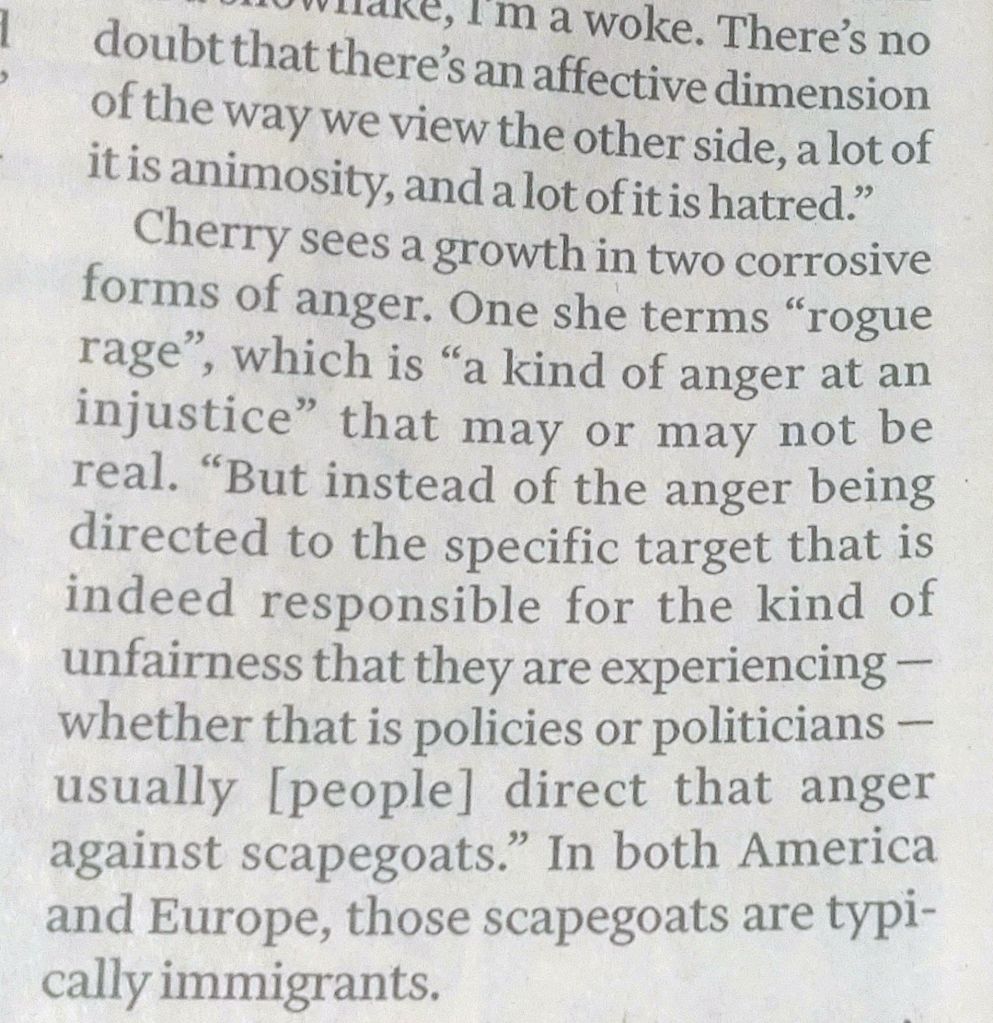
There’s an interesting article in this weekend’s Financial Times, about the emotional side of vote decision-making and how we fool ourselves if we believe that we vote wholly rationally.
This paragraph referencing #Fairness stood out in particular for this blog. Even if the term rogue rage seems a little manufactured, what is discussed does seem a fair description of the mindset of some members of the electorate, and a tendency that some politicians seek to benefit from.
I am happy to confirm as ever that the Sense of Fairness blog is a purely personal endeavour