Playing fair: the oddly inequitable world of team sport

“People — for all our differences politically, regionally, economically — most folks understand sports. Probably because it’s one of the few places where it’s a true meritocracy. There’s not a lot of BS. Ultimately, who’s winning, who’s losing, who’s performing, who’s not — it’s all laid out there.”

So said US President Obama in a March 2012 interview with Bill Simmons of ESPN, setting out his view of why sport seems so engaging*.

It’s a view shared by many.

Yet in a summer of much remarkable sport, including events in 2021 proudly badged as 2020, having been delayed because of the Covid-19 pandemic (congratulations, Italy; thank you, Tokyo), the stories that stick particularly are more suggestive of unfairness and the sense in which elite sport has become unhealthily detached from the rest of humanity – perhaps even detached from reality. Meritocracy may not matter as much as Obama says; community definitely does matter.

The sight of Indian Premier League (cricket) games continuing with all the razzmatazz of that competition whilst the latest wave of the pandemic swept by outside the stadiums felt almost obscene. Rarely has the language of Covid ‘bubbles’ for sports competitors seemed a more apt term. The reason the League (the richest competition in cricket) finally gave for calling off the tournament in May was safety of players and support staff, so it cannot be said with confidence that the IPL had come to its senses and recognised that the contrast inside and outside stadiums was unsupportable. But no doubt player embarrassment played some part in the decision-making, as well as the fear of illness.

That obscene sight occurred at the same time as the obscenity of the greed of the attempted breakaway European Super League for 12 of the continent’s leading football (soccer) clubs. Announced on April 18th, the concept had fallen apart within just 48 hours as the six English clubs withdrew. That withdrawal was remarkable as none of the clubs involved can have imagined the announcement would have been welcomed. Indeed, the fury of fans – who feel they have greater ownership of their clubs than those with mere legal title to them – was entirely predictable. The extent to which either fan pressure or political influence led to the abandonment perhaps will never be known, but the sight of politicians who care nothing for football talking about the importance of its traditions was at least a source of brief amusement.

These two parallel events suggest that the apparent meritocracy of sport may make some active in it believe that they are above criticism. It does seem to be true that there is more perfect information about skill and performance commitment in sport than in most careers (“it’s all laid out there,” as Obama says), enabling a more vigorous negotiation on the value that individuals bring to sporting clubs. Particularly in situations where there is free negotiation on salaries because of an absence of salary caps (introducing such caps was an important element of the European Super League plans – seen as necessary to make the financials work) and scope for player transfers between clubs, player salaries can rise dramatically.

For example, Lawrence Kahn (now a professor at Cornell) in a study of the US sports labour market notes a 38% rise in salaries in the year free agency arrived in baseball, and a further 22% rise the following year. Scope for such negotiation enables leading sporting stars (more specifically, their agents) to negotiate for greater reward, in effect taking the bulk of the benefit of increased media revenues. It is this that leads many clubs, despite their millions in revenues, to remain in precarious financial positions. As with many over-levered companies, the Covid-19 pandemic created additional pressure which made these debt burdens unsupportable – this seems to have been the key driver for the announcement of the European Super League.

But those events show also that the source of those media revenues, the fans, still have some influence. The fact is that strong tribalism about teams persists even despite the footloose international ownership of clubs and the mercenary guns-for-hire nature of many star players. This visceral tribalism, and its political sway, turns out to be enough to influence decision-making even among those divorced from the reality of the lives of those fans.

The community nature of sports, their grounded reality in society, turns out to be more important than many may have believed. The freedom that the apparent sporting meritocracy brings – whereby stars believe they are worth the huge sums that they are paid, and others around the sports also enjoy inflated salaries and inflated self-worth through proximity – turns out to be less important than the ongoing consent of the fans. Fans do not tend to complain about player salaries (unless an individual clearly underperforms the riches lavished upon him or her) or the broader excesses of the sporting world, but there is a sense in which this is only acceptable because of ongoing communal consent. Clubs take risks if they overstep the mark and lean too far on the apparent meritocracy of sport.

There is some sense too that meritocracy still has further to travel. Perhaps the story of the sporting summer was the distinct unfairness of the treatment of American Football players with brains damaged by repeated shocks to their head in the crashing contacts that make the sport such a spectacle.

Under so-called race-norming, black players were assumed to have had a lower starting cognitive ability than their white counterparts and so would receive smaller pay-outs from the $1 billion fund established to settle claims related to concussion and brain damage. According to the latest report on awards (which do not disclose racial statistics), more than 3,200 claims have been considered and nearly 1,300 are payable, with under 1,100 denied; average pay-outs are over $0.6 million. A number of black former players argue that their claims have been denied entirely because of the racism inherent in race-norming. The NFL only belatedly agreed to abandon the process in June this year.

Racism persists across sport. The shocking response by a few to the English football team’s failure (yet again) in a penalty shoot-out, no doubt permissioned in part by the response by some who should have known better to booing of players taking the knee against racism, shows that. But the strength of the anger that answered that racism, and the majority strong support for the players for taking the knee, shows that racism is eroding. Many fans recognised that the taking of the knee was a part of the team bonding as a team greater than the sum of its parts, and so played a key role in its progress through the competition. That team-building was (coach) Gareth Southgate’s gift to a mostly grateful nation.

Again, community appeared to triumph against a noisy minority. We have some way to go to real fairness, but sport – for all its tribalism – continues to work to bring people together.

I disagree with Obama. I don’t think it is seeming meritocracy that attracts people to sport. I think it is the sense of shared endeavour – a sense that exists even for those who only spectate. Of course, playing fields must be fair and referees and umpires unbiased. But it is the shared experience, the drawing of a community together, that is the key to why sport moves us. Long may it work to bring us together in joy.

See also: Bowling Together

* I am grateful to Michael Sandel’s remarkable The Tyranny of Merit for referencing this quote.
Read the book. It will change how you think.

I am also grateful to my friend Ben for encouraging me to write in this area, and for the thoughts inspired by his university dissertation.

US President Barack Obama interview with Bill Simmons of ESPN, the BS Report podcast, March 1 2012

VIVO IPL 2021 Postponed, IPL press release, May 4 2021

The Sports Business as a Labor Market Laboratory, Lawrence Kahn, Journal of Economic Perspectives, Vol 14 No 3, Summer 2000

NFL Concussion Settlement August 2021 summary report

NFL pledges to stop ‘race-norming,’ review past scores for potential race bias, June 2 2021

Diversity and fairness

Diversity in business is mainly driven by performance concerns: more diverse teams are shown to take better decisions, and recruitment and promotion approaches that fail successfully to encompass the whole population restrict the talent available to an organisation. But fairness is also one of the drivers for diversity in the business context. 

Advancing those who have previously been denied advancement is a matter of fairness, and a move to greater fairness sends a message to the wider organisation, its business partners, and to prospective recruits about the nature of the business and the role it wants to play in the world. Many will thereby see the company as a better business partner, a better potential employer, and a favoured choice for consumers.

According to my friends and former colleagues at Australian responsible investment shop Regnan, however, the role of fairness in diversity goes further than this. Their recent study of the literature reveals that diversity may deliver little on its own, unless it is accompanied by both equity and inclusion. By equity, they mean “fair arrangements that enable all people to access opportunities” and by inclusion, “workplace conditions that enable all individuals to make their fullest contributions at work”.

To deliver fair and equitable employment practices – a pre-requisite, they say, for delivering on the promise of the diversity agenda – Regnan argues that companies must eliminate bias throughout employment processes, including recruitment, remuneration, development and progression. To be most effective, this requires leaning proactively against biases and existing power imbalances. They highlight areas of focus to deliver this, and discuss metrics that may help to reveal more about it.

“Equitable employment practices and inclusive decision-making are direct levers for improving performance, irrespective of diversity. Failure to adopt these practices may indicate broader business issues (such as entrenched management)”

The paper is a thought-provoking and highly recommended read.

Beyond Diversity: Equity and inclusion as an overlooked opportunity for investors, Regnan, July 2021

Unfair food: the hunger trap

“It shouldn’t have taken a global pandemic to make us pay proper attention to dietary inequality. It has long been visible to the naked eye. A modern diet of cheap junk food has the peculiar quality that it can make you simultaneously overweight and poorly nourished.”

So states the National Food Strategy, a recently published independent review for the British government of national food policy – or of what a national food policy might look like. A key focus is inequality, or unfairness. Whether the government is likely to accept the recommendations of the report it has commissioned seems sadly in doubt – the knee-jerk negative anti-tax response to its first recommendation, for taxes to be raised on sugar and salt, suggests a lack of willingness to listen thoughtfully to the arguments that are made.

The independent review was led by Henry Dimbleby, a co-founder of healthy eatery chain Leon. If Dimbleby’s passion for the subject wasn’t clear from that heritage, it comes across clearly in the report, and dynamically in an interview for BBC Radio 4’s Food Programme. There, he urges a change in culture that will deliver a food system that is “designed to deliver health and nature and happiness and love and care”.

As he summarises the report, it is seeking to encourage two things: over time to change way people think about the food system, and to promote several things that the government can do now to start that change. The four things the govt needs to do now, Dimbleby argues, are:

  1. Break the junk food cycle: “exercise, education and willpower alone is not going to change diets”.
  2. Reduce health inequalities: “We need to focus particularly on the poor. People who are poorest have the worst diets and by far the worst health outcomes.”
  3. Farming transition to use the land better. “For a long time now…we have really just used the land for food. We now need to use it to restore biodiversity, to sequester carbon, to produce energy and to produce food.”
  4. Change food culture in the long-term, including changing the way government operates.

This is actually the second National Food Strategy report. The government’s reception for the interim one last year, which urged that the lessons of the Covid-19 pandemic be learned, is not encouraging. There were seven recommendations in that Part One report. The government seemed to ignore most, including those on ensuring trade protections for agricultural standards and the extension of free school meals. That hasn’t stopped DImbleby and the group repeating those calls in the Strategy’s final 14 recommendations.

Naturally, this blog focuses on the recommendations regarding efforts to reduce diet-related inequality (though there is much to commend in the wider report). The report summarises that inequality: 

“Children from the least well-off 20% of families consume around 29% less fruits and vegetables, 75% less oily fish, and 17% less fibre per day than children from the most well off 20%.”

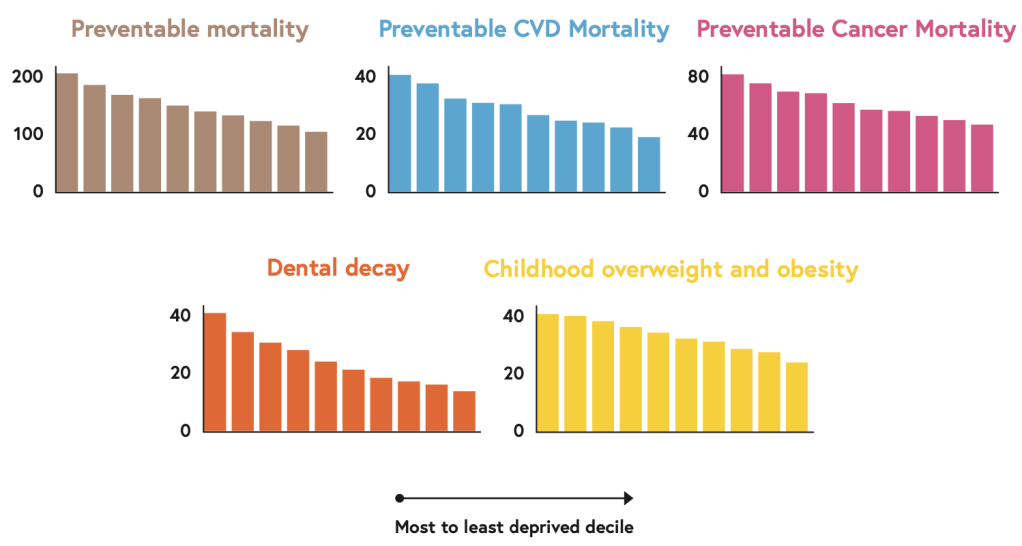
But it is the consequences of that inequality that are if anything still more stark (both in graphic form and in the text that explains it):

“People living in the most deprived decile are almost twice as likely to die from all preventable causes, compared to those in the richest decile. They are 2.1 times more likely to die from preventable heart disease; 1.7 times more likely to die from preventable cancer; and 3 times more likely to have tooth decay at age 5. Their children are nearly twice as likely to be overweight or obese at age 11.” Covid [CVD on the chart] mortality is double amongst those from the most deprived areas.

Recognising that many of these harms are built in from childhood, four of the 14 overall recommendations are purely focused on delivering change during schooling:

Recommendation 3. Launch a new “Eat and Learn” initiative for schools

Recommendation 4. Extend eligibility for free school meals

Recommendation 5. Fund the Holiday Activities and Food programme for the next three years

Recommendation 6. Expand the Healthy Start scheme

The upfront costs of these would be funded from the proposed tax on sugar and salt which is the report’s first recommendation (which, it says, will raise significant revenues as well as inevitably driving positive reformulations of processed food products). In the long-term, the expectation is that these changes would more than pay for themselves through reduced healthcare costs. It accepts a need to provide additional support for the poorest because the report concludes that eating well is difficult for the poor. Healthy diets are regressive, in the sense that healthy food “is more expensive per calorie than unhealthy food (especially when you factor in the opportunity cost and difficulty of cooking from scratch)”. Hence the need for the state to lean against this burden.

This focus on the issues in childhood makes sense according to global analysis of deprivation. “[C]hildren are hardest hit by poverty. Deprivation causes life-long damage to the mind and body of infants and small children. Child development, especially in the first years in life, is a succession of biological developments for which there is seldom a second chance. Infant malnutrition, for instance, leads to irreversible damage to health. It impedes the learning capacity of the child, which cannot be repaired later in life,” states Unicef in Equity begins with Children, a study on poverty and childhood. It is also likely that failing to address poverty will perpetuate it to the next generation: “Investing in children is a prerequisite for breaking the poverty cycle.” And it is good economics: “No country has ever sustained economic growth on the basis of high levels of illiteracy, widespread malnutrition and rampant morbidity.” The National Food Strategy’s charts on childhood height, where the UK average sits well below those of other developed economies, shames us – and should shame us into action.

But the Strategy does not focus solely on children. In particular, recommendation 7 would have a broad application across deprived communities. This recommendation calls for a trial “Community Eatwell” programme, supporting those on low incomes to improve their diets. Among other elements of this is a proposal to adopt ‘social prescription’ whereby GPs could prescribe fresh fruit and vegetables rather than drugs, as well as building knowledge to put that fresh food to good use. It notes success in a trial of such a programme in Washington DC. The problem is not a small one:

“While almost everyone in the UK eats too little fruit and vegetables, the problem is particularly acute among the most disadvantaged. The poorest 10% of British people eat on average 42% less fruit and vegetables than recommended, while the richest eat 13% less.”

The report quotes 2019 figures that diets low in fresh fruit accounted for over 10,000 early deaths, and a further 200,000 years of reduced life expectancy (on a disability adjusted basis); diets low in fresh vegetables had impacts that were around half each of these numbers (based on Global Health Data Exchange analysis).

To those who argue that this sounds like the nanny state intervening in how people live their lives, Dimbleby is clear: the costs to the state are substantial of not intervening, and at present it is much harder for the poor to eat well than to eat badly. Unhealthy calories are cheaper, which may be the decisive factor for those with hungry mouths to feed on a small budget. And simple practicalities like time and accessibility of quality food shopping weigh against healthier decisions. A wise state would assist its people more, to save state healthcare costs in the long-run – and if that happens to be described as nanny statism, I suspect Dimbleby would accept that.

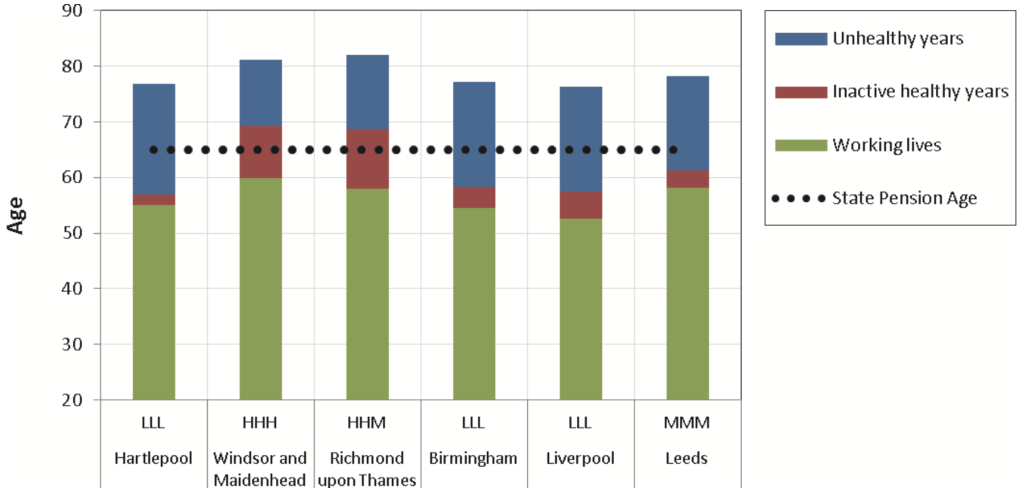
The opportunity from this is clear – or perhaps what is more clear is the opportunity cost of not taking these steps. Poor diets build up problems for later life and are one of the major drivers of poor health in older age. An excellent recent paper The Cost of Inequality – putting a price on health from the thoughtful people at CSFI tries to identify the fiscal drag from poor health outcomes in older age, highlighting the discrepancies in the experience of old age between different parts of the UK. It notes that the end of life is usually preceded by years of poor health, but before that there are healthy years after work (what the report calls inactive healthy years). The date boundaries between these and working life are highly variable across the country, dependent on relative poverty and other factors, as this chart shows:

The report states that: “a one-year extension in healthy life expectancy would add around 3.4 months to working lives and 4.5 months to overall life expectancy”. That is a wonderful gain, but it also brings a clear fiscal dividend as well: this “could reduce income taxes by 0.6 percentage points based on current data and policies”.

If there is to be levelling up, it is these sorts of discrepancies that need to be thought of. The epidemic of poor health associated with poverty and poor diet needs to be a core element of any such approach. These ideas deserve to be taken seriously, for the health of our economy as well as our health.

National Food Strategy

Plate of the Nation: Second Serving, the Food Programme, Radio 4, July 18 2021

Equity begins with Children, Jan Vandemoortele, Unicef Social and Economic Policy Working Paper 1201, 2012

Global Health Data Exchange

The Cost of Inequality – putting a price on health, Les Mayhew, Centre for the Study of Financial Innovation, July 2021